







Question: can you please answer these quesitions about the case study a new kind of Structure here is a copy of the article As
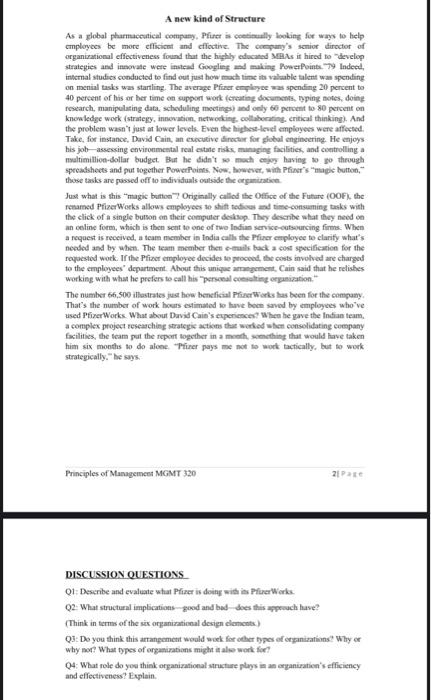
As a global pharmaceutical company, Pfizer is continually looking for ways to help employees be more efficient and effective. The company's senior director of organizational effectiveness found that the highly educated MBAs it hired to "develop strategies and innovate were instead Googling and making PowerPoints. 79 Indeed, internal studies conducted to find out just how much time its valuable talent was spending on menial tasks was startling. The average Pfizer employee was spending 20 percent to 40 percent of his or her time on support work (creating documents, typing notes, doing research, manipulating data, scheduling meetings) and only 60 percent to 80 percent on knowledge work (strategy, innovation, networking, collaborating, critical thinking). And the problem wasn't just at lower levels. Even the highest-level employees were affected.
Take, for instance, David Cain, an executive director for global engineering. He enjoys his job -assessing environmental real estate risks, managing facilities, and controlling a multimillion-dollar budget. But he didn't so much enjoy having to go through spreadsheets and put together PowerPoints. Now, however, with Pfizer's "magic button," those tasks are passed off to individuals outside the organization.
Just what is this "magic button"? Originally called the Office of the Future (OOF), the renamed PfizerWorks allows employees to shift tedious and time-consuming tasks with the click of a single button on their computer desktop. They describe what they need on an online form, which is then sent to one of two Indian service-outsourcing firms. When a request is received, a team member in India calls the Pfizer employee to clarify what's needed and by when. The team member then e-mails back a cost specification for the requested work. If the Pfizer employee decides to proceed, the costs involved are charged to the employees' department. About this unique arrangement, Cain said that he relishes working with what he prefers to call his "personal consulting organization.
The number 66,500 illustrates just how beneficial PfizerWorks has been for the company.
That's the number of work hours estimated to have been saved by employees who've used Pfizer Works. What about David Cain's experiences? When he gave the Indian team, a complex project researching strategic actions that worked when consolidating company facilities, the team put the report together in a month, something that would have taken him six months to do alone. "Pfizer pays me not to work tactically, but to work strategically," he says.
A new kind of Structure As a global pharmaceutical company, Pliser is ceecienally lookies for ways to belp cmplaryocs be more efficictet and cfloctive. The cocpuny's scmior diroctor of organirational effectiveness found that the highly edocated MBAls it hired to -develop strategies and inmovate were inutead Googlieg and making PowerPoints. Ty lndect, internal studes conducted to find out jus how moch time ith valeable talent was spending on menial tasks was startling. The average Pfirer encloyse was spending 20 pervent to 40 peretnt of his or ber time ce suppont work (creating documents, typing notes, doing research, manipolating data, scheduling mectings) and only 60 percent to 80 percent on knowkedge work (strategy, innowution, netwoking, collaborating, critical thinking). And the problem wasn't just at lower levels. Even the lighest-Aewel employos were affected. Take, for instance, David Cain, an evccutive Iliroctir for ghobal angincering. He cajoys his joh-assessing envieonmental real estate risks, munuging facilities, and cvetrolling a myaltimitlioe-dollar budget. bur he didn't wo moch eejy hasies io go through sprcatshects and put vogether PowerPoints, Now, hywever, with Pfixsr's "magle butmon," those tasks are possed off to individuals oulside the atganimation. Just what is this "magic baithon" Originally calliod the Otfice of the Future (OOF), the rerarned PfizerWoeks allows cmployees bo shitt tedious and time-consuming tasks with the slick of a single butson on their computer desisop. Thay deseribe what they neod on an oeline form, which is then sent to one of two lndian service-cutseurcing firms: Wben a request is received, a team member in India calls the Pliscr ertployee to clarify what's noedod and by when. The leam member then c-mall back a cost specificarion for the reqjacstod wotk. If the Pliacr smployec decides so grocobt, the costs involved are charged to the employees" department. About this unique ammegcment, Cain said that he relishes working with what he prefers to call his "persceal qoeseltient orjerization." The number 66,500 illastrates just how beneficial Prizerr Works las been for the compamy, That's the number of work hoerts estimated lo have boce saved by smployces who"ve used Pfirer Works. What about David Cain's expencoces? When he gave the Indian team, a comples project reseagching strategic actions that worked whem consolidating coeppany facilitics, the icam pat the report logerther in a month, somethibg that would have taken him six months to do alone. Phiner pays me not to work tactically, but fo work strategically. = be says. Principles of Mlanagemeest MGMT 320 3i P a if e DISCUSSION QUESTIONS Q1: Describe and evaluate what Pliaer is doinng with ies PlinerWorks. Q2. What structural implications good and bad-does this morecuch have? (Think in terms of the six organizational design claments.) Q1: Do you think this arranpemctit wauld week for oeher bypes af erpanizations? Wlyy or why nof? What types of oreatirations might in also work for? Q4: What role do yod think organizational structure plays in an erganiration's efficiency and effectiveness? Eplain
Step by Step Solution
There are 3 Steps involved in it

Get step-by-step solutions from verified subject matter experts
 Study Help