



Question: Can you please answer these questions for me? The Basics of Capital Budgeting: Payback Period Payback Period Payback period was the earliest -Select- selection criterion.
Can you please answer these questions for me?
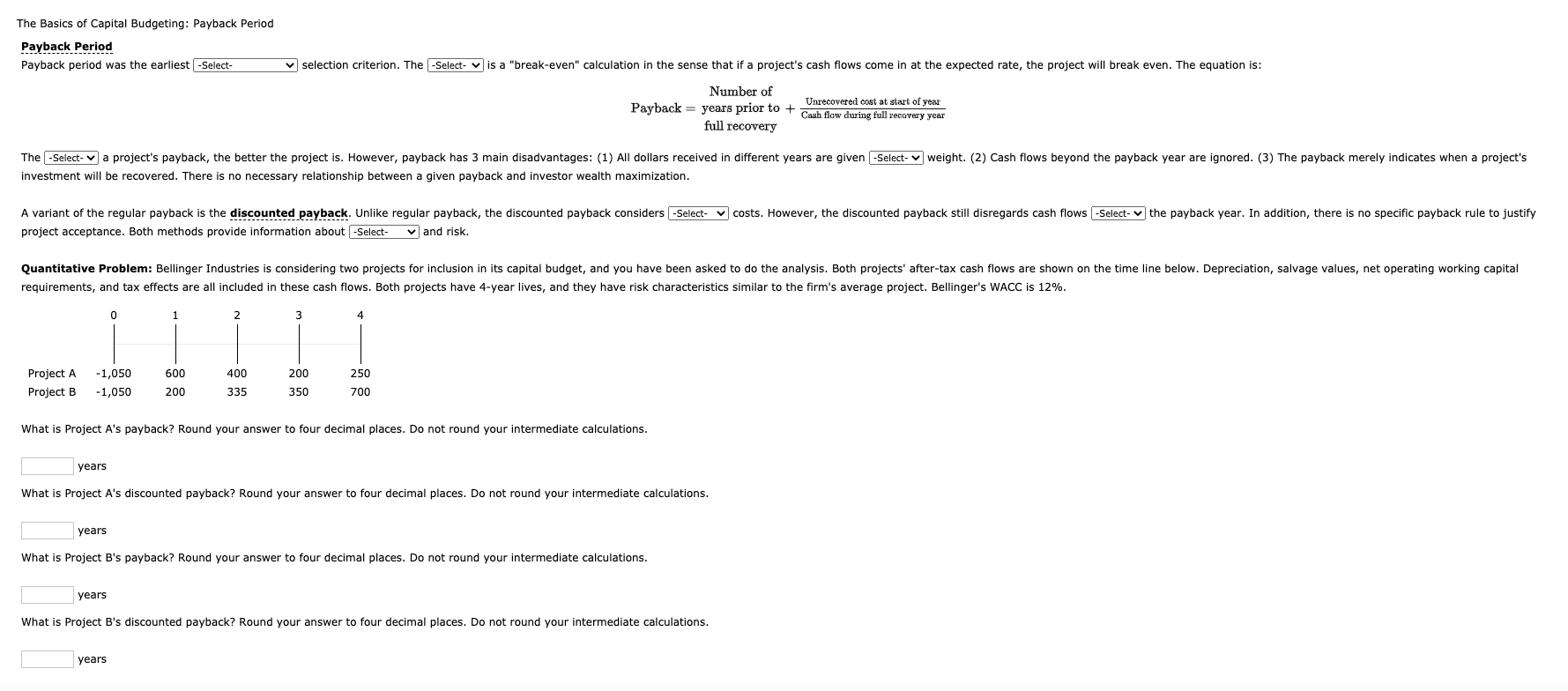
The Basics of Capital Budgeting: Payback Period Payback Period Payback period was the earliest -Select- selection criterion. The -Select-vis a "break-even" calculation in the sense that if a project's cash flows come in at the expected rate, the project will break even. The equation is: Number of Unrecovered cost at start of year Payback = years prior to + Cash flow during full recovery year full recovery The -Select- a project's payback, the better the project is. However, payback has 3 main disadvantages: (1) All dollars received in different years are given -Select-weight. (2) Cash flows beyond the payback year are ignored. (3) The payback merely indicates when a project's investment will be recovered. There is no necessary relationship between a given payback and investor wealth maximization. costs. However, the discounted payback still disregards cash flows - Select the payback year. In addition, there is no specific payback rule to justify A variant of the regular payback is the discounted payback. Unlike regular payback, the discounted payback considers -Select- project acceptance. Both methods provide information about -Select- and risk. Quantitative Problem: Bellinger Industries is considering two projects for inclusion in its capital budget, and you have been asked to do the analysis. Both projects' after-tax cash flows are shown on the time line below. Depreciation, salvage values, net operating working capital requirements, and tax effects are all included in these cash flows. Both projects have 4-year lives, and they have risk characteristics similar to the firm's average project. Bellinger's WACC is 12%. 0 1 2 3 600 400 200 250 Project A Project B -1,050 -1,050 200 335 350 700 What is Project A's payback? Round your answer to four decimal places. Do not round your intermediate calculations. years What is Project A's discounted payback? Round your answer to four decimal places. Do not round your intermediate calculations. years What is Project B's payback? Round your answer to four decimal places. Do not round your intermediate calculations. years What is Project B's discounted payback? Round your answer to four decimal places. Do not round your intermediate calculations. years The Basics of Capital Budgeting: Payback Period Payback Period Payback period was the earliest -Select- selection criterion. The -Select-vis a "break-even" calculation in the sense that if a project's cash flows come in at the expected rate, the project will break even. The equation is: Number of Unrecovered cost at start of year Payback = years prior to + Cash flow during full recovery year full recovery The -Select- a project's payback, the better the project is. However, payback has 3 main disadvantages: (1) All dollars received in different years are given -Select-weight. (2) Cash flows beyond the payback year are ignored. (3) The payback merely indicates when a project's investment will be recovered. There is no necessary relationship between a given payback and investor wealth maximization. costs. However, the discounted payback still disregards cash flows - Select the payback year. In addition, there is no specific payback rule to justify A variant of the regular payback is the discounted payback. Unlike regular payback, the discounted payback considers -Select- project acceptance. Both methods provide information about -Select- and risk. Quantitative Problem: Bellinger Industries is considering two projects for inclusion in its capital budget, and you have been asked to do the analysis. Both projects' after-tax cash flows are shown on the time line below. Depreciation, salvage values, net operating working capital requirements, and tax effects are all included in these cash flows. Both projects have 4-year lives, and they have risk characteristics similar to the firm's average project. Bellinger's WACC is 12%. 0 1 2 3 600 400 200 250 Project A Project B -1,050 -1,050 200 335 350 700 What is Project A's payback? Round your answer to four decimal places. Do not round your intermediate calculations. years What is Project A's discounted payback? Round your answer to four decimal places. Do not round your intermediate calculations. years What is Project B's payback? Round your answer to four decimal places. Do not round your intermediate calculations. years What is Project B's discounted payback? Round your answer to four decimal places. Do not round your intermediate calculations. years
Step by Step Solution
There are 3 Steps involved in it

Get step-by-step solutions from verified subject matter experts