







Question: can you please give excel formulas and explain them? i have no idea what to do. Assume that depreciation is straight-line to zero over the
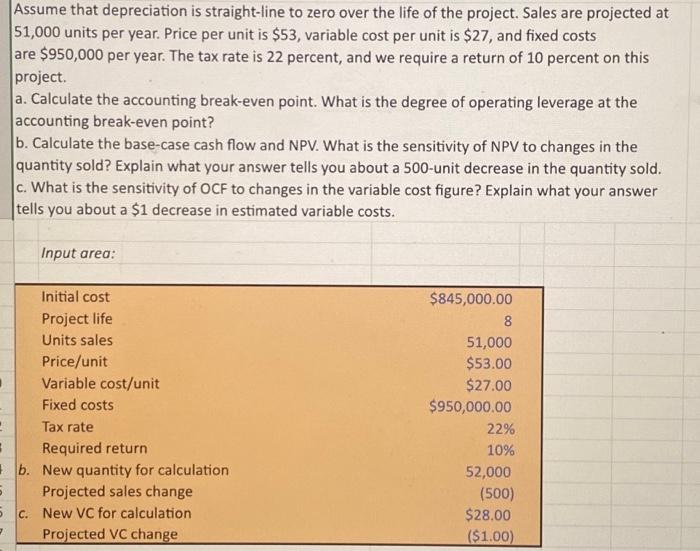
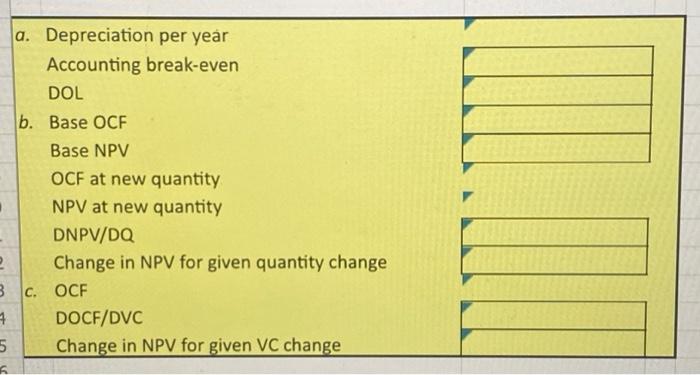
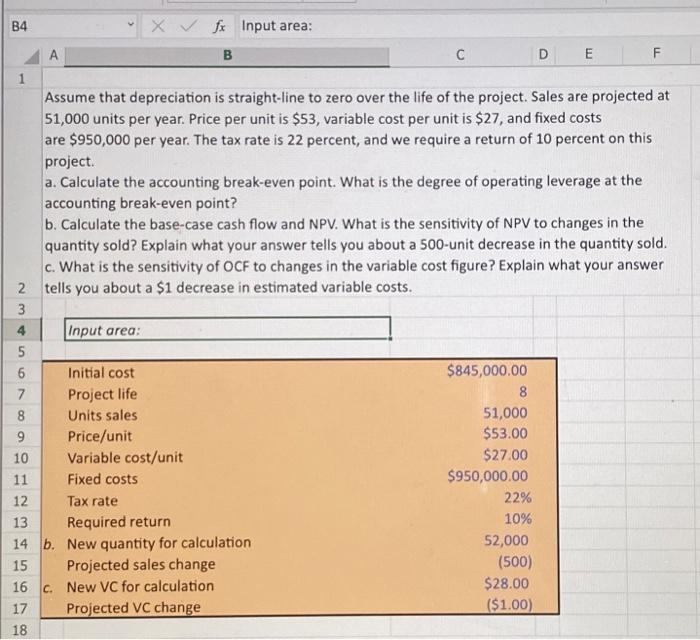
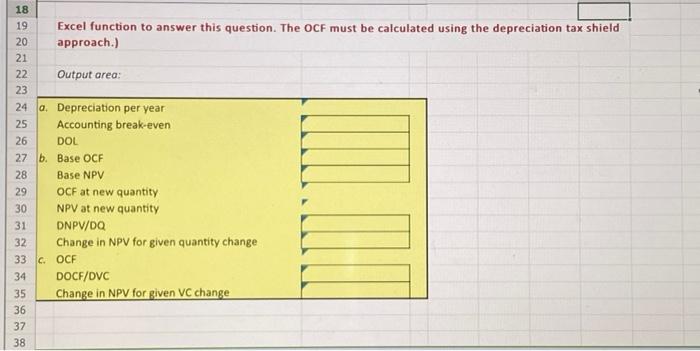
Assume that depreciation is straight-line to zero over the life of the project. Sales are projected at 51,000 units per year. Price per unit is $53, variable cost per unit is $27, and fixed costs are $950,000 per year. The tax rate is 22 percent, and we require a return of 10 percent on this project. a. Calculate the accounting break-even point. What is the degree of operating leverage at the accounting break-even point? b. Calculate the base-case cash flow and NPV. What is the sensitivity of NPV to changes in the quantity sold? Explain what your answer tells you about a 500-unit decrease in the quantity sold. c. What is the sensitivity of OCF to changes in the variable cost figure? Explain what your answer tells you about a $1 decrease in estimated variable costs. a. Depreciation per year Accounting break-even DOL b. Base OCF Base NPV OCF at new quantity NPV at new quantity DNPV/DQ Change in NPV for given quantity change c. OCF DOCF/DVC Change in NPV for given VC change Assume that depreciation is straight-line to zero over the life of the project. Sales are projected at 51,000 units per year. Price per unit is $53, variable cost per unit is $27, and fixed costs are $950,000 per year. The tax rate is 22 percent, and we require a return of 10 percent on this project. a. Calculate the accounting break-even point. What is the degree of operating leverage at the accounting break-even point? b. Calculate the base-case cash flow and NPV. What is the sensitivity of NPV to changes in the quantity sold? Explain what your answer tells you about a 500-unit decrease in the quantity sold. c. What is the sensitivity of OCF to changes in the variable cost figure? Explain what your answer tells you about a $1 decrease in estimated variable costs. Excel function to answer this question. The OCF must be calculated using the depreciation tax shield approach.) Assume that depreciation is straight-line to zero over the life of the project. Sales are projected at 51,000 units per year. Price per unit is $53, variable cost per unit is $27, and fixed costs are $950,000 per year. The tax rate is 22 percent, and we require a return of 10 percent on this project. a. Calculate the accounting break-even point. What is the degree of operating leverage at the accounting break-even point? b. Calculate the base-case cash flow and NPV. What is the sensitivity of NPV to changes in the quantity sold? Explain what your answer tells you about a 500-unit decrease in the quantity sold. c. What is the sensitivity of OCF to changes in the variable cost figure? Explain what your answer tells you about a $1 decrease in estimated variable costs. a. Depreciation per year Accounting break-even DOL b. Base OCF Base NPV OCF at new quantity NPV at new quantity DNPV/DQ Change in NPV for given quantity change c. OCF DOCF/DVC Change in NPV for given VC change Assume that depreciation is straight-line to zero over the life of the project. Sales are projected at 51,000 units per year. Price per unit is $53, variable cost per unit is $27, and fixed costs are $950,000 per year. The tax rate is 22 percent, and we require a return of 10 percent on this project. a. Calculate the accounting break-even point. What is the degree of operating leverage at the accounting break-even point? b. Calculate the base-case cash flow and NPV. What is the sensitivity of NPV to changes in the quantity sold? Explain what your answer tells you about a 500-unit decrease in the quantity sold. c. What is the sensitivity of OCF to changes in the variable cost figure? Explain what your answer tells you about a $1 decrease in estimated variable costs. Excel function to answer this question. The OCF must be calculated using the depreciation tax shield approach.)
Step by Step Solution
There are 3 Steps involved in it

Get step-by-step solutions from verified subject matter experts
 Study Help