Question: Can you please help me find the general solution for these problems: The standard form (Ajx + Bly + Ci)dx + (A2x + Bay +

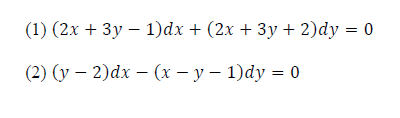
Can you please help me find the general solution for these problems:
Can you please help me find the general solutionCan you please help me find the general solutionCan you please help me find the general solution
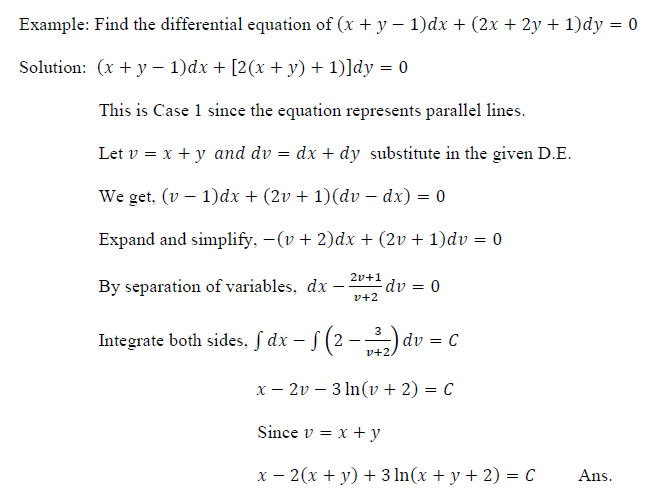
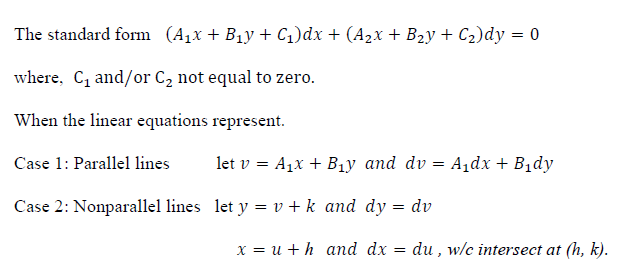
The standard form (Ajx + Bly + Ci)dx + (A2x + Bay + C2)dy = 0 where, C, and/ or C2 not equal to zero. When the linear equations represent. Case 1: Parallel lines let v = Aix + Bly and du = Aidx + Bidy Case 2: Nonparallel lines lety = v + k and dy = du x = uth and dx = du , w/c intersect at (h, k).Example: Find the differential equation of (x + y - 1)dx + (2x + 2y + 1)dy = 0 Solution: (x +y - 1)dx + [2(x + y) + 1)]dy = 0 This is Case 1 since the equation represents parallel lines. Let v = x +y and dv = dx + dy substitute in the given D.E. We get, (v - 1)dx + (2v + 1)(dv - dx) = 0 Expand and simplify. -(v + 2)dx + (2v + 1)dv = 0 By separation of variables, dy _ zu+1 dv = 0 v+2 Integrate both sides, f dx - S (2 - -) dv = C x - 2v - 3 In(v + 2) = C Since v = x ty x - 2(x + y) + 3ln(x + y + 2) = C Ans.\f

Step by Step Solution

There are 3 Steps involved in it

1 Expert Approved Answer
Step: 1 Unlock blur-text-image

Question Has Been Solved by an Expert!

Get step-by-step solutions from verified subject matter experts

Step: 2 Unlock
Step: 3 Unlock

Students Have Also Explored These Related Mathematics Questions!