



Question: can you please help me out with my assignment? 250 words 2. (80%). You read the posted article and submit your file to the drop
can you please help me out with my assignment? 250 words
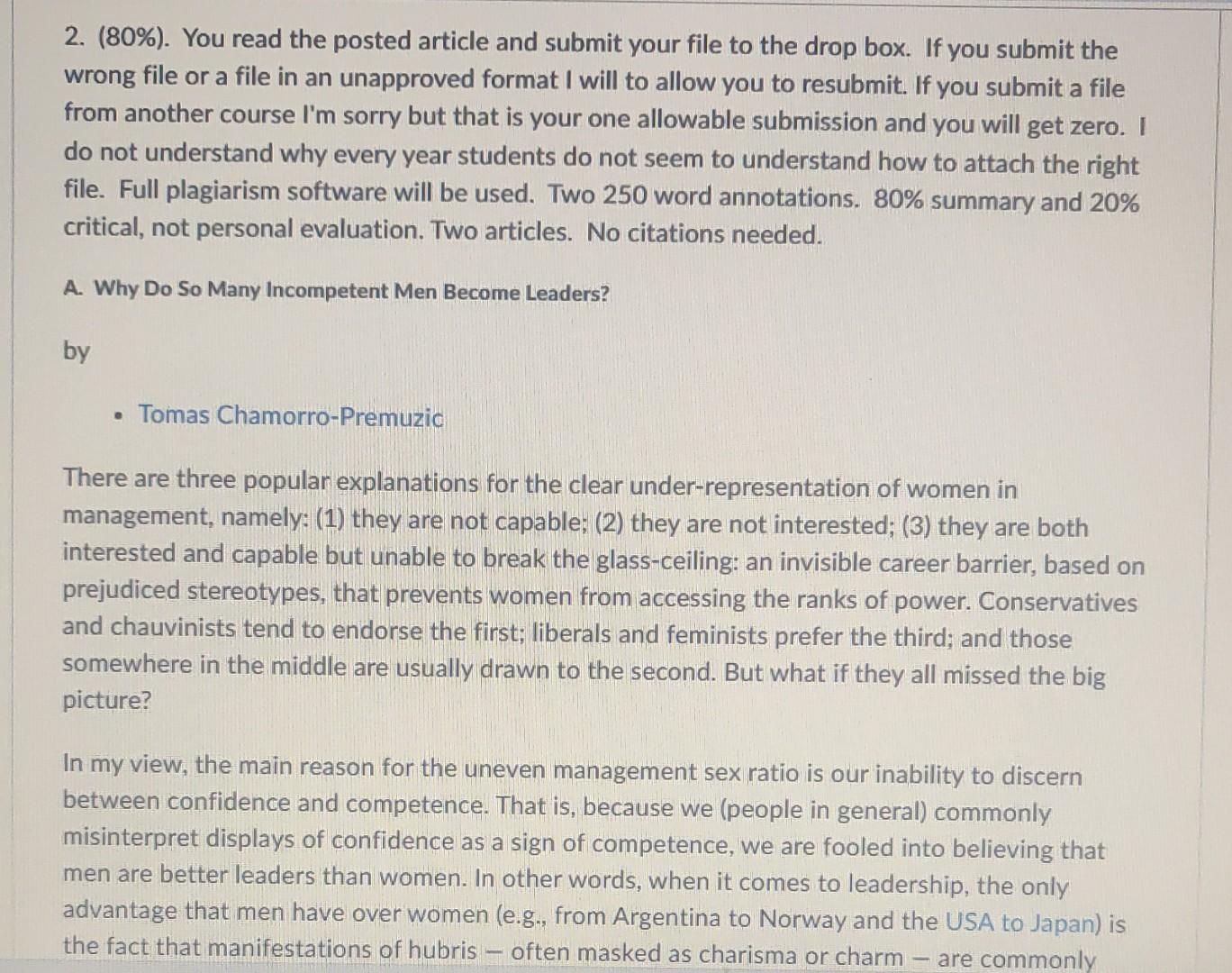
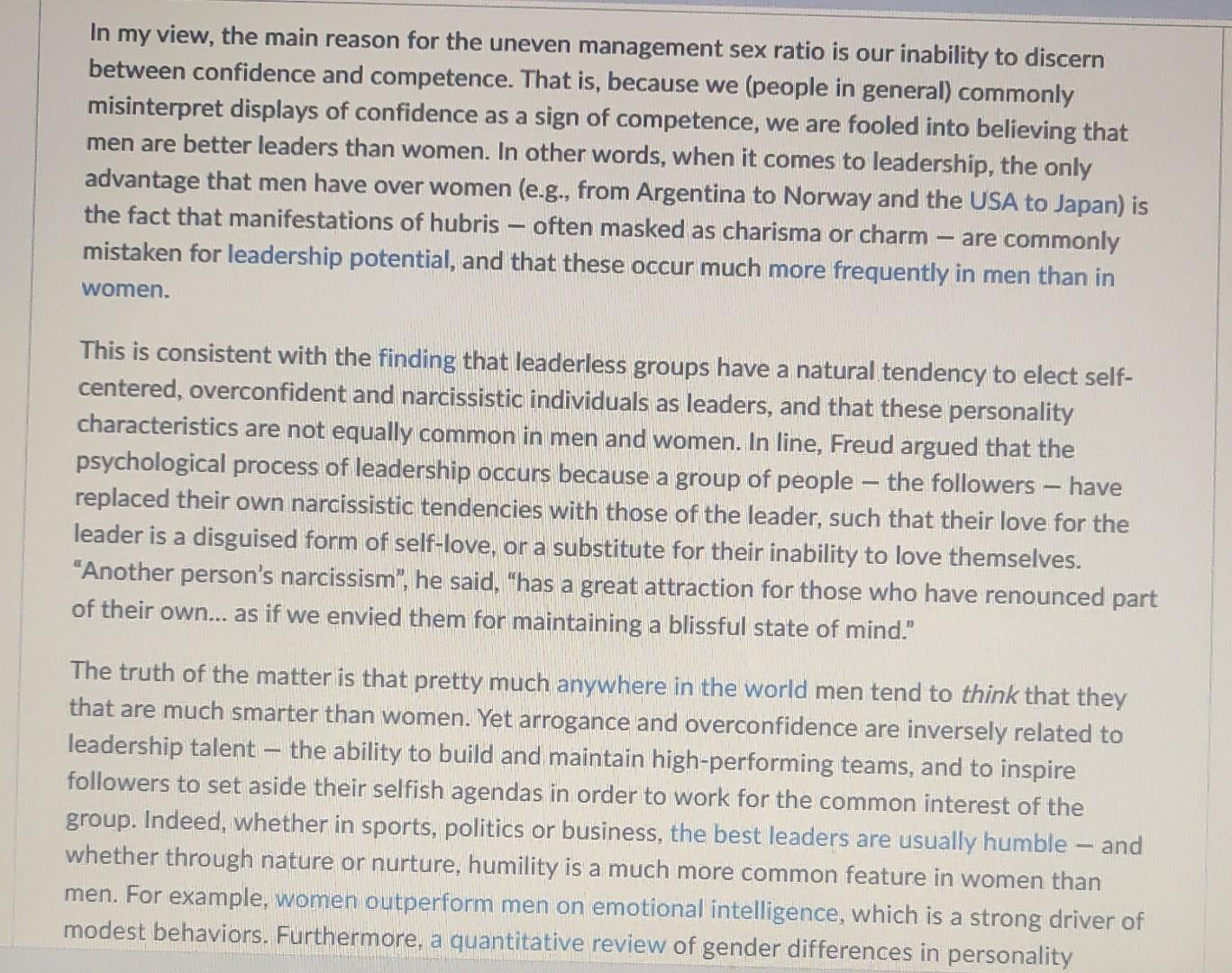
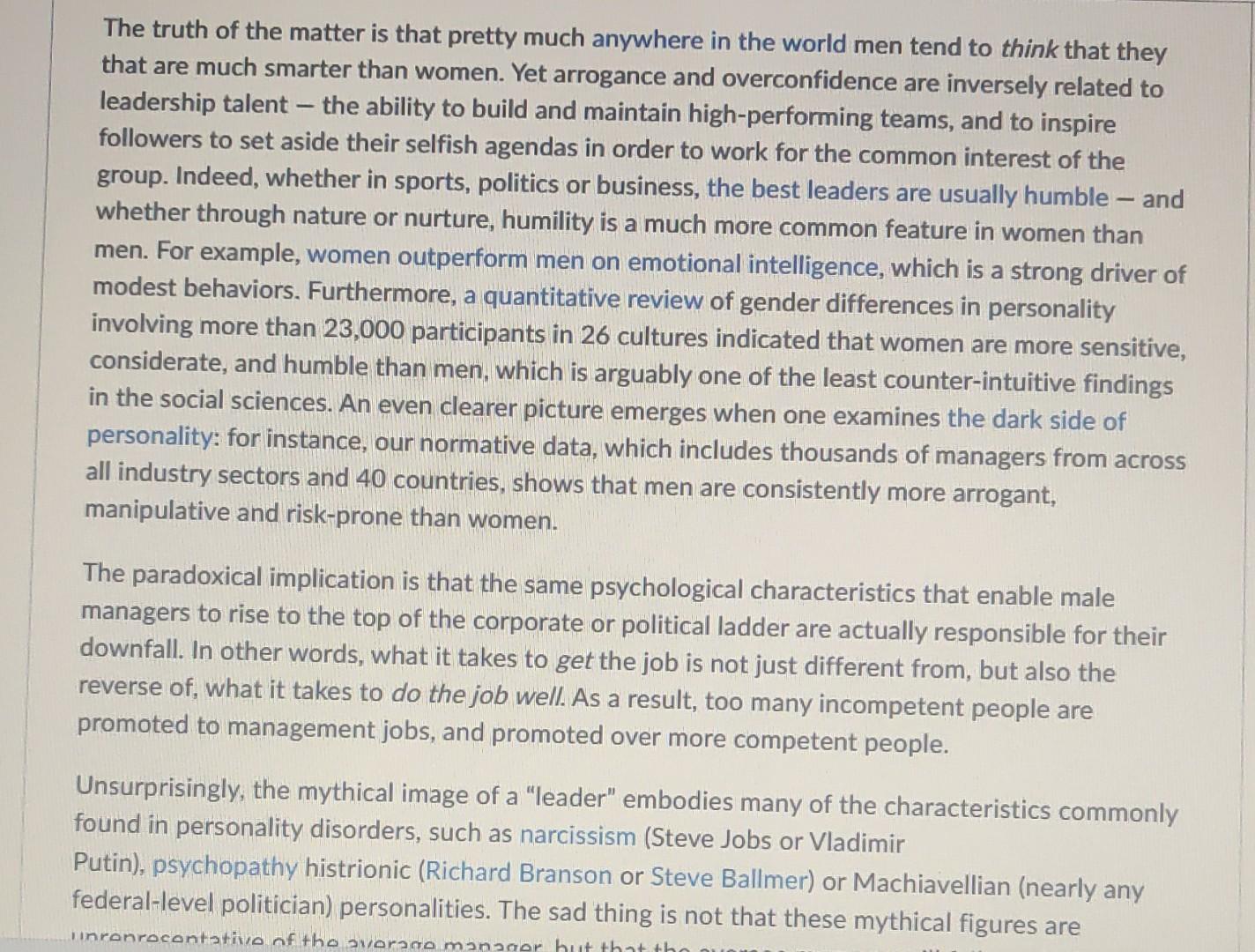
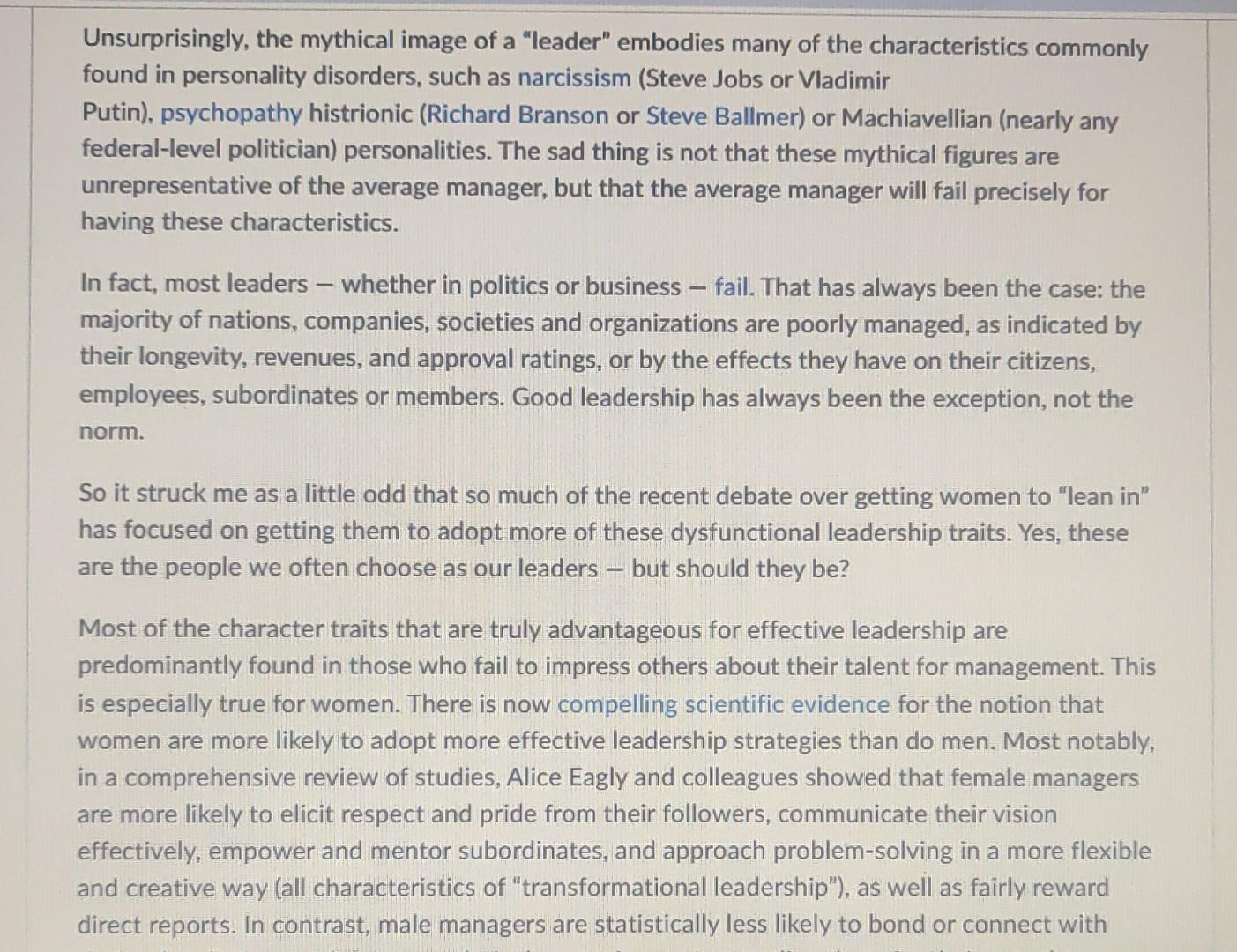
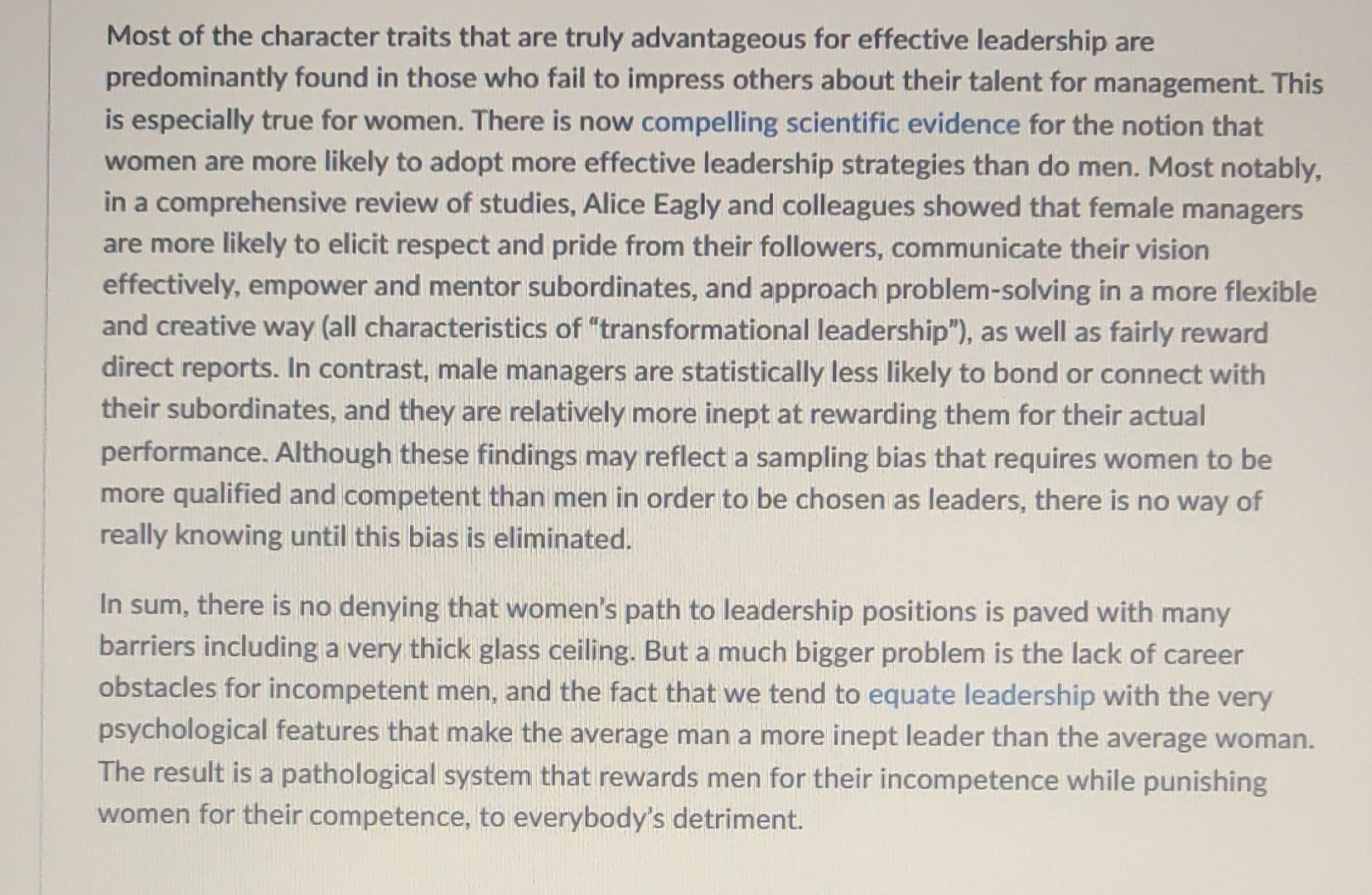
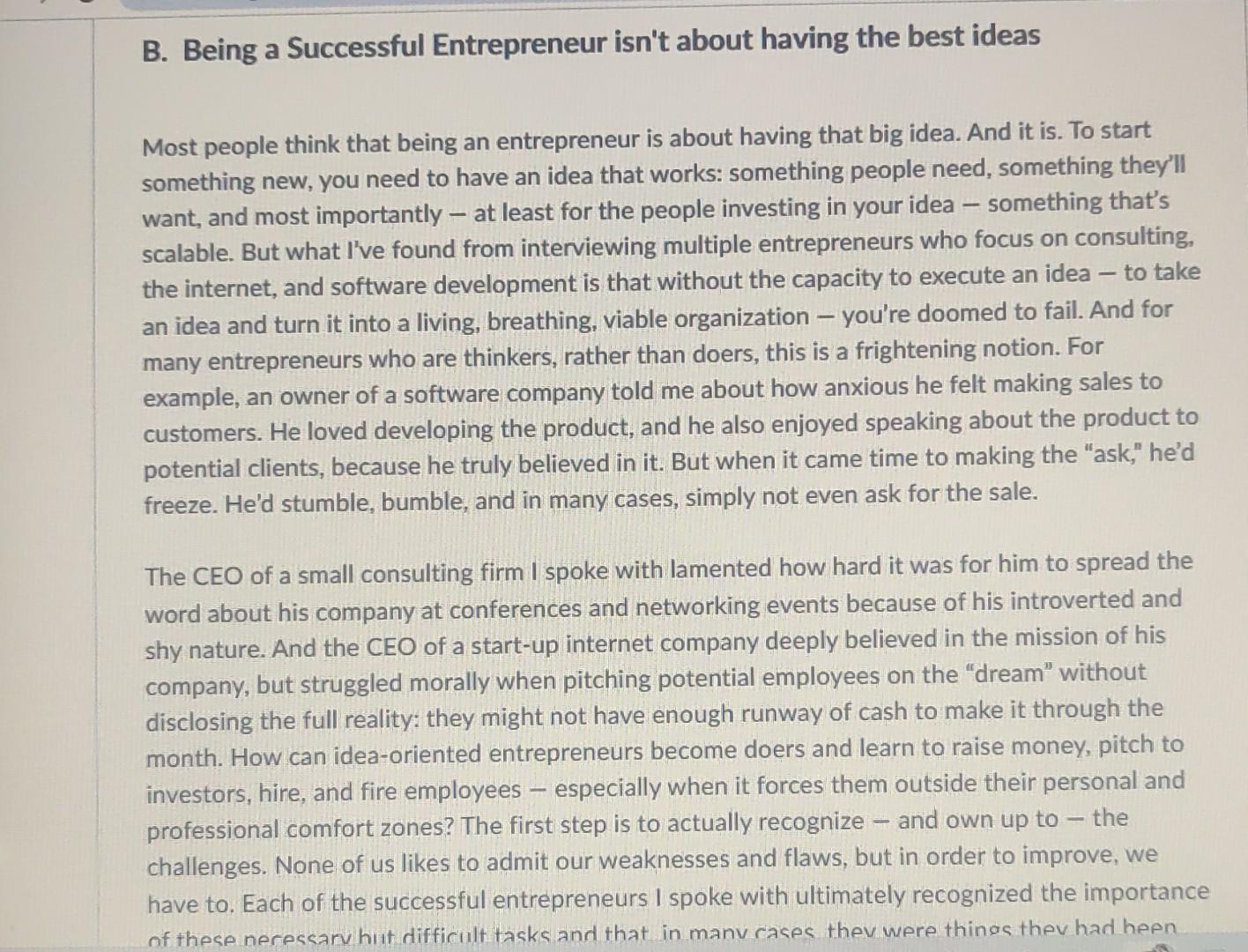
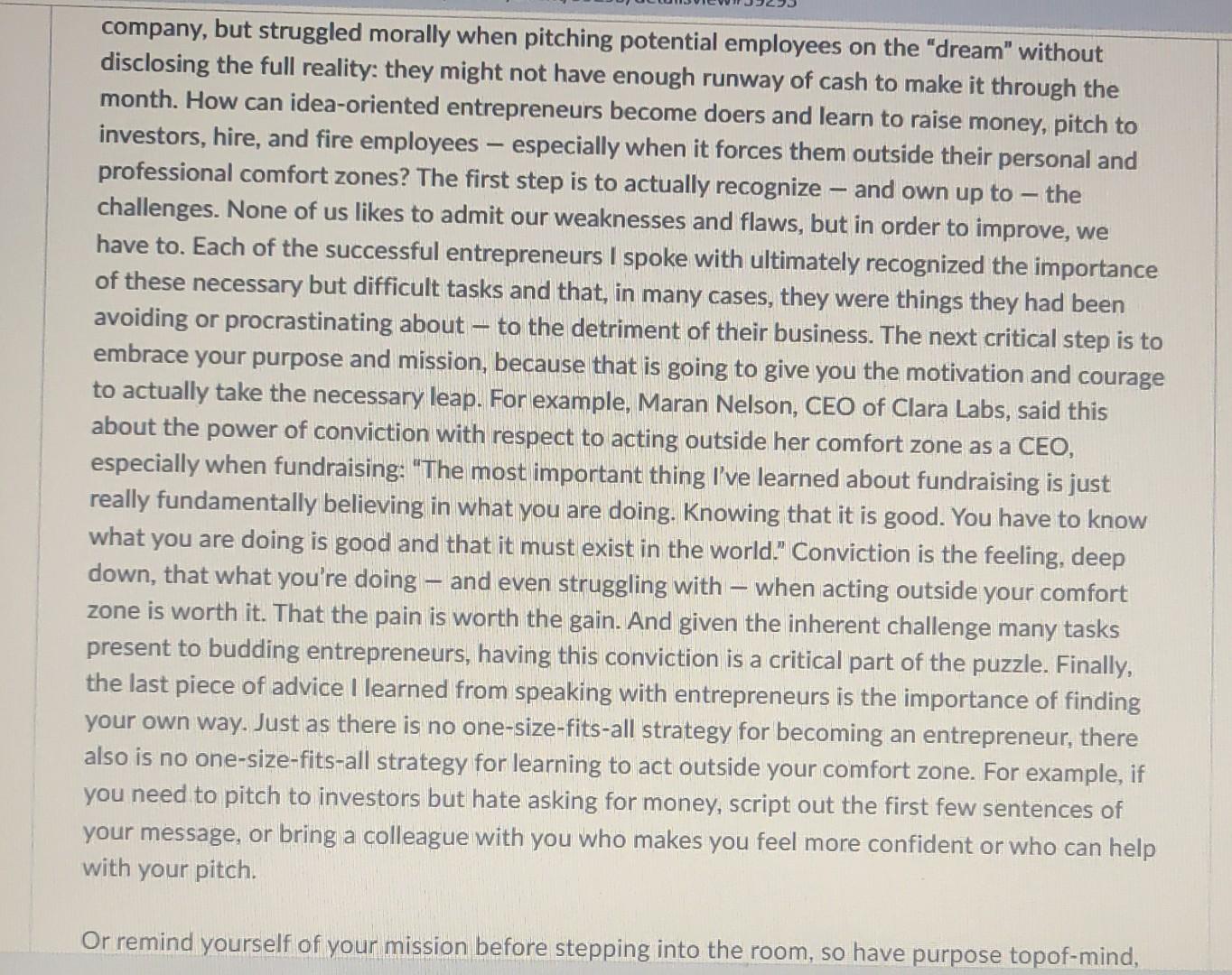
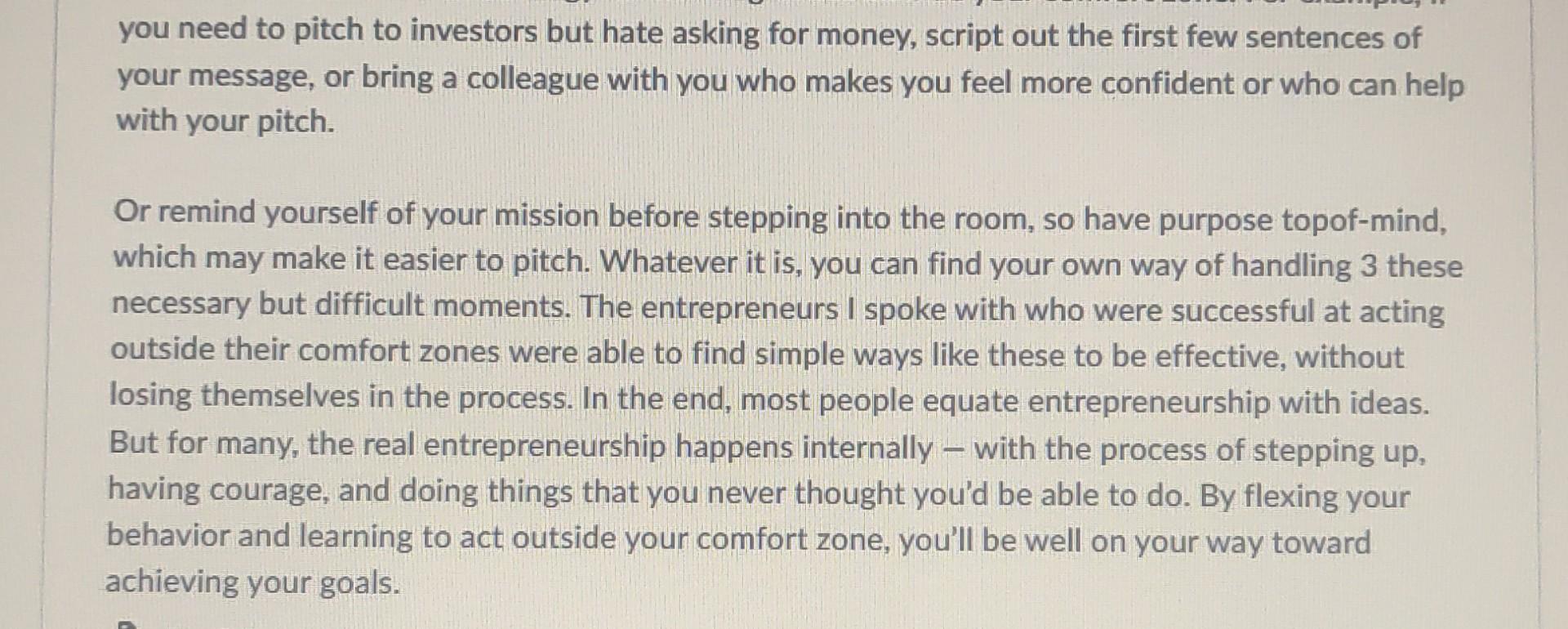
2. (80\%). You read the posted article and submit your file to the drop box. If you submit the wrong file or a file in an unapproved format I will to allow you to resubmit. If you submit a file from another course I'm sorry but that is your one allowable submission and you will get zero. I do not understand why every year students do not seem to understand how to attach the right file. Full plagiarism software will be used. Two 250 word annotations. 80% summary and 20% critical, not personal evaluation. Two articles. No citations needed. A. Why Do So Many Incompetent Men Become Leaders? by - Tomas Chamorro-Premuzic There are three popular explanations for the clear under-representation of women in management, namely: (1) they are not capable; (2) they are not interested; (3) they are both interested and capable but unable to break the glass-ceiling: an invisible career barrier, based on prejudiced stereotypes, that prevents women from accessing the ranks of power. Conservatives and chauvinists tend to endorse the first; liberals and feminists prefer the third; and those somewhere in the middle are usually drawn to the second. But what if they all missed the big picture? In my view, the main reason for the uneven management sex ratio is our inability to discern between confidence and competence. That is, because we (people in general) commonly misinterpret displays of confidence as a sign of competence, we are fooled into believing that men are better leaders than women. In other words, when it comes to leadership, the only advantage that men have over women (e.g., from Argentina to Norway and the USA to Japan) is the fact that manifestations of hubris - often masked as charisma or charm - are commonly In my view, the main reason for the uneven management sex ratio is our inability to discern between confidence and competence. That is, because we (people in general) commonly misinterpret displays of confidence as a sign of competence, we are fooled into believing that men are better leaders than women. In other words, when it comes to leadership, the only advantage that men have over women (e.g., from Argentina to Norway and the USA to Japan) is the fact that manifestations of hubris - often masked as charisma or charm - are commonly mistaken for leadership potential, and that these occur much more frequently in men than in women. This is consistent with the finding that leaderless groups have a natural tendency to elect selfcentered, overconfident and narcissistic individuals as leaders, and that these personality characteristics are not equally common in men and women. In line, Freud argued that the psychological process of leadership occurs because a group of people - the followers - have replaced their own narcissistic tendencies with those of the leader, such that their love for the leader is a disguised form of self-love, or a substitute for their inability to love themselves. "Another person's narcissism", he said, "has a great attraction for those who have renounced part of their own... as if we envied them for maintaining a blissful state of mind." The truth of the matter is that pretty much anywhere in the world men tend to think that they that are much smarter than women. Yet arrogance and overconfidence are inversely related to leadership talent - the ability to build and maintain high-performing teams, and to inspire followers to set aside their selfish agendas in order to work for the common interest of the group. Indeed, whether in sports, politics or business, the best leaders are usually humble - and whether through nature or nurture, humility is a much more common feature in women than men. For example, women outperform men on emotional intelligence, which is a strong driver of The truth of the matter is that pretty much anywhere in the world men tend to think that they that are much smarter than women. Yet arrogance and overconfidence are inversely related to leadership talent - the ability to build and maintain high-performing teams, and to inspire followers to set aside their selfish agendas in order to work for the common interest of the group. Indeed, whether in sports, politics or business, the best leaders are usually humble and whether through nature or nurture, humility is a much more common feature in women than men. For example, women outperform men on emotional intelligence, which is a strong driver of modest behaviors. Furthermore, a quantitative review of gender differences in personality involving more than 23,000 participants in 26 cultures indicated that women are more sensitive, considerate, and humble than men, which is arguably one of the least counter-intuitive findings in the social sciences. An even clearer picture emerges when one examines the dark side of personality: for instance, our normative data, which includes thousands of managers from across all industry sectors and 40 countries, shows that men are consistently more arrogant, manipulative and risk-prone than women. The paradoxical implication is that the same psychological characteristics that enable male managers to rise to the top of the corporate or political ladder are actually responsible for their downfall. In other words, what it takes to get the job is not just different from, but also the reverse of, what it takes to do the job well. As a result, too many incompetent people are promoted to management jobs, and promoted over more competent people. Unsurprisingly, the mythical image of a "leader" embodies many of the characteristics commonly found in personality disorders, such as narcissism (Steve Jobs or Vladimir Putin), psychopathy histrionic (Richard Branson or Steve Ballmer) or Machiavellian (nearly any federal-level politician) personalities. The sad thing is not that these mythical figures are Unsurprisingly, the mythical image of a "leader" embodies many of the characteristics commonly found in personality disorders, such as narcissism (Steve Jobs or Vladimir Putin), psychopathy histrionic (Richard Branson or Steve Ballmer) or Machiavellian (nearly any federal-level politician) personalities. The sad thing is not that these mythical figures are unrepresentative of the average manager, but that the average manager will fail precisely for having these characteristics. In fact, most leaders - whether in politics or business - fail. That has always been the case: the majority of nations, companies, societies and organizations are poorly managed, as indicated by their longevity, revenues, and approval ratings, or by the effects they have on their citizens, employees, subordinates or members. Good leadership has always been the exception, not the norm. So it struck me as a little odd that so much of the recent debate over getting women to "lean in" has focused on getting them to adopt more of these dysfunctional leadership traits. Yes, these are the people we often choose as our leaders - but should they be? Most of the character traits that are truly advantageous for effective leadership are predominantly found in those who fail to impress others about their talent for management. This is especially true for women. There is now compelling scientific evidence for the notion that women are more likely to adopt more effective leadership strategies than do men. Most notably, in a comprehensive review of studies, Alice Eagly and colleagues showed that female managers are more likely to elicit respect and pride from their followers, communicate their vision effectively, empower and mentor subordinates, and approach problem-solving in a more flexible and creative way (all characteristics of "transformational leadership"), as well as fairly reward direct reports. In contrast, male managers are statistically less likely to bond or connect with Most of the character traits that are truly advantageous for effective leadership are predominantly found in those who fail to impress others about their talent for management. This is especially true for women. There is now compelling scientific evidence for the notion that women are more likely to adopt more effective leadership strategies than do men. Most notably, in a comprehensive review of studies, Alice Eagly and colleagues showed that female managers are more likely to elicit respect and pride from their followers, communicate their vision effectively, empower and mentor subordinates, and approach problem-solving in a more flexible and creative way (all characteristics of "transformational leadership"), as well as fairly reward direct reports. In contrast, male managers are statistically less likely to bond or connect with their subordinates, and they are relatively more inept at rewarding them for their actual performance. Although these findings may reflect a sampling bias that requires women to be more qualified and competent than men in order to be chosen as leaders, there is no way of really knowing until this bias is eliminated. In sum, there is no denying that women's path to leadership positions is paved with many barriers including a very thick glass ceiling. But a much bigger problem is the lack of career obstacles for incompetent men, and the fact that we tend to equate leadership with the very psychological features that make the average man a more inept leader than the average woman. The result is a pathological system that rewards men for their incompetence while punishing women for their competence, to everybody's detriment. B. Being a Successful Entrepreneur isn't about having the best Ideas Most people think that being an entrepreneur is about having that big idea. And it is. To start something new, you need to have an idea that works: something people need, something they'll want, and most importantly - at least for the people investing in your idea - something that's scalable. But what I've found from interviewing multiple entrepreneurs who focus on consulting, the internet, and software development is that without the capacity to execute an idea - to take an idea and turn it into a living, breathing, viable organization - you're doomed to fail. And for many entrepreneurs who are thinkers, rather than doers, this is a frightening notion. For example, an owner of a software company told me about how anxious he felt making sales to customers. He loved developing the product, and he also enjoyed speaking about the product to potential clients, because he truly believed in it. But when it came time to making the "ask," he'd freeze. He'd stumble, bumble, and in many cases, simply not even ask for the sale. The CEO of a small consulting firm I spoke with lamented how hard it was for him to spread the word about his company at conferences and networking events because of his introverted and shy nature. And the CEO of a start-up internet company deeply believed in the mission of his company, but struggled morally when pitching potential employees on the "dream" without disclosing the full reality: they might not have enough runway of cash to make it through the month. How can idea-oriented entrepreneurs become doers and learn to raise money, pitch to investors, hire, and fire employees - especially when it forces them outside their personal and professional comfort zones? The first step is to actually recognize - and own up to - the challenges. None of us likes to admit our weaknesses and flaws, but in order to improve, we have to. Each of the successful entrepreneurs I spoke with ultimately recognized the importance of these neressaru hut difficult tasks and that in manv cases thev were things thev had heen company, but struggled morally when pitching potential employees on the "dream" without disclosing the full reality: they might not have enough runway of cash to make it through the month. How can idea-oriented entrepreneurs become doers and learn to raise money, pitch to investors, hire, and fire employees - especially when it forces them outside their personal and professional comfort zones? The first step is to actually recognize - and own up to - the challenges. None of us likes to admit our weaknesses and flaws, but in order to improve, we have to. Each of the successful entrepreneurs I spoke with ultimately recognized the importance of these necessary but difficult tasks and that, in many cases, they were things they had been avoiding or procrastinating about - to the detriment of their business. The next critical step is to embrace your purpose and mission, because that is going to give you the motivation and courage to actually take the necessary leap. For example, Maran Nelson, CEO of Clara Labs, said this about the power of conviction with respect to acting outside her comfort zone as a CEO, especially when fundraising: "The most important thing I've learned about fundraising is just really fundamentally believing in what you are doing. Knowing that it is good. You have to know what you are doing is good and that it must exist in the world." Conviction is the feeling, deep down, that what you're doing - and even struggling with - when acting outside your comfort zone is worth it. That the pain is worth the gain. And given the inherent challenge many tasks present to budding entrepreneurs, having this conviction is a critical part of the puzzle. Finally, the last piece of advice I learned from speaking with entrepreneurs is the importance of finding your own way. Just as there is no one-size-fits-all strategy for becoming an entrepreneur, there also is no one-size-fits-all strategy for learning to act outside your comfort zone. For example, if you need to pitch to investors but hate asking for money, script out the first few sentences of your message, or bring a colleague with you who makes you feel more confident or who can help with your pitch. you need to pitch to investors but hate asking for money, script out the first few sentences of your message, or bring a colleague with you who makes you feel more confident or who can help with your pitch. Or remind yourself of your mission before stepping into the room, so have purpose topof-mind, which may make it easier to pitch. Whatever it is, you can find your own way of handling 3 these necessary but difficult moments. The entrepreneurs I spoke with who were successful at acting outside their comfort zones were able to find simple ways like these to be effective, without losing themselves in the process. In the end, most people equate entrepreneurship with ideas. But for many, the real entrepreneurship happens internally - with the process of stepping up, having courage, and doing things that you never thought you'd be able to do. By flexing your behavior and learning to act outside your comfort zone, you'll be well on your way toward achieving your goalsStep by Step Solution
There are 3 Steps involved in it
1 Expert Approved Answer
Step: 1 Unlock

Question Has Been Solved by an Expert!
Get step-by-step solutions from verified subject matter experts
Step: 2 Unlock
Step: 3 Unlock