







Question: can you please provide clear solution for part 2 and 3? part 1 solution is not need. i will hit a like Shipyard Red Steel
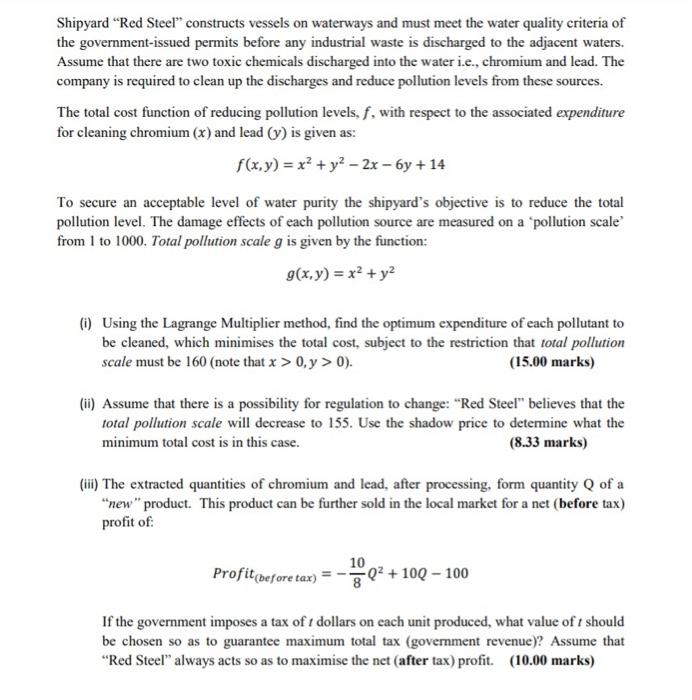
Shipyard "Red Steel constructs vessels on waterways and must meet the water quality criteria of the government-issued permits before any industrial waste is discharged to the adjacent waters. Assume that there are two toxic chemicals discharged into the water i.e., chromium and lead. The company is required to clean up the discharges and reduce pollution levels from these sources. The total cost function of reducing pollution levels, f, with respect to the associated expenditure for cleaning chromium (x) and lead (y) is given as: f(x,y) = x + y2 - 2x - 6y + 14 To secure an acceptable level of water purity the shipyard's objective is to reduce the total pollution level. The damage effects of each pollution source are measured on a "pollution scale from 1 to 1000. Total pollution scale g is given by the function: g(x,y) = x2 + y2 (1) Using the Lagrange Multiplier method, find the optimum expenditure of each pollutant to be cleaned, which minimises the total cost, subject to the restriction that total pollution scale must be 160 (note that x > 0, y > 0). (15.00 marks) (ii) Assume that there is a possibility for regulation to change: "Red Steel" believes that the total pollution scale will decrease to 155. Use the shadow price to determine what the minimum total cost is in this case. (8.33 marks) (iii) The extracted quantities of chromium and lead, after processing, form quantity Q of a "new" product. This product can be further sold in the local market for a net (before tax) profit of Profit before tax) 1902 + 10Q 100 If the government imposes a tax of dollars on each unit produced, what value of t should be chosen so as to guarantee maximum total tax (government revenue)? Assume that "Red Steel" always acts so as to maximise the net (after tax) profit. (10.00 marks) Shipyard "Red Steel constructs vessels on waterways and must meet the water quality criteria of the government-issued permits before any industrial waste is discharged to the adjacent waters. Assume that there are two toxic chemicals discharged into the water i.e., chromium and lead. The company is required to clean up the discharges and reduce pollution levels from these sources. The total cost function of reducing pollution levels, f, with respect to the associated expenditure for cleaning chromium (x) and lead (y) is given as: f(x,y) = x + y2 - 2x - 6y + 14 To secure an acceptable level of water purity the shipyard's objective is to reduce the total pollution level. The damage effects of each pollution source are measured on a "pollution scale from 1 to 1000. Total pollution scale g is given by the function: g(x,y) = x2 + y2 (1) Using the Lagrange Multiplier method, find the optimum expenditure of each pollutant to be cleaned, which minimises the total cost, subject to the restriction that total pollution scale must be 160 (note that x > 0, y > 0). (15.00 marks) (ii) Assume that there is a possibility for regulation to change: "Red Steel" believes that the total pollution scale will decrease to 155. Use the shadow price to determine what the minimum total cost is in this case. (8.33 marks) (iii) The extracted quantities of chromium and lead, after processing, form quantity Q of a "new" product. This product can be further sold in the local market for a net (before tax) profit of Profit before tax) 1902 + 10Q 100 If the government imposes a tax of dollars on each unit produced, what value of t should be chosen so as to guarantee maximum total tax (government revenue)? Assume that "Red Steel" always acts so as to maximise the net (after tax) profit. (10.00 marks)
Step by Step Solution
There are 3 Steps involved in it

Get step-by-step solutions from verified subject matter experts
 Study Help