







Question: Can you please provide step by step instruction on how to solve this problem? In this problem. we will use the Naive Bayes algorithm to
Can you please provide step by step instruction on how to solve this problem?
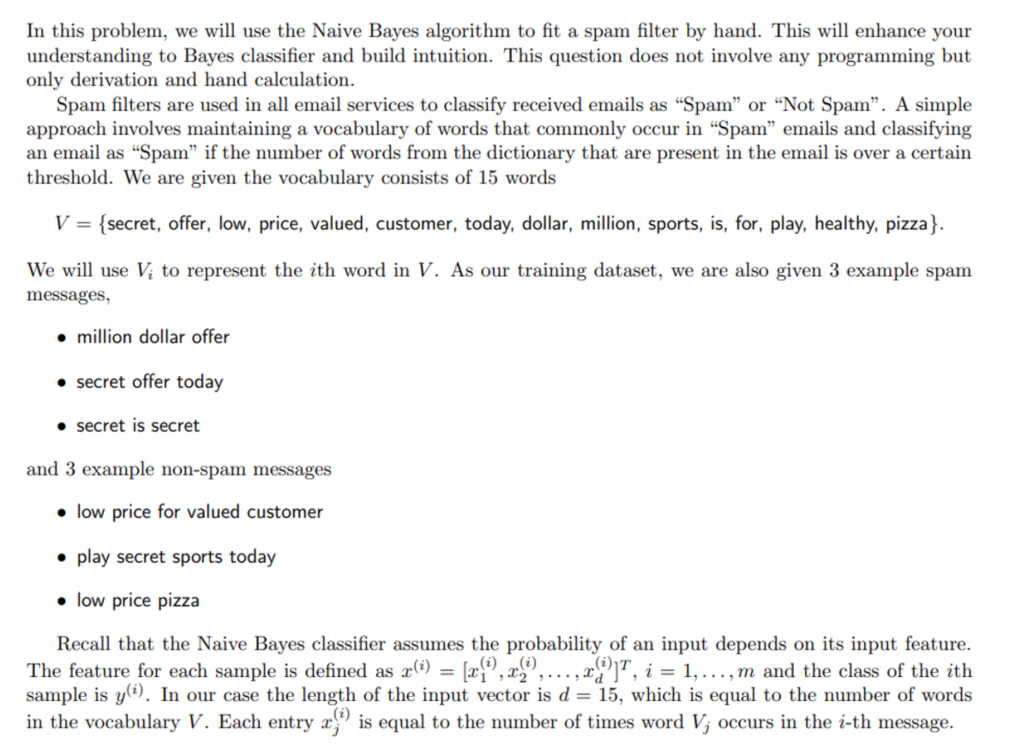
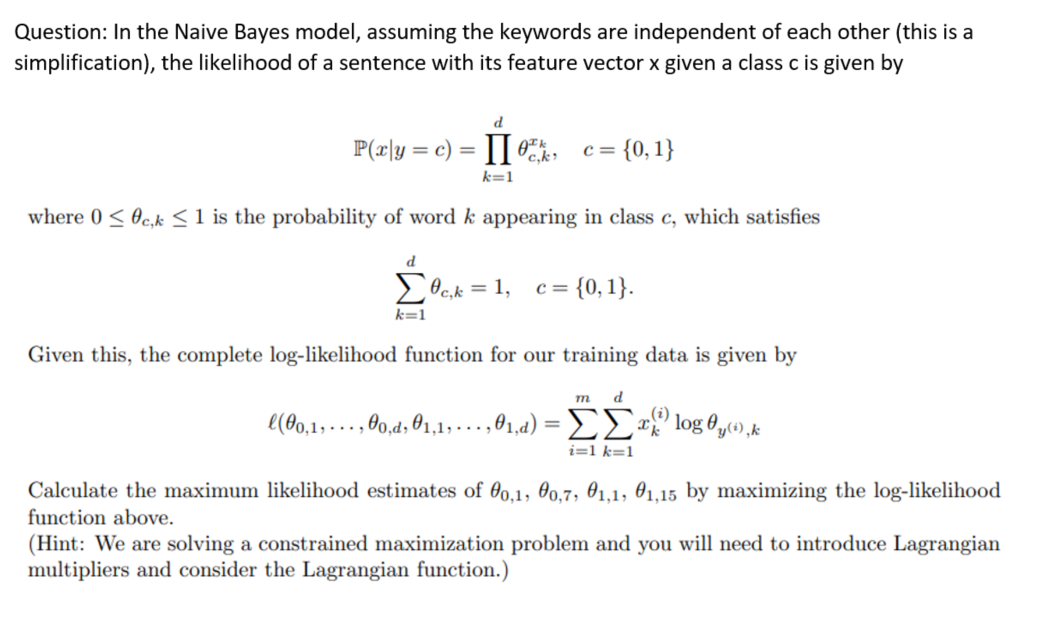
In this problem. we will use the Naive Bayes algorithm to t a spam lter by hand. This will enhance your understanding to Bayes classier and build intuition. This question does not involve any programming but only derivation and hand calculation. Spam lters are used in all email services to classify received emails as \"Spam" or \"Not Spam\". A simple approach involves maintaining a vocabulary of words that commonly occur in \"Spam\" emails and classifying an email as \"Spam\" if the number of words from the dictionary that are present in the email is over a certain threshold. We are given the vocabulary consists of 15 words V = {secret. offer. low. price. valued. customer. today. dollar. million. sports. is. for. play. healthy. pizza}. We will use 1/. to represent the ith word in V. As our training dataset. we are also given 3 example spam messages. 0 million dollar offer 0 secret offer today 0 secret is secret and 3 example non-spam messages a low price for valued customer a play secret sports today 0 low price pizza Recall that the Naive Bayes classier assumes the probability'of an input depends on its input feature. The feature for each sample is dened as e\") = bets", . . . ,eg'HT, i = 1. . . . . m and the class of the ith sample is y\"). In our case the length of the input vector is d = 15, which is equal to the number of words in the vocabulary V. Each entry I?) is equal to the number of times word P3.- occurs in the i-th message. Question: In the Naive Bayes model, assuming the keywords are independent of each other (this is a simplification), the likelihood of a sentence with its feature vector x given a class c is given by d P(xly = c) = Oh c = {0, 1} k=1 where 0
Step by Step Solution
There are 3 Steps involved in it

Get step-by-step solutions from verified subject matter experts
 Study Help