



Question: can you please send the answer a little bit faster please PRACTICE ANOTHER (a) Suppose n = 6 and the sample correlation coefficient is r
can you please send the answer a little bit faster please
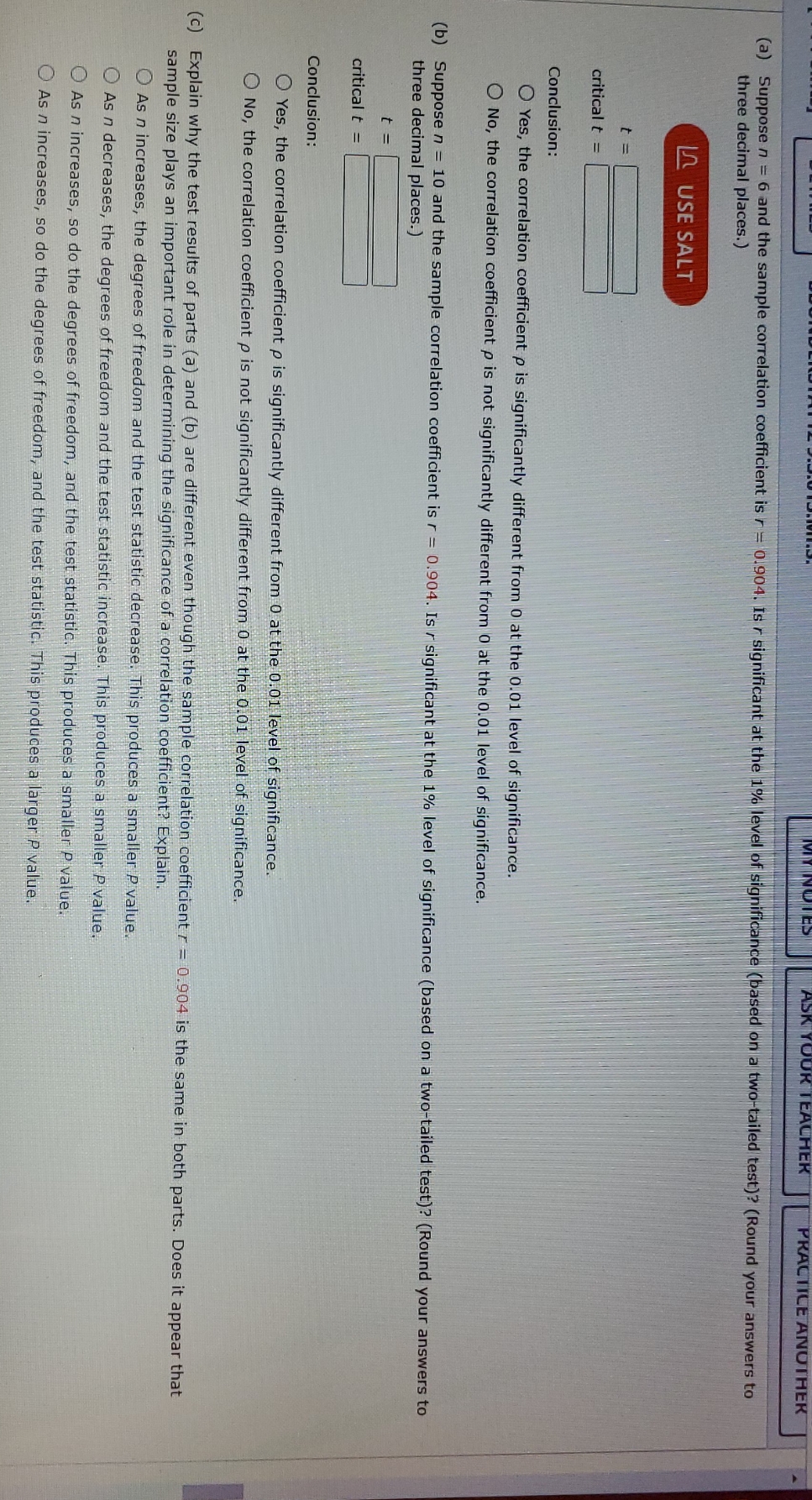
PRACTICE ANOTHER (a) Suppose n = 6 and the sample correlation coefficient is r = 0.904. Is r significant at the 1% level of significance (based on a two-tailed test)? (Round your answers to three decimal places.) In USE SALT = critical t = Conclusion: Yes, the correlation coefficient p is significantly different from 0 at the 0.01 level of significance. O No, the correlation coefficient p is not significantly different from 0 at the 0.01 level of significance. (b) Suppose n = 10 and the sample correlation coefficient is r = 0.904. Is / significant at the 1% level of significance (based on a two-tailed test)? (Round your answers to three decimal places.) = critical t = Conclusion: O Yes, the correlation coefficient p is significantly different from 0 at the 0.01 level of significance. O No, the correlation coefficient p is not significantly different from 0 at the 0.01 level of significance. (c) Explain why the test results of parts (a) and (b) are different even though the sample correlation coefficient / = 0.904 is the same in both parts. Does it appear that sample size plays an important role in determining the significance of a correlation coefficient? Explain. O As n increases, the degrees of freedom and the test statistic decrease. This produces a smaller P value. O As n decreases, the degrees of freedom and the test statistic increase. This produces a smaller P value. O As n increases, so do the degrees of freedom, and the test statistic. This produces a smaller P value. O As n increases, so do the degrees of freedom, and the test statistic. This produces a larger P value
Step by Step Solution
There are 3 Steps involved in it

Get step-by-step solutions from verified subject matter experts