Question: can you please show all steps (5) Using the same situation as in (4), calculate the eigenvalues and eigenvectors of the Sx5 matrix A A
can you please show all steps
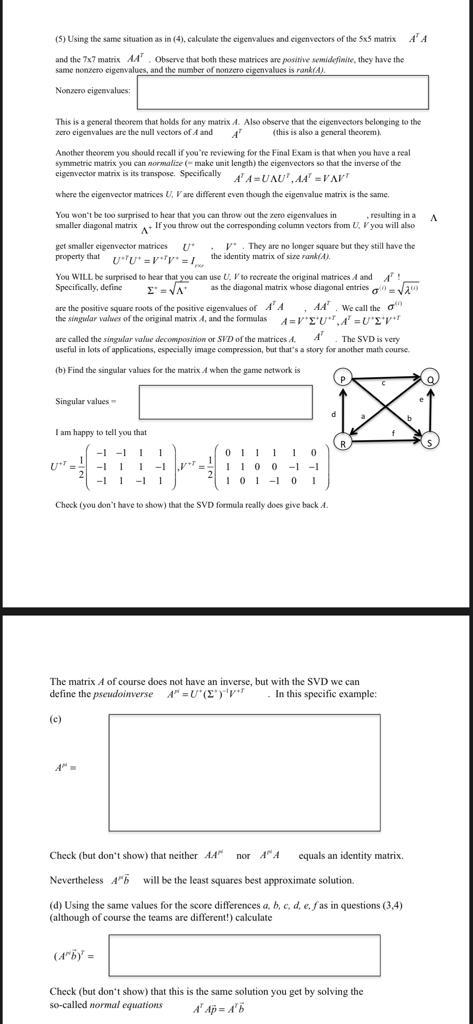
(5) Using the same situation as in (4), calculate the eigenvalues and eigenvectors of the Sx5 matrix A A and the 7x7 matrix d' . Observe that both these matrices are positive semidefinite, they have the same nonzero eigenvalues, and the number of nonzero eigenvalues is rankyAl. Nonzero cigenvalues; This is a general theorem that holds for any matrix . Also observe that the eigenvectors belonging to the zero eigenvalues are the null vectors of of and (this is also a general theorem). Another theorem you should recall if you're reviewing for the Final Exam is that when you have a real symmetric matrix you can normalize (" make unit length) the eigenvectors so that the inverse of the cigenvector matrix is its transpose. Specifically A-UAU!, AA =VAV where the cigenvector matrices U V are different even though the eigenvalue matrix is the same, You won't be too surprised to hear that you can throw out the zero eigenvalues in . resulting in a A smaller diagonal matrix , If you throw out the corresponding column vectors from ( I' you will also get smaller eigenvector matrices (* They are no longer square but they still have the property that the identity matrix of size rank(), You WILL be surprised to hear that you can use U. I' to recreate the original matrices A and Specifically, define [' =VA as the diagonal matrix whose diagonal entries 0 =10 are the positive square roots of the positive eigenvalues of A'A , A4 . We call the d' the stegwar valves of the original matrix , and the formalas A =VEU. A=USV are called the singular value decomposition or SPD of the matrices 4. The SVD is very useful in lots of applications, especially image compression, but that's a story for another math course, (b) Find the singular values for the matrix / when the game network is Singular values I am happy to tell you that -1 -1 0 1 Check (you don't have to show) that the SVD formula really does give back A. The matrix A of course does not have an inverse, but with the SVD we can define the pseudoinverse "=U(EV . In this specific example: (c) Check (but don't show) that neither A4" nor A"A equals an identity matrix. Nevertheless 4"b will be the least squares best approximate solution. (d) Using the same values for the score differences a, b, c. d, e. fas in questions (3.4) (although of course the teams are different! ) calculate CANby = Check (but don't show) that this is the same solution you get by solving the so-called normal equations A' Ap = A'6









 Study Help