Question: can you please solve it in Java language. at they are to each other category as a rete e of 1.570 ite! Mathew QWERTYUIOP ASDFGHJKL
can you please solve it in Java language.
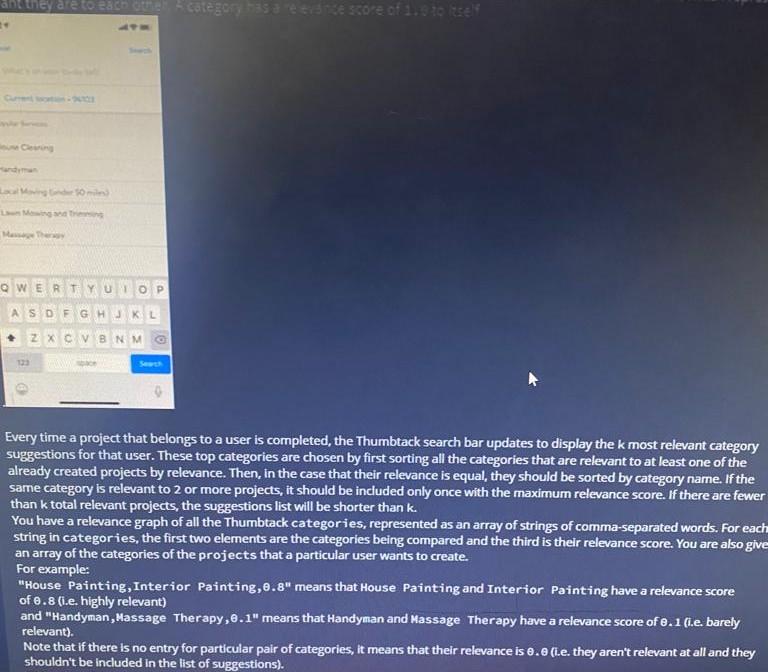
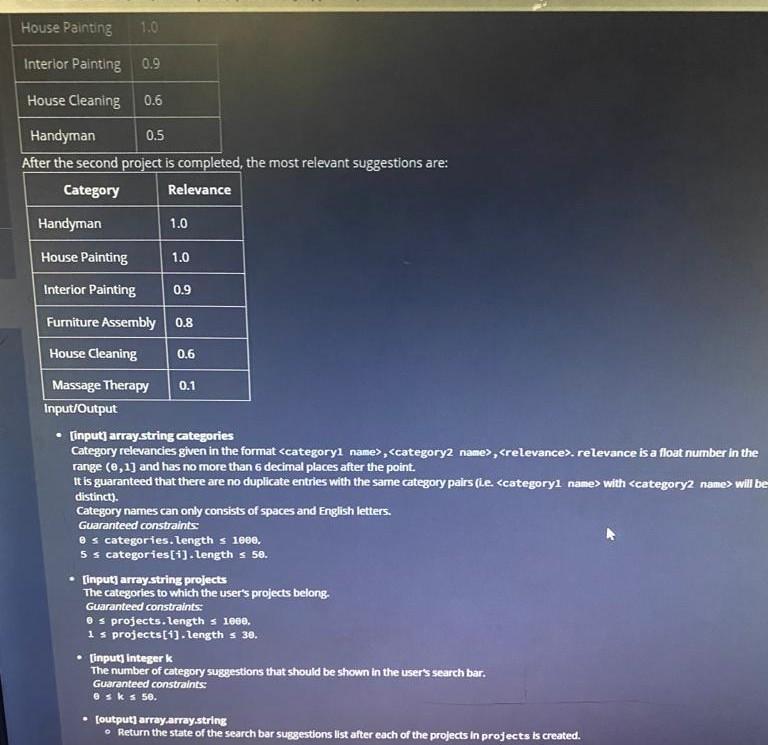
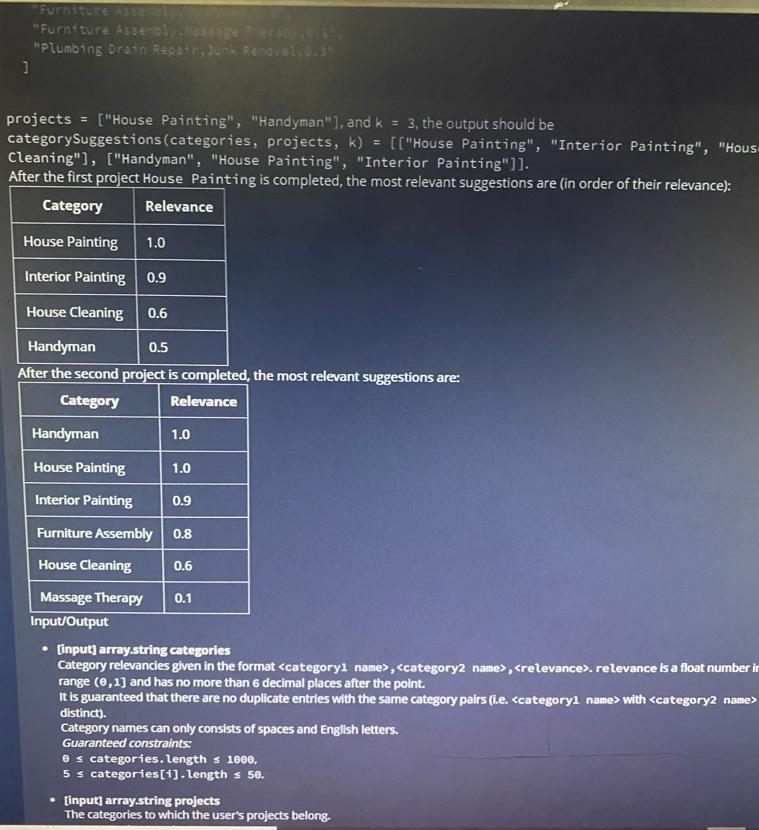
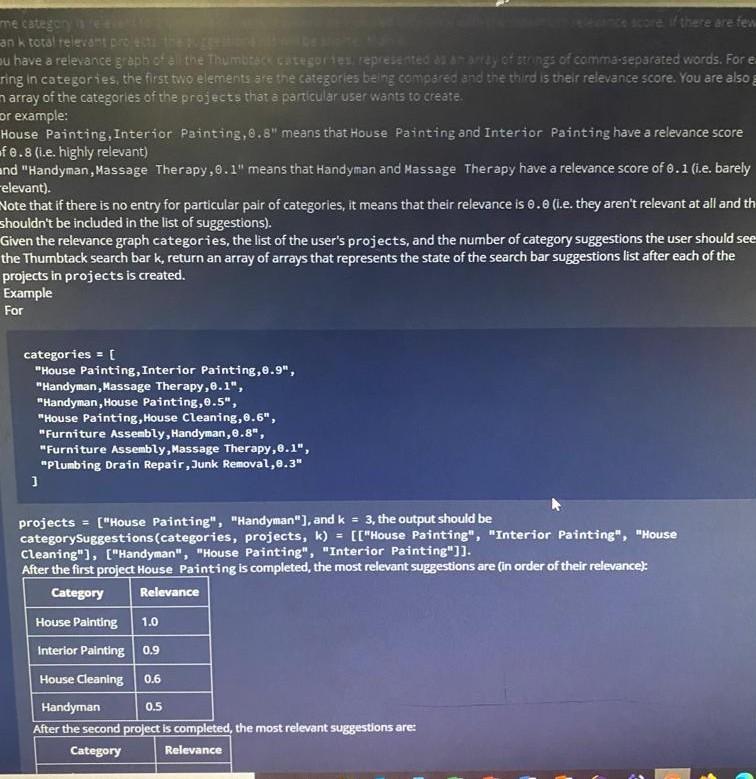
at they are to each other category as a rete e of 1.570 ite! Mathew QWERTYUIOP ASDFGHJKL 2 XCVBNM Every time a project that belongs to a user is completed, the Thumbtack search bar updates to display the k most relevant category suggestions for that user. These top categories are chosen by first sorting all the categories that are relevant to at least one of the already created projects by relevance. Then, in the case that their relevance is equal, they should be sorted by category name. If the same category is relevant to 2 or more projects, it should be included only once with the maximum relevance score. If there are fewer than k total relevant projects, the suggestions list will be shorter than k. You have a relevance graph of all the Thumbtack categories, represented as an array of strings of comma-separated words. For each string in categories, the first two elements are the categories being compared and the third is their relevance score. You are also give an array of the categories of the projects that a particular user wants to create. For example: "House Painting, Interior Painting, 0.8" means that House Painting and Interior Painting have a relevance score of 8.8 (.e. highly relevant) and "Handyman, Massage Therapy, 6.1" means that Handyman and Massage Therapy have a relevance score of 8.1 (.e. barely relevant). Note that If there is no entry for particular pair of categories, it means that their relevance is 0.(i.e. they aren't relevant at all and they shouldn't be included in the list of suggestions). House Painting 1.0 Interior Painting 0.9 House Cleaning 0.6 Handyman 0.5 After the second project is completed, the most relevant suggestions are: Category Relevance Handyman 1.0 House Painting 1.0 Interior Painting 0.9 Furniture Assembly 0.8 House Cleaning 0.6 Massage Therapy 0.1 Input/Output [input array.string categories Category relevancies given in the format ,.relevance is a float number in the range (0,1) and has no more than 6 decimal places after the point. It is guaranteed that there are no duplicate entries with the same category pairs (ie. with will be distinct). Category names can only consists of spaces and English letters. Guaranteed constraints es categories.lengths 1800. 5 s categories[1]. length 5e. [inputjarray.string projects The categories to which the user's projects belong Guaranteed constraints: @s projects.lengths 1980. 1 s projects(1).lengths 30. input) integerk The number of category suggestions that should be shown in the user's search bar. Guaranteed constraints @sks 5e. (output array array.string Return the state of the search bar suggestions list after each of the projects in projects is created. "Furniture "Furniture Assembly "Plumbing Drain Repair, dunk Remo ] projects = ["House Painting", "Handyman"), and k = 3, the output should be categorySuggestions(categories, projects, k) = [["House Painting", "Interior Painting", "Hous Cleaning"], ["Handyman", "House Painting", "Interior Painting"]). After the first project House Painting is completed, the most relevant suggestions are in order of their relevance): Category Relevance House Painting 1.0 Interior Painting 0.9 House Cleaning 0.6 Handyman 0.5 After the second project is completed, the most relevant suggestions are: Category Relevance Handyman 1.0 House Painting 1.0 Interior Painting 0.9 Furniture Assembly 0.8 House Cleaning 0.6 Massage Therapy 0.1 Input/Output [input] array.string categories Category relevancies given in the format , , with distinct). Category names can only consists of spaces and English letters. Guaranteed constraints: es categories.length 1000. 5 s categories[1]. Length s 50. [input] array.string projects The categories to which the user's projects belong. me categorie ank total relevant path su bave a relevance grapbofal the Thumbise categories, represented an amarthy of strings of comma-separated words. For e ring in categories, the first two elements are the categories being compared and the third is their relevance score. You are also narray of the categories of the projects that a particular user wants to create. or example: House Painting, Interior Painting,0.8" means that House Painting and Interior Painting have a relevance score fe.8 (t.e. highly relevant) and "Handyman, Massage Therapy,0.1" means that Handyman and Massage Therapy have a relevance score of 0.1 (i.e. barely elevant). Note that if there is no entry for particular pair of categories, it means that their relevance is 6.0 (i.e. they aren't relevant at all and th shouldn't be included in the list of suggestions). Given the relevance graph categories, the list of the user's projects, and the number of category suggestions the user should see the Thumbtack search bar k, return an array of arrays that represents the state of the search bar suggestions list after each of the projects in projects is created. Example For categories = [ "House Painting, Interior Painting, 6.9", "Handyman, Massage Therapy,0.1", "Handyman, House Painting,0.5", "House Painting, House Cleaning, 6.6", "Furniture Assembly, Handyman, 0.8", "Furniture Assembly, Massage Therapy,0.1", "Plumbing Drain Repair,Junk Removal,0.3" } projects ["House Painting", "Handyman"), and k = 3, the output should be categorySuggestions(categories, projects, k) = [["House Painting", "Interior Painting", "House Cleaning"], ["Handyman", "House Painting", "Interior Painting"]]. After the first project House Painting is completed, the most relevant suggestions are (in order of their relevance): Category Relevance House Painting 1.0 Interior Painting 0.9 House Cleaning 0.6 Handyman 0.5 After the second project is completed, the most relevant suggestions are Category Relevance









 Study Help