







Question: Can you please solve this in Matlab numerically ? I attached the question with answer A solid slab occupying the space between y = -b
Can you please solve this in Matlab numerically ? I attached the question with answer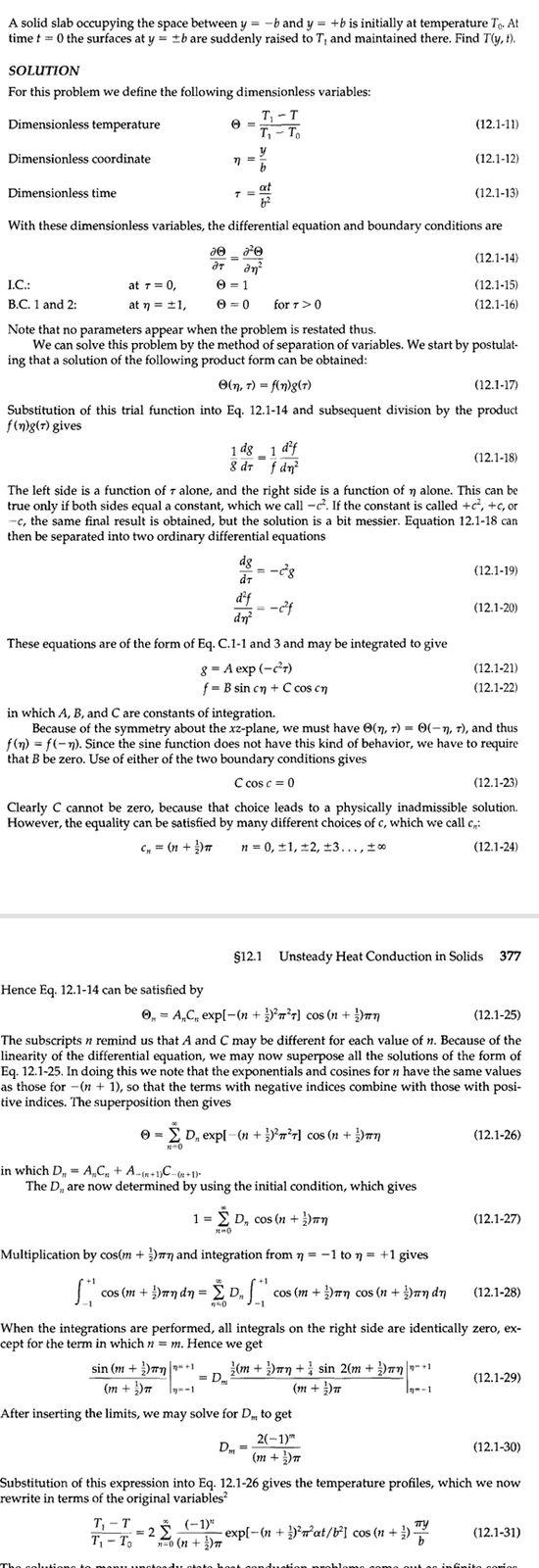
A solid slab occupying the space between y = -b and y = +b is initially at temperature To. At time t = 0 the surfaces at y = +b are suddenly raised to T, and maintained there. Find Tly, t). SOLUTION For this problem we define the following dimensionless variables: Dimensionless temperature T-T T, - T. Dimensionless coordinate = (12.1-11) b (12.1-12) Dimensionless time at ? (12.1-13) With these dimensionless variables, the differential equation and boundary conditions are de a @ (12.1-14) an I.C.: at T = 0, = 1 (12.1-15) B.C. 1 and 2: at n = 1, =0 0 for > 0 (12.1-16) ) Note that no parameters appear when the problem is restated thus. We can solve this problem by the method of separation of variables. We start by postulat- ing that a solution of the following product form can be obtained: (n.) = f(n)g(T) (12.1-17) Substitution of this trial function into Eq. 12.1-14 and subsequent division by the product f(n)g(1) gives 1 dg 104 (12.1-18) 8 dTf dry The left side is a function of 7 alone, and the right side is a function of n alone. This can be true only if both sides equal a constant, which we call -. If the constant is called +, +c, or -C, the same final result is obtained, but the solution is a bit messier. Equation 12.1-18 can then be separated into two ordinary differential equations dg = -cg (12.1-19) dr -c4 (12.1-20) dn These equations are of the form of Eq. C.1-1 and 3 and may be integrated to give 8 - A exp(-1) (12.1-21) f=B sin cn + C cos en (12.1-22) in which A, B, and C are constants of integration. Because of the symmetry about the xz-plane, we must have (7, 7) = (-7, 7), and thus f(n) = f(-n). Since the sine function does not have this kind of behavior, we have to require that B be zero. Use of either of the two boundary conditions gives Ccos c = 0 (12.1-23) Clearly C cannot be zero, because that choice leads to a physically inadmissible solution. However, the equality can be satisfied by many different choices of c, which we call c: C = (1 + 3) n = 0, +1, +2, +3..., (12.1-24) $12.1 Unsteady Heat Conduction in Solids 377 Hence Eq. 12.1-14 can be satisfied by O. - A, C, expl-(n + )?r) cos (1 + 3) (12.1-25) The subscripts n remind us that A and C may be different for each value of n. Because of the linearity of the differential equation, we may now superpose all the solutions of the form of Eq. 12.1-25. In doing this we note that the exponentials and cosines for n have the same values as those for -(n + 1), so that the terms with negative indices combine with those with posi- tive indices. The superposition then gives - D, expl-(n + m?r] cos (n + 3) (12.1-26) RO in which D = A.C + A-(+1C-le+1) The D, are now determined by using the initial condition, which gives 1 = D, cos (n + ) (+ ) (12.1-27) 0 7 1 19-1 Multiplication by cos(m + 3) and integration from 7 = -1 to n = +1 gives scos (m + Bandn = EDS m + cos (m + 3) cos (1 + 2)indn (12.1-28) When the integrations are performed, all integrals on the right side are identically zero, ex- cept for the term in which = m. Hence we get sin (m + 3)*+ (n + + sin 2(mm + 3) - +1 = D. (12.1-29) (m + ) (m + ) After inserting the limits, we may solve for D. to get 21-1) D.. (12.1-30) (m + ) Substitution of this expression into Eq. 12.1-26 gives the temperature profiles, which we now rewrite in terms of the original variables? T, -T TTY (12.1-31) T, -T = 2 (-1) ? ? (n + 1)mexp[-(n + ??#at/8] cos (n + ) hing hool
Step by Step Solution
There are 3 Steps involved in it

Get step-by-step solutions from verified subject matter experts
 Study Help