Question: Can you please write the introduction, background, key issues and problems, critical evaluation of ket issues.. , conclusion and references. PLEASE i need them for
Can you please write the introduction, background, key issues and problems, critical evaluation of ket issues.. , conclusion and references.
PLEASE i need them for today.
Human Resource Subject
HR project
Thanks.
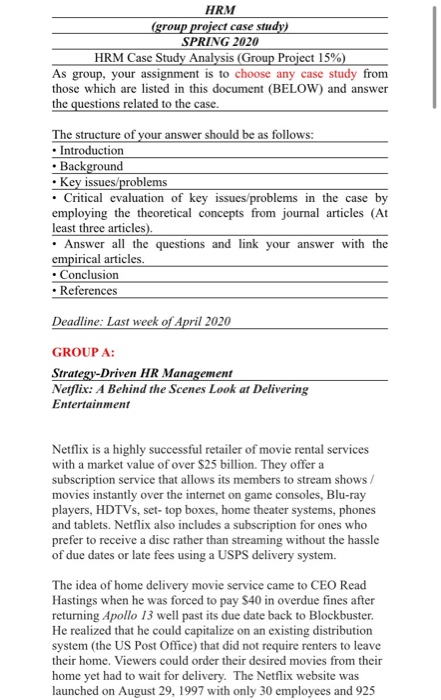
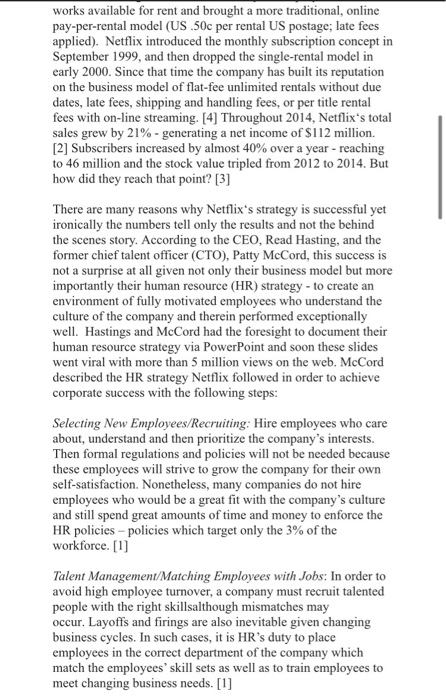
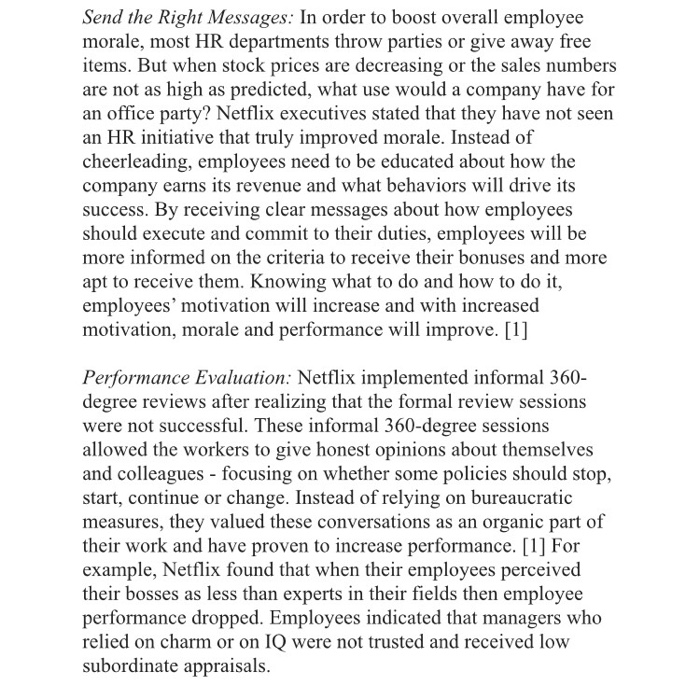
HRM (group project case study) SPRING 2020 HRM Case Study Analysis (Group Project 15%) As group. your assignment is to choose any case study from those which are listed in this document (BELOW) and answer the questions related to the case. The structure of your answer should be as follows: Introduction Background Key issues/problems Critical evaluation of key issues problems in the case by employing the theoretical concepts from journal articles (At least three articles). Answer all the questions and link your answer with the empirical articles. . Conclusion References Deadline: Last week of April 2020 GROUP A: Strategy-Driven HR Management Netflix: A Behind the Scenes Look at Delivering Entertainment Netflix is a highly successful retailer of movie rental services with a market value of over $25 billion. They offer a subscription service that allows its members to stream shows/ movies instantly over the internet on game consoles, Blu-ray players, HDTVs, set-top boxes, home theater systems, phones and tablets. Netflix also includes a subscription for ones who prefer to receive a disc rather than streaming without the hassle of due dates or late fees using a USPS delivery system. The idea of home delivery movie service came to CEO Read Hastings when he was forced to pay S40 in overdue fines after returning Apollo 13 well past its due date back to Blockbuster. He realized that he could capitalize on an existing distribution system (the US Post Office) that did not require renters to leave their home. Viewers could order their desired movies from their home yet had to wait for delivery. The Netflix website was launched on August 29, 1997 with only 30 employees and 925 works available for rent and brought a more traditional, online pay-per-rental model (US.50c per rental US postage; late fees applied). Netflix introduced the monthly subscription concept in September 1999, and then dropped the single-rental model in early 2000. Since that time the company has built its reputation on the business model of flat-fee unlimited rentals without due dates, late fees, shipping and handling fees, or per title rental fees with on-line streaming. [4] Throughout 2014, Netflix's total sales grew by 21% - generating a net income of $112 million. [2] Subscribers increased by almost 40% over a year-reaching to 46 million and the stock value tripled from 2012 to 2014. But how did they reach that point? [3] There are many reasons why Netflix's strategy is successful yet ironically the numbers tell only the results and not the behind the scenes story. According to the CEO, Read Hasting, and the former chief talent officer (CTO), Patty McCord, this success is not a surprise at all given not only their business model but more importantly their human resource (HR) strategy - to create an environment of fully motivated employees who understand the culture of the company and therein performed exceptionally well. Hastings and McCord had the foresight to document their human resource strategy via PowerPoint and soon these slides went viral with more than 5 million views on the web. McCord described the HR strategy Netflix followed in order to achieve corporate success with the following steps: Selecting New Employees/Recruiting: Hire employees who care about, understand and then prioritize the company's interests. Then formal regulations and policies will not be needed because these employees will strive to grow the company for their own self-satisfaction. Nonetheless, many companies do not hire employees who would be a great fit with the company's culture and still spend great amounts of time and money to enforce the HR policies - policies which target only the 3% of the workforce. [1] Talent Management Matching Employees with Jobs: In order to avoid high employee turnover, a company must recruit talented people with the right skillsalthough mismatches may occur. Layoffs and firings are also inevitable given changing business cycles. In such cases, it is HR's duty to place employees in the correct department of the company which match the employees' skill sets as well as to train employees to meet changing business needs. [1] Send the Right Messages: In order to boost overall employee morale, most HR departments throw parties or give away free items. But when stock prices are decreasing or the sales numbers are not as high as predicted, what use would a company have for an office party? Netflix executives stated that they have not seen an HR initiative that truly improved morale. Instead of cheerleading, employees need to be educated about how the company earns its revenue and what behaviors will drive its success. By receiving clear messages about how employees should execute and commit to their duties, employees will be more informed on the criteria to receive their bonuses and more apt to receive them. Knowing what to do and how to do it, employees' motivation will increase and with increased motivation, morale and performance will improve. [1] Performance Evaluation: Netflix implemented informal 360- degree reviews after realizing that the formal review sessions were not successful. These informal 360-degree sessions allowed the workers to give honest opinions about themselves and colleagues - focusing on whether some policies should stop, start, continue or change. Instead of relying on bureaucratic measures, they valued these conversations as an organic part of their work and have proven to increase performance. [1] For example, Netflix found that when their employees perceived their bosses as less than experts in their fields then employee performance dropped. Employees indicated that managers who relied on charm or on IQ were not trusted and received low subordinate appraisals. HRM (group project case study) SPRING 2020 HRM Case Study Analysis (Group Project 15%) As group. your assignment is to choose any case study from those which are listed in this document (BELOW) and answer the questions related to the case. The structure of your answer should be as follows: Introduction Background Key issues/problems Critical evaluation of key issues problems in the case by employing the theoretical concepts from journal articles (At least three articles). Answer all the questions and link your answer with the empirical articles. . Conclusion References Deadline: Last week of April 2020 GROUP A: Strategy-Driven HR Management Netflix: A Behind the Scenes Look at Delivering Entertainment Netflix is a highly successful retailer of movie rental services with a market value of over $25 billion. They offer a subscription service that allows its members to stream shows/ movies instantly over the internet on game consoles, Blu-ray players, HDTVs, set-top boxes, home theater systems, phones and tablets. Netflix also includes a subscription for ones who prefer to receive a disc rather than streaming without the hassle of due dates or late fees using a USPS delivery system. The idea of home delivery movie service came to CEO Read Hastings when he was forced to pay S40 in overdue fines after returning Apollo 13 well past its due date back to Blockbuster. He realized that he could capitalize on an existing distribution system (the US Post Office) that did not require renters to leave their home. Viewers could order their desired movies from their home yet had to wait for delivery. The Netflix website was launched on August 29, 1997 with only 30 employees and 925 works available for rent and brought a more traditional, online pay-per-rental model (US.50c per rental US postage; late fees applied). Netflix introduced the monthly subscription concept in September 1999, and then dropped the single-rental model in early 2000. Since that time the company has built its reputation on the business model of flat-fee unlimited rentals without due dates, late fees, shipping and handling fees, or per title rental fees with on-line streaming. [4] Throughout 2014, Netflix's total sales grew by 21% - generating a net income of $112 million. [2] Subscribers increased by almost 40% over a year-reaching to 46 million and the stock value tripled from 2012 to 2014. But how did they reach that point? [3] There are many reasons why Netflix's strategy is successful yet ironically the numbers tell only the results and not the behind the scenes story. According to the CEO, Read Hasting, and the former chief talent officer (CTO), Patty McCord, this success is not a surprise at all given not only their business model but more importantly their human resource (HR) strategy - to create an environment of fully motivated employees who understand the culture of the company and therein performed exceptionally well. Hastings and McCord had the foresight to document their human resource strategy via PowerPoint and soon these slides went viral with more than 5 million views on the web. McCord described the HR strategy Netflix followed in order to achieve corporate success with the following steps: Selecting New Employees/Recruiting: Hire employees who care about, understand and then prioritize the company's interests. Then formal regulations and policies will not be needed because these employees will strive to grow the company for their own self-satisfaction. Nonetheless, many companies do not hire employees who would be a great fit with the company's culture and still spend great amounts of time and money to enforce the HR policies - policies which target only the 3% of the workforce. [1] Talent Management Matching Employees with Jobs: In order to avoid high employee turnover, a company must recruit talented people with the right skillsalthough mismatches may occur. Layoffs and firings are also inevitable given changing business cycles. In such cases, it is HR's duty to place employees in the correct department of the company which match the employees' skill sets as well as to train employees to meet changing business needs. [1] Send the Right Messages: In order to boost overall employee morale, most HR departments throw parties or give away free items. But when stock prices are decreasing or the sales numbers are not as high as predicted, what use would a company have for an office party? Netflix executives stated that they have not seen an HR initiative that truly improved morale. Instead of cheerleading, employees need to be educated about how the company earns its revenue and what behaviors will drive its success. By receiving clear messages about how employees should execute and commit to their duties, employees will be more informed on the criteria to receive their bonuses and more apt to receive them. Knowing what to do and how to do it, employees' motivation will increase and with increased motivation, morale and performance will improve. [1] Performance Evaluation: Netflix implemented informal 360- degree reviews after realizing that the formal review sessions were not successful. These informal 360-degree sessions allowed the workers to give honest opinions about themselves and colleagues - focusing on whether some policies should stop, start, continue or change. Instead of relying on bureaucratic measures, they valued these conversations as an organic part of their work and have proven to increase performance. [1] For example, Netflix found that when their employees perceived their bosses as less than experts in their fields then employee performance dropped. Employees indicated that managers who relied on charm or on IQ were not trusted and received low subordinate appraisals









 Study Help