







Question: can you plot this using either python or matlab i want to see the code used it is the ni= BT^2/3 e^(-Eg/2kT Spartanium Material Characteristics
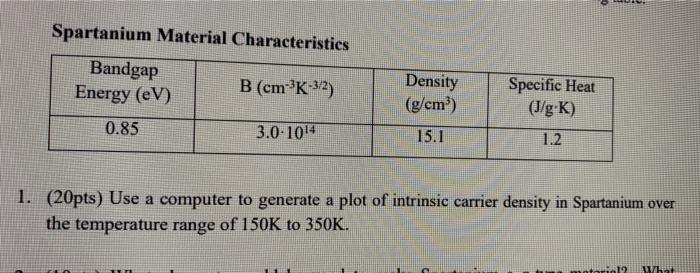
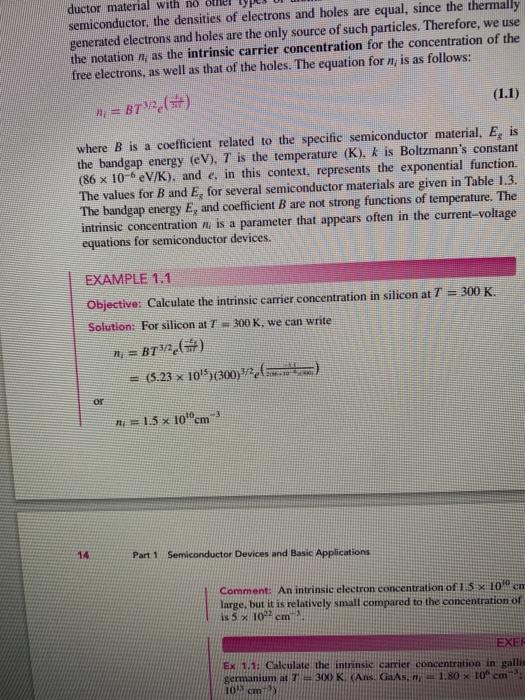
Spartanium Material Characteristics Bandgap Energy (V) B (cm K32) 0.85 3.0-101 Density (g/cm) Specific Heat (J/g-K) 15.1 1.2 1. (20pts) Use a computer to generate a plot of intrinsic carrier density in Spartanium over the temperature range of 150K to 350K. ETTI 12 Avh ductor material with no semiconductor, the densities of electrons and holes are equal, since the thermally generated electrons and holes are the only source of such particles. Therefore, we use the notation ng as the intrinsic carrier concentration for the concentration of the free electrons, as well as that of the holes. The equation for nis as follows: (1.1) - B72G) where B is a coefficient related to the specific semiconductor material, E, is the bandgap energy (eV), 7 is the temperature (K). k is Boltzmann's constant (86 x 10-6 eV/K). and e, in this context, represents the exponential function. The values for B and E. for several semiconductor materials are given in Table 1.3. The bandgap energy E, and coefficient B are not strong functions of temperature. The intrinsic concentration is a parameter that appears often in the current-voltage equations for semiconductor devices. EXAMPLE 1.1 Objective: Calculate the intrinsic carrier concentration in silicon at T = 300 K. Solution: For silicon at T = 300 K, we can write n = B7/ 25) = (5.23 x 10'S)(3002) or ni = 13 x 10cm 14 Part 1 Semiconductor Devices and Basic Applications Comment: An intrinsic electron concentration of 1.5 x 10 cm large, but it is relatively small compared to the concentration of is 5 x 10 cm EXER EX 1.1: Calculate the intrinsic carrier concentration in galli germanium at 7 = 300 K Ans Gaas. 1.80 x 10 cm 101 cm
Step by Step Solution
There are 3 Steps involved in it

Get step-by-step solutions from verified subject matter experts
 Study Help