Question: Can you properly apply M L A format to this text using A Writer's Reference, 10th edition: C Composing and revising, pp. 3-48 A1 Reading
Can you properly apply M L A format to this text using A Writer's Reference, 10th edition:
C "Composing and revising," pp. 3-48
A1 "Reading and writing critically," pp. 51-68
G1 "Subject-verb agreement," pp. 361-369
G5 "Sentence fragments," pp.395-400
G6 "Run-on sentences," pp. 400-406
MLA-5, pp.198-206
Summary of How a Blind Astronomer Found a Way to Hear the Stars by Wanda Diaz-Merced
In her TED Talk, "How a Blind Astronomer Found a Way to Hear the Stars," first presented in February 2016, Wanda Daz-Merced shares her personal journey of overcoming the challenges she faced after losing her sight as an astronomer. The article describes how she adapted to her new circumstances by finding a way to study the universe through sound instead of relying on sight, which is the traditional approach in astronomy. After becoming blind, Daz-Merced struggled to access the data that sighted astronomers use, such as graphs that display light patterns from stars. However, she developed an innovative method called sonification, which turns data into sound, allowing her to continue her work. The main point of her talk is that using sound in astronomy can help blind and sighted scientists alike to better understand data, making science more inclusive for everyone.
One major point Daz-Merced discusses is the difficulty that blind individuals face in a field that depends so much on visual information. She explains that astronomers often use visual tools like light curves, which are graphs showing the intensity of light over time, to study stars and other celestial objects. Daz-Merced describes how losing her sight due to illness meant that she could no longer see these important graphs, which left her unable to work as she had before. She states, "I completely lost my sight because of extended illness, and with it, I lost the opportunity to see this plot and the opportunity to do m y physics." This experience was devastating for her both personally and professionally, as it took away her ability to study the stars in the way she had trained for years. This struggle made her realize that astronomy, like many scientific fields, was not set up to include people with disabilities, and she needed to find a new way to access the data.
To solve this problem, Daz-Merced and her colleagues developed a technique called sonification, which converts numerical data into sound. By listening to the data, Daz-Merced could detect patterns and details that would usually be seen on a graph. For example, she could study gamma-ray bursts, which are powerful explosions in space, by listening to how the sound changes over time. She explains that "listening to this gamma-ray burst that you're seeing on the screen brought something to the ear beyond the obvious burst." This means that by turning the data into sound, she was able to hear details that might be missed when just looking at a graph. Sonification allowed her to continue her research at the same level as sighted astronomers and even provided new insights that were not visible through traditional methods.
Daz-Merced also highlights the broader impact of making science more accessible through sound, arguing that it can open doors for many people with disabilities. She emphasizes that anyone can develop a disability at any point in life, and access to information should not be limited by physical abilities. She states, "Information access empowers us to flourish. It gives us equal opportunities to display our talents and choose what we want to do with our lives." By developing sonification techniques, Daz-Merced not only found a way to continue her own work but also created opportunities for others who may face similar challenges. She currently works at the South African Astronomical Observatory, where she teaches students with disabilities how to use sound to study astronomical data, helping to make the field of astronomy more inclusive for all.
In conclusion, Wanda Daz-Merced's story shows how innovative approaches like sonification can transform fields that traditionally rely on visual data. By turning data into sound, she not only overcame the challenges of losing her sight but also proved that science can be made accessible to everyone, regardless of physical abilities. Her work serves as a powerful example of how inclusive practices can benefit not just individuals with disabilities but the entire scientific community. Daz-Merced's experience demonstrates the value of creating a supportive environment where all people, regardless of their abilities, can contribute to the advancement of knowledge. This approach not only enriches the field of astronomy but also helps to build a more inclusive and diverse scientific world.
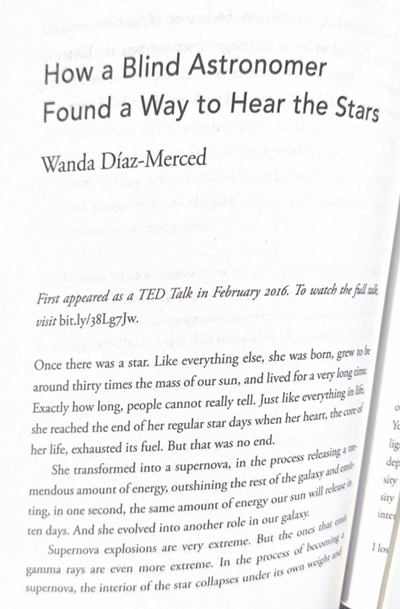
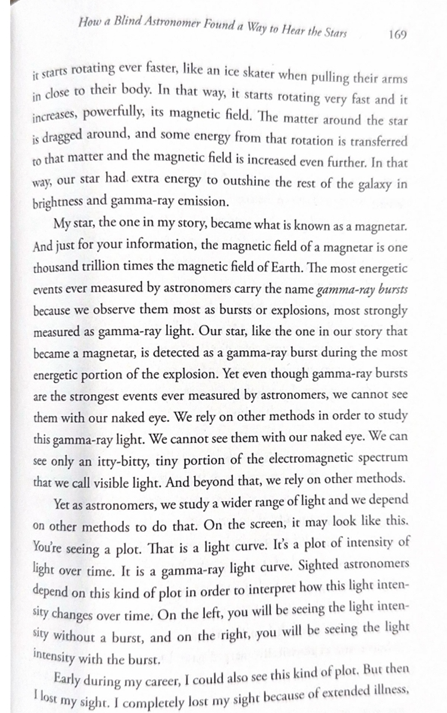
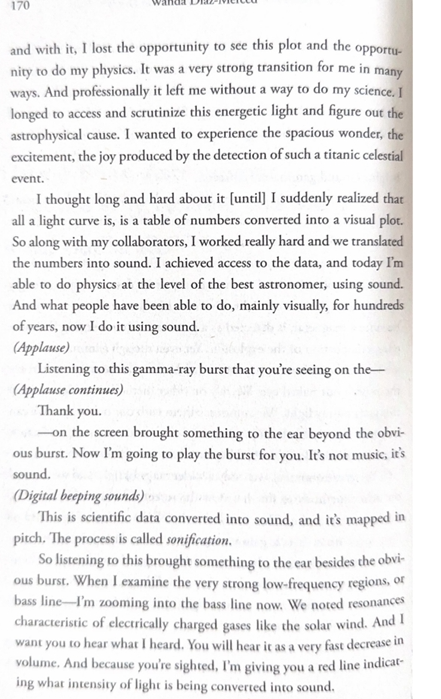
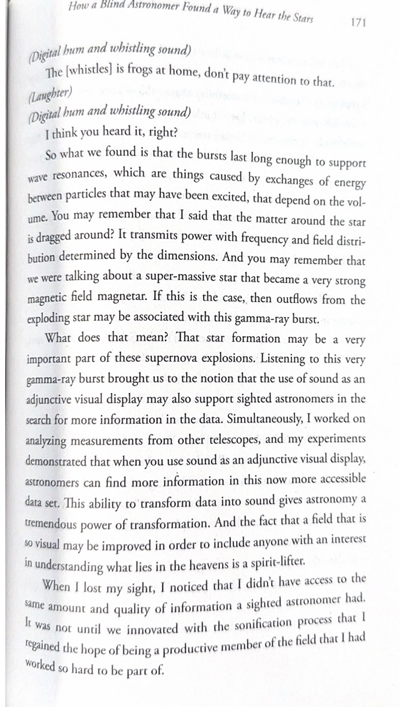
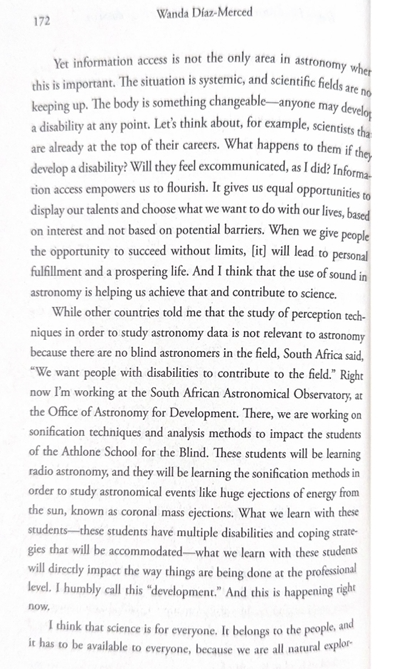
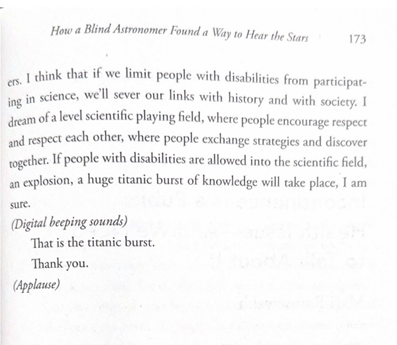
How a Blind Astronomer Found a Way to Hear the Stars Wanda Diaz-Merced First appeared as a TED Talk in February 2016. To watch the full ale visit bit.ly/38Lg7]w. Once there was a star. Like everything else, she was born, grew to be around thirty times the mass of our sun, and lived for a very long time Exactly how long, people cannot really tell. Just like everything in life she reached the end of her regular star days when her heart, the core of her life, exhausted its fuel. But that was no end. lig She transformed into a supernova, in the process releasing a or dep mendous amount of energy, outshining the rest of the galaxy and cut sity ting, in one second, the same amount of energy our sun will rekasi sity ten days. And she evolved into another role in our galaxy. ince Supernova explosions are very extreme, But the ones that car gamma rays are even more extreme. In the process of becoming ! I los supernova, the interior of the star collapses under its own weight andHow a Blind Astronomer Found a Way to Hear the Stars 169 it starts rotating ever faster, like an ice skater when pulling their arms in close to their body. In that way, it starts rotating very fast and it increases, powerfully, its magnetic field. The matter around the star is dragged around, and some energy from that rotation is transferred to that matter and the magnetic field is increased even further. In that way, our star had extra energy to outshine the rest of the galaxy in brightness and gamma-ray emission. My star, the one in my story, became what is known as a magnetar. And just for your information, the magnetic field of a magnetar is one thousand trillion times the magnetic field of Earth. The most energetic events ever measured by astronomers carry the name gamma-ray bursts because we observe them most as bursts or explosions, most strongly measured as gamma-ray light. Our star, like the one in our story that became a magnetar, is detected as a gamma-ray burst during the most energetic portion of the explosion. Yet even though gamma-ray bursts are the strongest events ever measured by astronomers, we cannot see them with our naked eye. We rely on other methods in order to study this gamma-ray light. We cannot see them with our naked eye. We can see only an itty-bitty, tiny portion of the electromagnetic spectrum that we call visible light. And beyond that, we rely on other methods. Yet as astronomers, we study a wider range of light and we depend on other methods to do that. On the screen, it may look like this. You're seeing a plot. That is a light curve. It's a plot of intensity of light over time. It is a gamma-ray light curve. Sighted astronomers depend on this kind of plot in order to interpret how this light inten- sity changes over time. On the left, you will be seeing the light inten- sity without a burst, and on the right, you will be seeing the light intensity with the burst. Early during my career, I could also see this kind of plot. But then lost my sight. I completely lost my sight because of extended illness,170 and with it, I lost the opportunity to see this plot and the opportu nity to do my physics. It was a very strong transition for me in many ways. And professionally it left me without a way to do my science. I longed to access and scrutinize this energetic light and figure out the astrophysical cause. I wanted to experience the spacious wonder, the excitement, the joy produced by the detection of such a titanic celestial event. I thought long and hard about it [until] I suddenly realized that all a light curve is, is a table of numbers converted into a visual plot. So along with my collaborators, I worked really hard and we translated the numbers into sound. I achieved access to the data, and today I'm able to do physics at the level of the best astronomer, using sound. And what people have been able to do, mainly visually, for hundreds of years, now I do it using sound. (Applause) tolarge Listening to this gamma-ray burst that you're seeing on the- (Applause continues) Thank you. on the screen brought something to the ear beyond the obvi- ous burst. Now I'm going to play the burst for you. It's not music, it's sound. (Digital beeping sounds) via This is scientific data converted into sound, and it's mapped in pitch. The process is called sonification. So listening to this brought something to the ear besides the obvi- ous burst. When I examine the very strong low-frequency regions, or bass line-I'm zooming into the bass line now. We noted resonances characteristic of electrically charged gases like the solar wind. And I want you to hear what I heard. You will hear it as a very fast decrease in volume. And because you're sighted, I'm giving you a red line indicat- ing what intensity of light is being converted into sound.Have a Blind Astronomer Found a Way to Hear the Stars 171 (Digital hum and whistling sound) The (whistles] is frogs at home, don't pay attention to that. (Laughter) (Digital bum and whistling sound) I think you heard it, right? So what we found is that the bursts last long enough to support wave resonances, which are things caused by exchanges of energy between particles that may have been excited, that depend on the vol- ume. You may remember that I said that the matter around the star is dragged around? It transmits power with frequency and field distri- bution determined by the dimensions. And you may remember that we were talking about a super-massive star that became a very strong magnetic field magnetar. If this is the case, then outflows from the exploding star may be associated with this gamma-ray burst. What does that mean? That star formation may be a very important part of these supernova explosions. Listening to this very gamma-ray burst brought us to the notion that the use of sound as an adjunctive visual display may also support sighted astronomers in the search for more information in the data. Simultaneously, I worked on analyzing measurements from other telescopes, and my experiments demonstrated that when you use sound as an adjunctive visual display, astronomers can find more information in this now more accessible data set. This ability to transform data into sound gives astronomy a tremendous power of transformation. And the fact that a field that is so visual may be improved in order to include anyone with an interest in understanding what lies in the heavens is a spirit-lifter. When I lost my sight, I noticed that I didn't have access to the same amount and quality of information a sighted astronomer had. It was not until we innovated with the sonification process that I regained the hope of being a productive member of the field that I had worked so hard to be part of.Wanda Diaz-Merced 172 Yet information access is not the only area in astronomy wher this is important. The situation is systemic, and scientific fields are no keeping up. The body is something changeable-anyone may develop a disability at any point. Let's think about, for example, scientists tha are already at the top of their careers. What happens to them if they develop a disability? Will they feel excommunicated, as I did? Informa- tion access empowers us to flourish. It gives us equal opportunities to display our talents and choose what we want to do with our lives, based on interest and not based on potential barriers. When we give people the opportunity to succeed without limits, [it] will lead to personal fulfillment and a prospering life. And I think that the use of sound in astronomy is helping us achieve that and contribute to science. While other countries told me that the study of perception tech- niques in order to study astronomy data is not relevant to astronomy because there are no blind astronomers in the field, South Africa said, "We want people with disabilities to contribute to the field." Right now I'm working at the South African Astronomical Observatory, at the Office of Astronomy for Development. There, we are working on sonification techniques and analysis methods to impact the students of the Athlone School for the Blind. These students will be learning radio astronomy, and they will be learning the sonification methods in order to study astronomical events like huge ejections of energy from the sun, known as coronal mass ejections. What we learn with these students-these students have multiple disabilities and coping strate- gies that will be accommodated-what we learn with these students will directly impact the way things are being done at the professional level. I humbly call this "development." And this is happening right now. I think that science is for everyone. It belongs to the people, and it has to be available to everyone, because we are all natural explor-How a Blind Astronomer Found a Way to Hear the Stars 173 ers. I think that if we limit people with disabilities from participat- ing in science, we'll sever our links with history and with society. I dream of a level scientific playing field, where people encourage respect and respect each other, where people exchange strategies and discover together. If people with disabilities are allowed into the scientific field, an explosion, a huge titanic burst of knowledge will take place, I am sure. (Digital beeping sounds) That is the titanic burst. Thank you. (Applause)
Step by Step Solution
There are 3 Steps involved in it
1 Expert Approved Answer
Step: 1 Unlock
Question Has Been Solved by an Expert!
Get step-by-step solutions from verified subject matter experts
Step: 2 Unlock
Step: 3 Unlock
Students Have Also Explored These Related Business Writing Questions!