







Question: can you show me how to do this using excel? it is constraint management theory. I can write the document. that is all the information
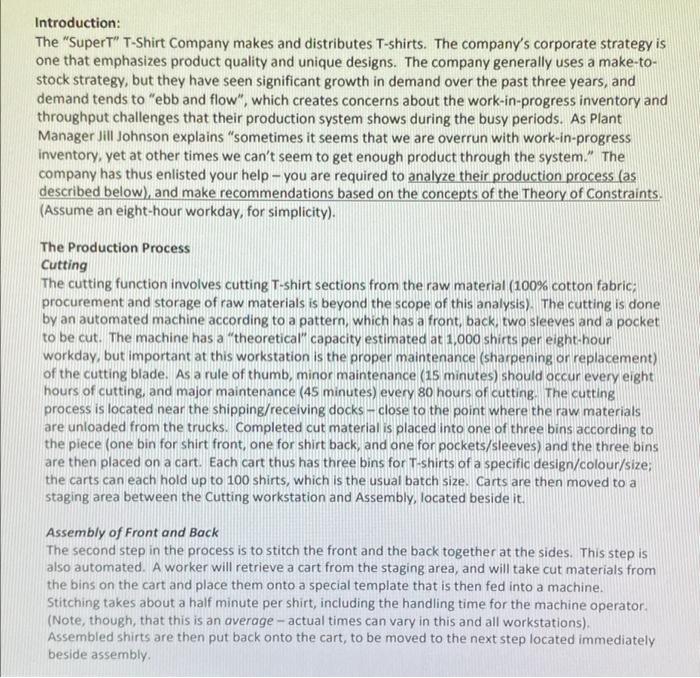
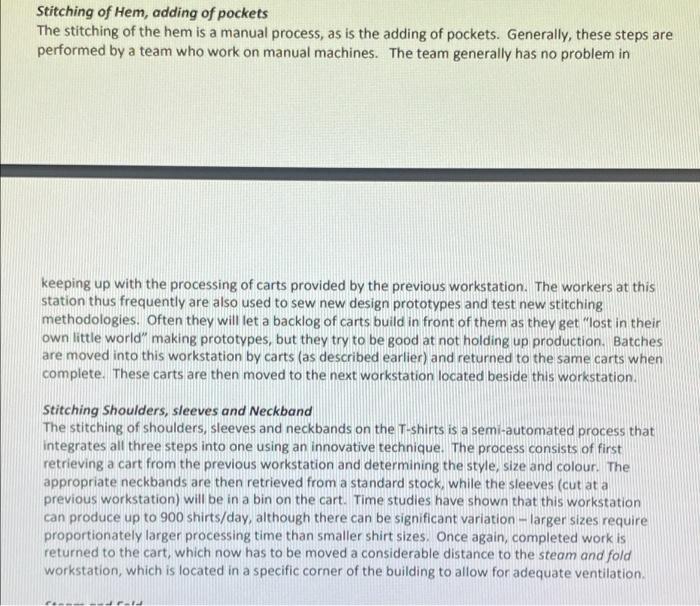
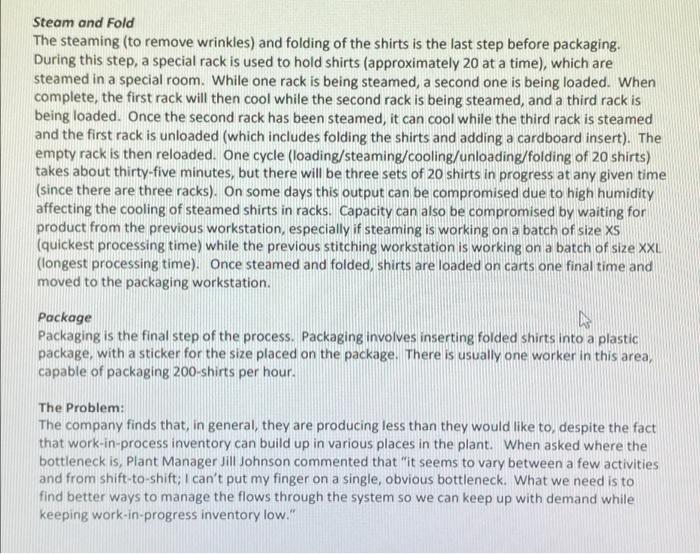
Introduction: The "SuperT" T-Shirt Company makes and distributes T-shirts. The company's corporate strategy is one that emphasizes product quality and unique designs. The company generally uses a make-to- stock strategy, but they have seen significant growth in demand over the past three years, and demand tends to "ebb and flow", which creates concerns about the work-in-progress inventory and throughput challenges that their production system shows during the busy periods. As Plant Manager Jill Johnson explains "sometimes it seems that we are overrun with work-in-progress inventory, yet at other times we can't seem to get enough product through the system. The company has thus enlisted your help - you are required to analyze their production process (as described below), and make recommendations based on the concepts of the Theory of Constraints. (Assume an eight-hour workday, for simplicity). The Production Process Cutting The cutting function involves cutting T-shirt sections from the raw material (100% cotton fabric: procurement and storage of raw materials is beyond the scope of this analysis). The cutting is done by an automated machine according to a pattern, which has a front, back, two sleeves and a pocket to be cut. The machine has a "theoretical" capacity estimated at 1,000 shirts per eight-hour workday, but important at this workstation is the proper maintenance (sharpening or replacement) of the cutting blade. As a rule of thumb, minor maintenance (15 minutes) should occur every eight hours of cutting, and major maintenance (45 minutes) every 80 hours of cutting. The cutting process is located near the shipping/receiving docks - close to the point where the raw materials are unloaded from the trucks. Completed cut material is placed into one of three bins according to the piece (one bin for shirt front, one for shirt back, and one for pockets/sleeves) and the three bins are then placed on a cart. Each cart thus has three bins for T-shirts of a specific design/colour/size; the carts can each hold up to 100 shirts, which is the usual batch size. Carts are then moved to a staging area between the Cutting workstation and Assembly, located beside it. - Assembly of Front and Back The second step in the process is to stitch the front and the back together at the sides. This step is also automated. A worker will retrieve a cart from the staging area, and will take cut materials from the bins on the cart and place them onto a special template that is then fed into a machine. Stitching takes about a half minute per shirt, including the handling time for the machine operator. (Note, though, that this is an average - actual times can vary in this and all workstations), Assembled shirts are then put back onto the cart, to be moved to the next step located immediately beside assembly Stitching of Hem, adding of pockets The stitching of the hem is a manual process, as is the adding of pockets. Generally, these steps are performed by a team who work on manual machines. The team generally has no problem in keeping up with the processing of carts provided by the previous workstation. The workers at this station thus frequently are also used to sew new design prototypes and test new stitching methodologies. Often they will let a backlog of carts build in front of them as they get lost in their own little world" making prototypes, but they try to be good at not holding up production Batches are moved into this workstation by carts (as described earlier) and returned to the same carts when complete. These carts are then moved to the next workstation located beside this workstation Stitching Shoulders, sleeves and Neckband The stitching of shoulders, sleeves and neckbands on the T-shirts is a semi-automated process that integrates all three steps into one using an innovative technique. The process consists of first retrieving a cart from the previous workstation and determining the style, size and colour. The appropriate neckbands are then retrieved from a standard stock, while the sleeves (cut at a previous workstation) will be in a bin on the cart. Time studies have shown that this workstation can produce up to 900 shirts/day, although there can be significant variation - larger sizes require proportionately larger processing time than smaller shirt sizes. Once again, completed work is returned to the cart, which now has to be moved a considerable distance to the steam and fold workstation, which is located in a specific corner of the building to allow for adequate ventilation Steam and Fold The steaming (to remove wrinkles) and folding of the shirts is the last step before packaging. During this step, a special rack is used to hold shirts (approximately 20 at a time), which are steamed in a special room. While one rack is being steamed, a second one is being loaded. When complete, the first rack will then cool while the second rack is being steamed, and a third rack is being loaded. Once the second rack has been steamed, it can cool while the third rack is steamed and the first rack is unloaded (which includes folding the shirts and adding a cardboard insert). The empty rack is then reloaded. One cycle (loading/steaming/cooling/unloading/folding of 20 shirts) takes about thirty-five minutes, but there will be three sets of 20 shirts in progress at any given time (since there are three racks). On some days this output can be compromised due to high humidity affecting the cooling of steamed shirts in racks. Capacity can also be compromised by waiting for product from the previous workstation, especially if steaming is working on a batch of size XS (quickest processing time) while the previous stitching workstation is working on a batch of size XXL (longest processing time). Once steamed and folded, shirts are loaded on carts one final time and moved to the packaging workstation. Package Packaging is the final step of the process. Packaging involves inserting folded shirts into a plastic package, with a sticker for the size placed on the package. There is usually one worker in this area, capable of packaging 200-shirts per hour. The Problem: The company finds that, in general, they are producing less than they would like to, despite the fact that work-in-process inventory can build up in various places in the plant. When asked where the bottleneck is, Plant Manager Jill Johnson commented that "it seems to vary between a few activities and from shift-to-shift: I can't put my finger on a single, obvious bottleneck. What we need is to find better ways to manage the flows through the system so we can keep up with demand while keeping work-in-progress inventory low." w
Step by Step Solution
There are 3 Steps involved in it

Get step-by-step solutions from verified subject matter experts
 Study Help