







Question: can you solve these? 37. Why is a NMO (normal moveout) correction applied to reflections in a CMP gather? a. To correct for the dip
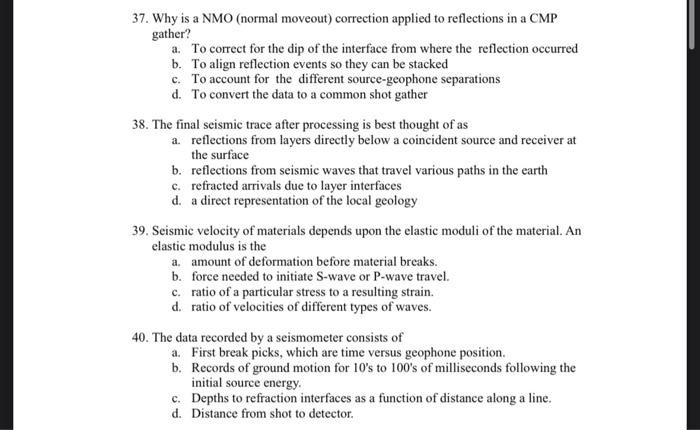
37. Why is a NMO (normal moveout) correction applied to reflections in a CMP gather? a. To correct for the dip of the interface from where the reflection occurred b. To align reflection events so they can be stacked c. To account for the different source-geophone separations d. To convert the data to a common shot gather 38. The final seismic trace after processing is best thought of as a. reflections from layers directly below a coincident source and receiver at the surface b. reflections from seismic waves that travel various paths in the earth c. refracted arrivals due to layer interfaces d. a direct representation of the local geology 39. Seismic velocity of materials depends upon the elastic moduli of the material. An elastic modulus is the a. amount of deformation before material breaks. b. force needed to initiate S-wave or P-wave travel. c. ratio of a particular stress to a resulting strain. d. ratio of velocities of different types of waves. 40. The data recorded by a seismometer consists of a. First break picks, which are time versus geophone position. b. Records of ground motion for 10's to 100's of milliseconds following the initial source energy. c. Depths to refraction interfaces as a function of distance along a line. d. Distance from shot to detector
Step by Step Solution
There are 3 Steps involved in it

Get step-by-step solutions from verified subject matter experts
 Study Help