



Question: can you write a conclusion 200-300 words please? Introduction: Fair Trade Practice is a term quite commonly used throughout the marketplace, however hardly ever practiced
can you write a conclusion 200-300 words please? 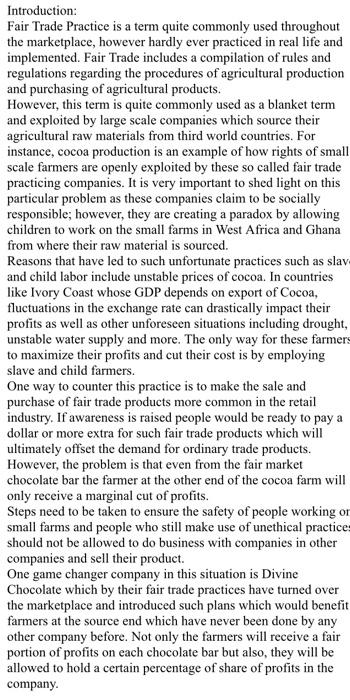
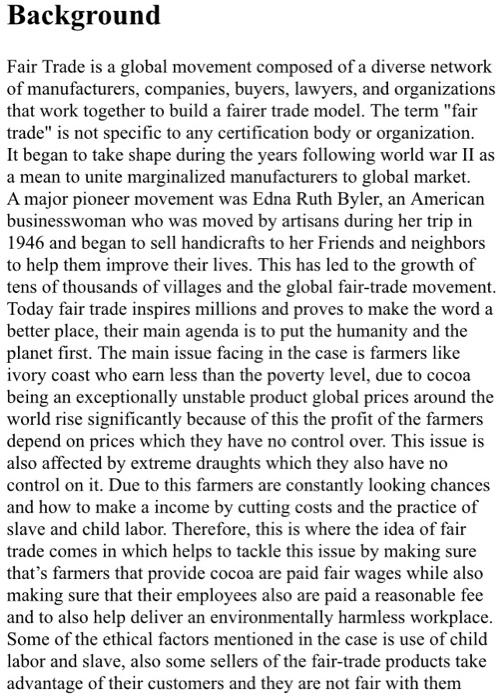
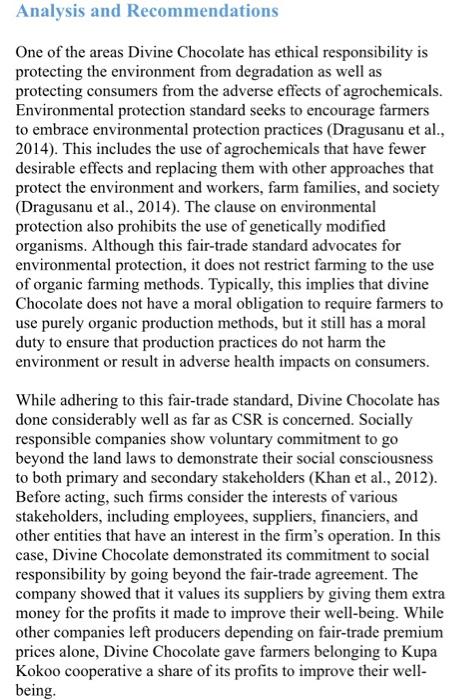
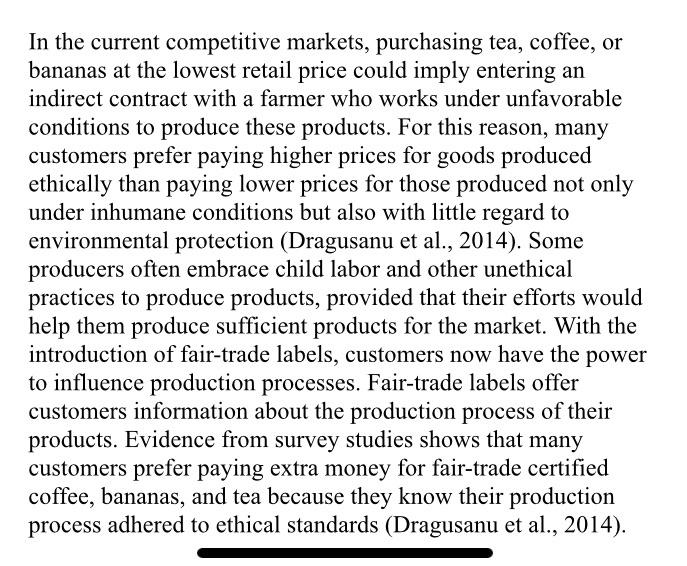
Introduction: Fair Trade Practice is a term quite commonly used throughout the marketplace, however hardly ever practiced in real life and implemented. Fair Trade includes a compilation of rules and regulations regarding the procedures of agricultural production and purchasing of agricultural products. However, this term is quite commonly used as a blanket term and exploited by large scale companies which source their agricultural raw materials from third world countries. For instance, cocoa production is an example of how rights of small scale farmers are openly exploited by these so called fair trade practicing companies. It is very important to shed light on this particular problem as these companies claim to be socially responsible; however, they are creating a paradox by allowing children to work on the small farms in West Africa and Ghana from where their raw material is sourced. Reasons that have led to such unfortunate practices such as slav and child labor include unstable prices of cocoa. In countries like Ivory Coast whose GDP depends on export of Cocoa, fluctuations in the exchange rate can drastically impact their profits as well as other unforeseen situations including drought, unstable water supply and more. The only way for these farmers to maximize their profits and cut their cost is by employing slave and child farmers. One way to counter this practice is to make the sale and purchase of fair trade products more common in the retail industry. If awareness is raised people would be ready to pay a dollar or more extra for such fair trade products which will ultimately offset the demand for ordinary trade products. However, the problem is that even from the fair market chocolate bar the farmer at the other end of the cocoa farm will only receive a marginal cut of profits. Steps need to be taken to ensure the safety of people working or small farms and people who still make use of unethical practice should not be allowed to do business with companies in other companies and sell their product. One game changer company in this situation is Divine Chocolate which by their fair trade practices have turned over the marketplace and introduced such plans which would benefit farmers at the source end which have never been done by any other company before. Not only the farmers will receive a fair portion of profits on each chocolate bar but also, they will be allowed to hold a certain percentage of share of profits in the company. Background Fair Trade is a global movement composed of a diverse network of manufacturers, companies, buyers, lawyers, and organizations that work together to build a fairer trade model. The term "fair trade" is not specific to any certification body or organization. It began to take shape during the years following world war II as a mean to unite marginalized manufacturers to global market. A major pioneer movement was Edna Ruth Byler, an American businesswoman who was moved by artisans during her trip in 1946 and began to sell handicrafts to her Friends and neighbors to help them improve their lives. This has led to the growth of tens of thousands of villages and the global fair-trade movement. Today fair trade inspires millions and proves to make the word a better place, their main agenda is to put the humanity and the planet first. The main issue facing in the case is farmers like ivory coast who earn less than the poverty level, due to cocoa being an exceptionally unstable product global prices around the world rise significantly because of this the profit of the farmers depend on prices which they have no control over. This issue is also affected by extreme draughts which they also have no control on it. Due to this farmers are constantly looking chances and how to make a income by cutting costs and the practice of slave and child labor. Therefore, this is where the idea of fair trade comes in which helps to tackle this issue by making sure that's farmers that provide cocoa are paid fair wages while also making sure that their employees also are paid a reasonable fee and to also help deliver an environmentally harmless workplace. Some of the ethical factors mentioned in the case is use of child labor and slave, also some sellers of the fair-trade products take advantage of their customers and they are not fair with them Analysis and Recommendations One of the areas Divine Chocolate has ethical responsibility is protecting the environment from degradation as well as protecting consumers from the adverse effects of agrochemicals. Environmental protection standard seeks to encourage farmers to embrace environmental protection practices (Dragusanu et al., 2014). This includes the use of agrochemicals that have fewer desirable effects and replacing them with other approaches that protect the environment and workers, farm families, and society (Dragusanu et al., 2014). The clause on environmental protection also prohibits the use of genetically modified organisms. Although this fair-trade standard advocates for environmental protection, it does not restrict farming to the use of organic farming methods. Typically, this implies that divine Chocolate does not have a moral obligation to require farmers to use purely organic production methods, but it still has a moral duty to ensure that production practices do not harm the environment or result in adverse health impacts on consumers. While adhering to this fair-trade standard, Divine Chocolate has done considerably well as far as CSR is concerned. Socially responsible companies show voluntary commitment to go beyond the land laws to demonstrate their social consciousness to both primary and secondary stakeholders (Khan et al., 2012). Before acting, such firms consider the interests of various stakeholders, including employees, suppliers, financiers, and other entities that have an interest in the firm's operation. In this case, Divine Chocolate demonstrated its commitment to social responsibility by going beyond the fair-trade agreement. The company showed that it values its suppliers by giving them extra money for the profits it made to improve their well-being. While other companies left producers depending on fair-trade premium prices alone, Divine Chocolate gave farmers belonging to Kupa Kokoo cooperative a share of its profits to improve their well- being. In the current competitive markets, purchasing tea, coffee, or bananas at the lowest retail price could imply entering an indirect contract with a farmer who works under unfavorable conditions to produce these products. For this reason, many customers prefer paying higher prices for goods produced ethically than paying lower prices for those produced not only under inhumane conditions but also with little regard to environmental protection (Dragusanu et al., 2014). Some producers often embrace child labor and other unethical practices to produce products, provided that their efforts would help them produce sufficient products for the market. With the introduction of fair-trade labels, customers now have the power to influence production processes. Fair-trade labels offer customers information about the production process of their products. Evidence from survey studies shows that many customers prefer paying extra money for fair-trade certified coffee, bananas, and tea because they know their production process adhered to ethical standards (Dragusanu et al., 2014) Step by Step Solution
There are 3 Steps involved in it
1 Expert Approved Answer
Step: 1 Unlock

Question Has Been Solved by an Expert!
Get step-by-step solutions from verified subject matter experts
Step: 2 Unlock
Step: 3 Unlock