







Question: can you write a summary of case study 41.2? Case 41.2 Air Products and Chemicals, Inc. v. Airgas, Inc. Court of Chancery of Delaware, 16
can you write a summary of case study 41.2? 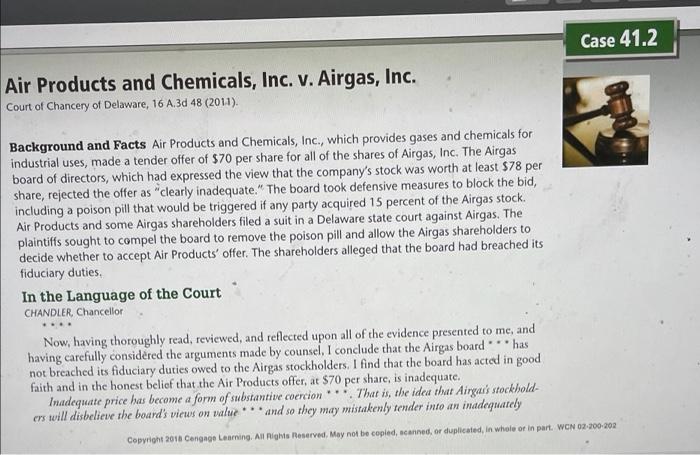
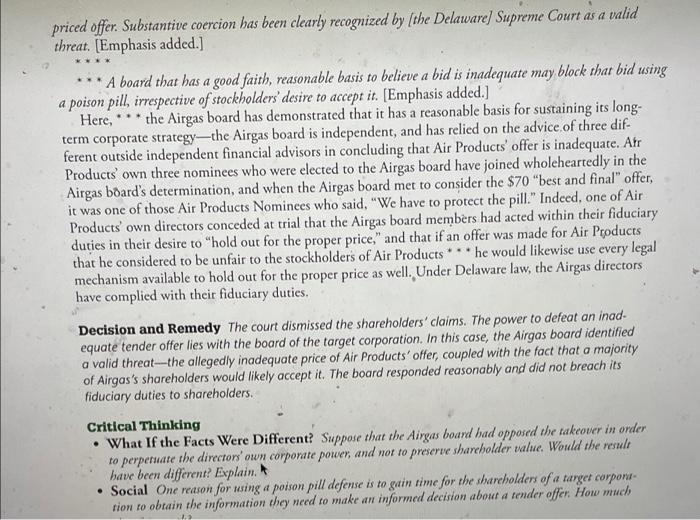
Case 41.2 Air Products and Chemicals, Inc. v. Airgas, Inc. Court of Chancery of Delaware, 16 A.3d 48 (2011). Background and Facts Air Products and Chemicals, Inc., which provides gases and chemicals for industrial uses, made a tender offer of $70 per share for all of the shares of Airgas, Inc. The Airgas board of directors, which had expressed the view that the company's stock was worth at least 578 per share, rejected the offer as "clearly inadequate." The board took defensive measures to block the bid, including a poison pill that would be triggered if any party acquired 15 percent of the Airgas stock. Air Products and some Airgas shareholders filed a suit in a Delaware state court against Airgas. The plaintiffs sought to compel the board to remove the poison pill and allow the Airgas shareholders to decide whether to accept Air Products' offer. The shareholders alleged that the board had breached its fiduciary duties In the Language of the Court CHANDLER Chancellor ... Now, having thoroughly read, reviewed, and reflected upon all of the evidence presented to me, and having carefully considered the arguments made by counsel, I conclude that the Airgas board has not breached its fiduciary duties owed to the Airgas stockholders. I find that the board has acted in good faith and in the honest belief that the Air Products offer, at $70 per share, is inadequate. Inadequate price has become a form of substantive coercion ** That is the idea that Airga's stockhold- ers will disbelieve the board's views on value *** and so they may mistakenly tender into an inadequately Copyright 2018 Cengage Learning. All Rights Reserved. May not be copied, scanned, or duplicated, in whole or in part. WCN 02-200-202 a priced offer. Substantive coercion has been clearly recognized by the Delaware) Supreme Court as a valid threat. [Emphasis added.] A board that has a good faith, reasonable basis to believe a bid is inadequate may block that bid using a poison pill, irrespective of stockholders' desire to accept it. [Emphasis added.] Here, *** the Airgas board has demonstrated that it has a reasonable basis for sustaining its long- term corporate strategythe Airgas board is independent, and has relied on the advice of three dif- ferent outside independent financial advisors in concluding that Air Products offer is inadequate. Afr Products' own three nominees who were elected to the Airgas board have joined wholeheartedly in the Airgas board's determination, and when the Airgas board met to consider the $70 "best and final" offer, it was one of those Air Products Nominees who said, "We have to protect the pill." Indeed, one of Air Products' own directors conceded at trial that the Airgas board members had acted within their fiduciary duties in their desire to "hold out for the proper price," and that if an offer was made for Air Products that he considered to be unfair to the stockholders of Air Products *** he would likewise use every legal mechanism available to hold out for the proper price as well. Under Delaware law, the Airgas directors have complied with their fiduciary duties. Decision and Remedy The court dismissed the shareholders' claims. The power to defeat an inad- equate tender offer lies with the board of the target corporation. In this case, the Airgas board identified a valid threat--the allegedly inadequate price of Air Products' offer, coupled with the fact that a majority of Airgas's shareholders would likely accept it. The board responded reasonably and did not breach its fiduciary duties to shareholders. Critical Thinking What If the Facts Were Different? Suppose that the Airgas board had opposed the takeover in order to perpetuate the directors' own corporate power , and not to preserve shareholder value. Would the result have been different? Explain. Social One reason for using a poison pill defense is to gain time for the shareholders of a target corpore tion to obtain the information they need to make an informed decision about a tender offer. How much 4 Case 41.2 Air Products and Chemicals, Inc. v. Airgas, Inc. Court of Chancery of Delaware, 16 A.3d 48 (2011). Background and Facts Air Products and Chemicals, Inc., which provides gases and chemicals for industrial uses, made a tender offer of $70 per share for all of the shares of Airgas, Inc. The Airgas board of directors, which had expressed the view that the company's stock was worth at least 578 per share, rejected the offer as "clearly inadequate." The board took defensive measures to block the bid, including a poison pill that would be triggered if any party acquired 15 percent of the Airgas stock. Air Products and some Airgas shareholders filed a suit in a Delaware state court against Airgas. The plaintiffs sought to compel the board to remove the poison pill and allow the Airgas shareholders to decide whether to accept Air Products' offer. The shareholders alleged that the board had breached its fiduciary duties In the Language of the Court CHANDLER Chancellor ... Now, having thoroughly read, reviewed, and reflected upon all of the evidence presented to me, and having carefully considered the arguments made by counsel, I conclude that the Airgas board has not breached its fiduciary duties owed to the Airgas stockholders. I find that the board has acted in good faith and in the honest belief that the Air Products offer, at $70 per share, is inadequate. Inadequate price has become a form of substantive coercion ** That is the idea that Airga's stockhold- ers will disbelieve the board's views on value *** and so they may mistakenly tender into an inadequately Copyright 2018 Cengage Learning. All Rights Reserved. May not be copied, scanned, or duplicated, in whole or in part. WCN 02-200-202 a priced offer. Substantive coercion has been clearly recognized by the Delaware) Supreme Court as a valid threat. [Emphasis added.] A board that has a good faith, reasonable basis to believe a bid is inadequate may block that bid using a poison pill, irrespective of stockholders' desire to accept it. [Emphasis added.] Here, *** the Airgas board has demonstrated that it has a reasonable basis for sustaining its long- term corporate strategythe Airgas board is independent, and has relied on the advice of three dif- ferent outside independent financial advisors in concluding that Air Products offer is inadequate. Afr Products' own three nominees who were elected to the Airgas board have joined wholeheartedly in the Airgas board's determination, and when the Airgas board met to consider the $70 "best and final" offer, it was one of those Air Products Nominees who said, "We have to protect the pill." Indeed, one of Air Products' own directors conceded at trial that the Airgas board members had acted within their fiduciary duties in their desire to "hold out for the proper price," and that if an offer was made for Air Products that he considered to be unfair to the stockholders of Air Products *** he would likewise use every legal mechanism available to hold out for the proper price as well. Under Delaware law, the Airgas directors have complied with their fiduciary duties. Decision and Remedy The court dismissed the shareholders' claims. The power to defeat an inad- equate tender offer lies with the board of the target corporation. In this case, the Airgas board identified a valid threat--the allegedly inadequate price of Air Products' offer, coupled with the fact that a majority of Airgas's shareholders would likely accept it. The board responded reasonably and did not breach its fiduciary duties to shareholders. Critical Thinking What If the Facts Were Different? Suppose that the Airgas board had opposed the takeover in order to perpetuate the directors' own corporate power , and not to preserve shareholder value. Would the result have been different? Explain. Social One reason for using a poison pill defense is to gain time for the shareholders of a target corpore tion to obtain the information they need to make an informed decision about a tender offer. How much 4
Step by Step Solution
There are 3 Steps involved in it
1 Expert Approved Answer
Step: 1 Unlock

Question Has Been Solved by an Expert!
Get step-by-step solutions from verified subject matter experts
Step: 2 Unlock
Step: 3 Unlock
 Study Help