







Question: Can you you please write matlab code for the following that i can copy and paste into the program Download Weights.zip from D2L. The linearity
Can you you please write matlab code for the following that i can copy and paste into the program
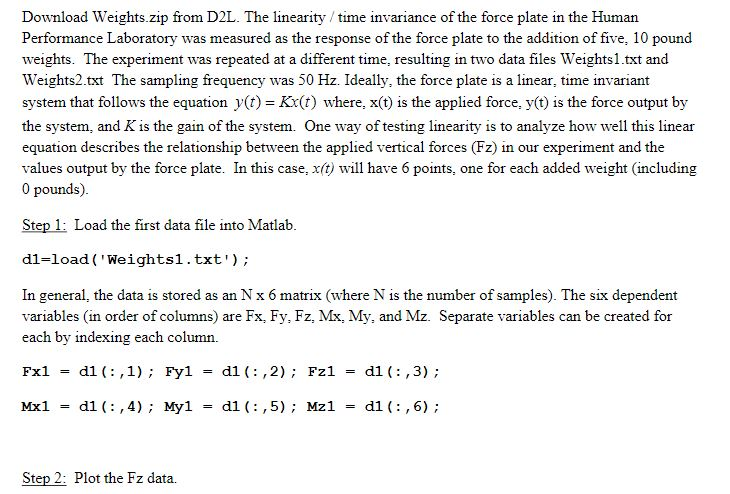
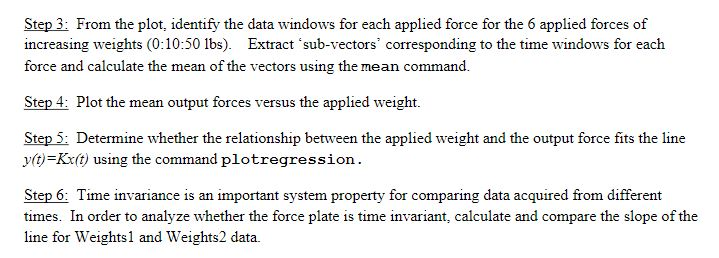
Download Weights.zip from D2L. The linearity time invariance of the force plate in the Human Performance Laboratory was measured as the response of the force plate to the addition of five, 10 pound weights. The experiment was repeated at a different time, resulting in two data files Weightsl.txt and Weights2.txt The sampling frequency was 50 Hz. Ideally, the force plate is a linear, time invariant system that follows the equation y(t)-Kx(t) where, x(t) is the applied force, y(t) is the force output by the system, and K is the gain of the system. One way of testing linearity is to analyze how well this linear equation describes the relationship between the applied vertical forces (Fz) in our experiment and the values output by the force plate. In this case, x(t) will have 6 points, one for each added weight (including 0 pounds) Step 1: Load the first data file into Matlab d1-load ('Weights1.txt'); In general, the data is stored as an N x 6 matrix (where N is the number of samples). The six dependent variables (in order of columns) are Fx, Fy, Fz, Mx, My, and Mz. Separate variables can be created for each by indexing each column. Fx1 = d1 ( : ,1) ; Fyl-d1 ( : ,2) ; F:1=d1 ( : ,3); Step 2: Plot the Fz data. Download Weights.zip from D2L. The linearity time invariance of the force plate in the Human Performance Laboratory was measured as the response of the force plate to the addition of five, 10 pound weights. The experiment was repeated at a different time, resulting in two data files Weightsl.txt and Weights2.txt The sampling frequency was 50 Hz. Ideally, the force plate is a linear, time invariant system that follows the equation y(t)-Kx(t) where, x(t) is the applied force, y(t) is the force output by the system, and K is the gain of the system. One way of testing linearity is to analyze how well this linear equation describes the relationship between the applied vertical forces (Fz) in our experiment and the values output by the force plate. In this case, x(t) will have 6 points, one for each added weight (including 0 pounds) Step 1: Load the first data file into Matlab d1-load ('Weights1.txt'); In general, the data is stored as an N x 6 matrix (where N is the number of samples). The six dependent variables (in order of columns) are Fx, Fy, Fz, Mx, My, and Mz. Separate variables can be created for each by indexing each column. Fx1 = d1 ( : ,1) ; Fyl-d1 ( : ,2) ; F:1=d1 ( : ,3); Step 2: Plot the Fz data
Step by Step Solution
There are 3 Steps involved in it

Get step-by-step solutions from verified subject matter experts
 Study Help