







Question: Canonical utility function. Consider the utility function cl-o uc) (a) where c denotes consumption of some arbitrary good and o (Greek lowercase letter sigma) is
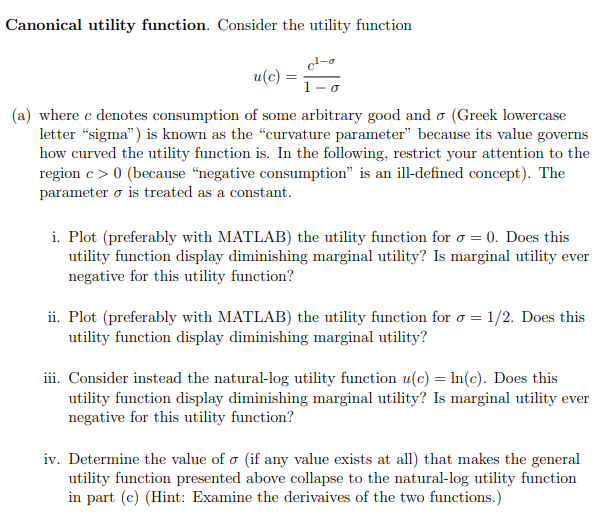
Canonical utility function. Consider the utility function cl-o uc) (a) where c denotes consumption of some arbitrary good and o (Greek lowercase letter "sigma") is known as the "curvature parameter" because its value governs how curved the utility function is. In the following, restrict your attention to the region c> 0 (because negative consumption is an ill-defined concept). The parameter o is treated as a constant. i. Plot (preferably with MATLAB) the utility function for o = 0. Does this utility function display diminishing marginal utility? Is marginal utility ever negative for this utility function? ii. Plot (preferably with MATLAB) the utility function for o = 1/2. Does this utility function display diminishing marginal utility? iii. Consider instead the natural-log utility function u(c) = ln(c). Does this utility function display diminishing marginal utility? Is marginal utility ever negative for this utility function? iv. Determine the value of o (if any value exists at all) that makes the general utility function presented above collapse to the natural-log utility function in part (c) (Hint: Examine the derivaives of the two functions.) Canonical utility function. Consider the utility function cl-o uc) (a) where c denotes consumption of some arbitrary good and o (Greek lowercase letter "sigma") is known as the "curvature parameter" because its value governs how curved the utility function is. In the following, restrict your attention to the region c> 0 (because negative consumption is an ill-defined concept). The parameter o is treated as a constant. i. Plot (preferably with MATLAB) the utility function for o = 0. Does this utility function display diminishing marginal utility? Is marginal utility ever negative for this utility function? ii. Plot (preferably with MATLAB) the utility function for o = 1/2. Does this utility function display diminishing marginal utility? iii. Consider instead the natural-log utility function u(c) = ln(c). Does this utility function display diminishing marginal utility? Is marginal utility ever negative for this utility function? iv. Determine the value of o (if any value exists at all) that makes the general utility function presented above collapse to the natural-log utility function in part (c) (Hint: Examine the derivaives of the two functions.)
Step by Step Solution
There are 3 Steps involved in it

Get step-by-step solutions from verified subject matter experts
 Study Help