



Question: . capability innate, or at least a natural, capacity (Brunner, 1990). By contrast, abstract analysis is not something that we do naturally. It is something
.
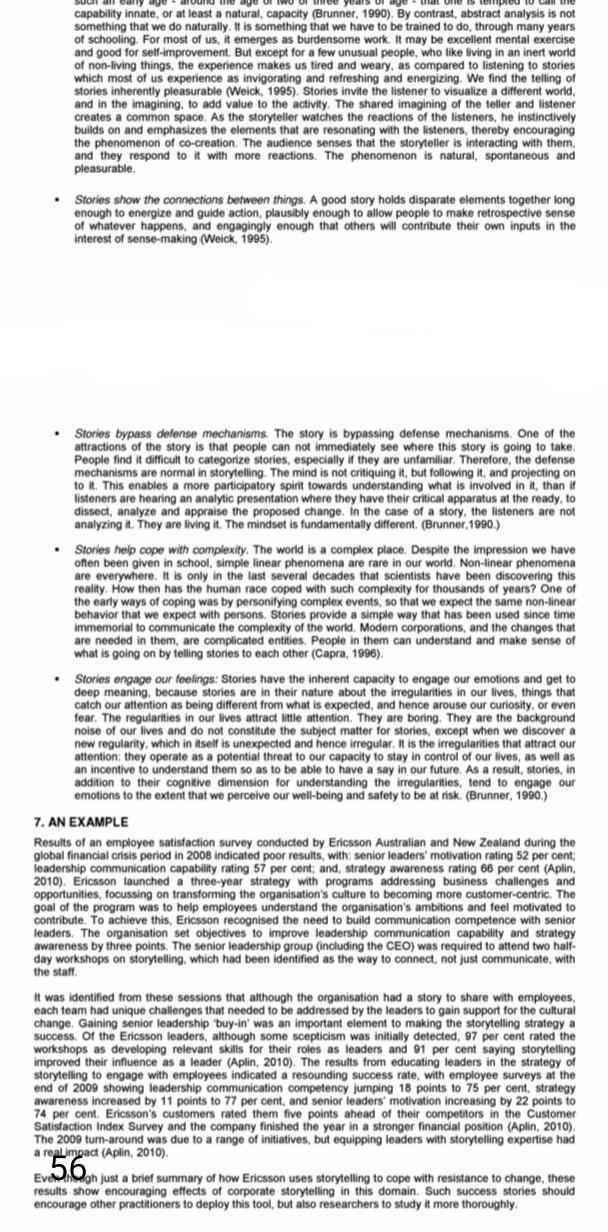
capability innate, or at least a natural, capacity (Brunner, 1990). By contrast, abstract analysis is not something that we do naturally. It is something that we have to be trained to do, through many years of schooling. For most of us, it emerges as burdensome work. It may be excellent mental exercise and good for self-improvement. But except for a few unusual people, who like living in an inert world of non-living things, the experience makes us tired and weary, as compared to listening to stories which most of us experience as invigorating and refreshing and energizing. We find the telling of stories inherently pleasurable (Weick, 1995). Stories invite the listener to visualize a different world, and in the imagining, to add value to the activity. The shared imagining of the teller and listener creates a common space. As the storyteller watches the reactions of the listeners, he instinctively builds on and emphasizes the elements that are resonating with the listeners, thereby encouraging the phenomenon of co-creation. The audience senses that the storyteller is interacting with them, and they respond to it with more reactions. The phenomenon is natural, spontaneous and pleasurable. Stories show the connections between things. A good story holds disparate elements together long enough to energize and guide action, plausibly enough to allow people to make retrospective sense of whatever happens, and engagingly enough that others will contribute their own inputs in the interest of sense-making (Weick, 1995) Stories bypass defense mechanisms. The story is bypassing defense mechanisms. One of the attractions of the story is that people can not immediately see where this story is going to take People find it difficult to categorize stories, especially if they are unfamiliar. Therefore, the defense mechanisms are normal in storytelling. The mind is not critiquing it, but following it, and projecting on to it. This enables a more participatory spirit towards understanding what is involved in it, than if listeners are hearing an analytic presentation where they have their critical apparatus at the ready to dissect, analyze and appraise the proposed change in the case of a story, the listeners are not analyzing it. They are living it. The mindset is fundamentally different. (Brunner, 1990) Stories help cope with complexity. The world is a complex place. Despite the impression we have often been given in school, simple linear phenomena are rare in our world. Non-linear phenomena are everywhere. It is only in the last several decades that scientists have been discovering this reality. How then has the human race coped with such complexity for thousands of years? One of the early ways of coping was by personifying complex events, so that we expect the same non-linear behavior that we expect with persons. Stories provide a simple way that has been used since time immemorial to communicate the complexity of the world. Modern corporations, and the changes that are needed in them, are complicated entities. People in them can understand and make sense of what is going on by telling stories to each other (Capra, 1996). Stories engage our feelings: Stories have the inherent capacity to engage our emotions and get to deep meaning, because stories are in their nature about the irregularities in our lives, things that catch our attention as being different from what is expected, and hence arouse our curiosity, or even fear. The regularities in our lives attract little attention. They are boring. They are the background noise of our lives and do not constitute the subject matter for stories, except when we discover a new regularity, which in itself is unexpected and hence irregular. It is the irregularities that attract our attention: they operate as a potential threat to our capacity to stay in control of our lives, as well as an incentive to understand them so as to be able to have a say in our future. As a result, stories, in addition to their cognitive dimension for understanding the irregularities, tend to engage our emotions to the extent that we perceive our well-being and safety to be at risk. (Brunner, 1990) 7. AN EXAMPLE Results of an employee satisfaction survey conducted by Ericsson Australian and New Zealand during the global financial crisis period in 2008 indicated poor results, with senior leaders' motivation rating 52 per cent leadership communication capability rating 57 per cent and strategy awareness rating 66 per cent (Aplin, 2010). Ericsson launched a three-year strategy with programs addressing business challenges and opportunities, focussing on transforming the organisation's culture to becoming more customer-centric. The goal of the program was to help employees understand the organisation's ambitions and feel motivated to contribute. To achieve this, Ericsson recognised the need to build communication competence with senior leaders. The organisation set objectives to improve leadership communication capability and strategy awareness by three points. The senior leadership group (including the CEO) was required to attend two half- day workshops on storytelling, which had been identified as the way to connect, not just communicate with the staff It was identified from these sessions that although the organisation had a story to share with employees, each team had unique challenges that needed to be addressed by the leaders to gain support for the cultural change. Gaining senior leadership buy-in' was an important element to making the storytelling strategy a success. Of the Ericsson leaders, although some scepticism was initially detected, 97 per cent rated the workshops as developing relevant skills for their roles as leaders and 91 per cent saying storytelling improved their influence as a leader (Aplin, 2010). The results from educating leaders in the strategy of storytelling to engage with employees indicated a resounding success rate, with employee surveys at the end of 2009 showing leadership communication competency jumping 18 points to 75 per cent strategy awareness increased by 11 points to 77 per cent, and senior leaders' motivation increasing by 22 points to 74 per cent. Ericsson's customers rated them five points ahead of their competitors in the Customer Satisfaction Index Survey and the company finished the year in a stronger financial position (Aplin, 2010) The 2009 turn-around was due to a range of initiatives, but equipping leaders with storytelling expertise had a real impact (Aplin, 2010) v5.6gn just a brief summary of how Ericsson uses storytelling to cope with resistance to change these gh results show encouraging effects of corporate storytelling in this domain. Such success stories should encourage other practitioners to deploy this tool, but also researchers to study it more thoroughly. capability innate, or at least a natural, capacity (Brunner, 1990). By contrast, abstract analysis is not something that we do naturally. It is something that we have to be trained to do, through many years of schooling. For most of us, it emerges as burdensome work. It may be excellent mental exercise and good for self-improvement. But except for a few unusual people, who like living in an inert world of non-living things, the experience makes us tired and weary, as compared to listening to stories which most of us experience as invigorating and refreshing and energizing. We find the telling of stories inherently pleasurable (Weick, 1995). Stories invite the listener to visualize a different world, and in the imagining, to add value to the activity. The shared imagining of the teller and listener creates a common space. As the storyteller watches the reactions of the listeners, he instinctively builds on and emphasizes the elements that are resonating with the listeners, thereby encouraging the phenomenon of co-creation. The audience senses that the storyteller is interacting with them, and they respond to it with more reactions. The phenomenon is natural, spontaneous and pleasurable. Stories show the connections between things. A good story holds disparate elements together long enough to energize and guide action, plausibly enough to allow people to make retrospective sense of whatever happens, and engagingly enough that others will contribute their own inputs in the interest of sense-making (Weick, 1995) Stories bypass defense mechanisms. The story is bypassing defense mechanisms. One of the attractions of the story is that people can not immediately see where this story is going to take People find it difficult to categorize stories, especially if they are unfamiliar. Therefore, the defense mechanisms are normal in storytelling. The mind is not critiquing it, but following it, and projecting on to it. This enables a more participatory spirit towards understanding what is involved in it, than if listeners are hearing an analytic presentation where they have their critical apparatus at the ready to dissect, analyze and appraise the proposed change in the case of a story, the listeners are not analyzing it. They are living it. The mindset is fundamentally different. (Brunner, 1990) Stories help cope with complexity. The world is a complex place. Despite the impression we have often been given in school, simple linear phenomena are rare in our world. Non-linear phenomena are everywhere. It is only in the last several decades that scientists have been discovering this reality. How then has the human race coped with such complexity for thousands of years? One of the early ways of coping was by personifying complex events, so that we expect the same non-linear behavior that we expect with persons. Stories provide a simple way that has been used since time immemorial to communicate the complexity of the world. Modern corporations, and the changes that are needed in them, are complicated entities. People in them can understand and make sense of what is going on by telling stories to each other (Capra, 1996). Stories engage our feelings: Stories have the inherent capacity to engage our emotions and get to deep meaning, because stories are in their nature about the irregularities in our lives, things that catch our attention as being different from what is expected, and hence arouse our curiosity, or even fear. The regularities in our lives attract little attention. They are boring. They are the background noise of our lives and do not constitute the subject matter for stories, except when we discover a new regularity, which in itself is unexpected and hence irregular. It is the irregularities that attract our attention: they operate as a potential threat to our capacity to stay in control of our lives, as well as an incentive to understand them so as to be able to have a say in our future. As a result, stories, in addition to their cognitive dimension for understanding the irregularities, tend to engage our emotions to the extent that we perceive our well-being and safety to be at risk. (Brunner, 1990) 7. AN EXAMPLE Results of an employee satisfaction survey conducted by Ericsson Australian and New Zealand during the global financial crisis period in 2008 indicated poor results, with senior leaders' motivation rating 52 per cent leadership communication capability rating 57 per cent and strategy awareness rating 66 per cent (Aplin, 2010). Ericsson launched a three-year strategy with programs addressing business challenges and opportunities, focussing on transforming the organisation's culture to becoming more customer-centric. The goal of the program was to help employees understand the organisation's ambitions and feel motivated to contribute. To achieve this, Ericsson recognised the need to build communication competence with senior leaders. The organisation set objectives to improve leadership communication capability and strategy awareness by three points. The senior leadership group (including the CEO) was required to attend two half- day workshops on storytelling, which had been identified as the way to connect, not just communicate with the staff It was identified from these sessions that although the organisation had a story to share with employees, each team had unique challenges that needed to be addressed by the leaders to gain support for the cultural change. Gaining senior leadership buy-in' was an important element to making the storytelling strategy a success. Of the Ericsson leaders, although some scepticism was initially detected, 97 per cent rated the workshops as developing relevant skills for their roles as leaders and 91 per cent saying storytelling improved their influence as a leader (Aplin, 2010). The results from educating leaders in the strategy of storytelling to engage with employees indicated a resounding success rate, with employee surveys at the end of 2009 showing leadership communication competency jumping 18 points to 75 per cent strategy awareness increased by 11 points to 77 per cent, and senior leaders' motivation increasing by 22 points to 74 per cent. Ericsson's customers rated them five points ahead of their competitors in the Customer Satisfaction Index Survey and the company finished the year in a stronger financial position (Aplin, 2010) The 2009 turn-around was due to a range of initiatives, but equipping leaders with storytelling expertise had a real impact (Aplin, 2010) v5.6gn just a brief summary of how Ericsson uses storytelling to cope with resistance to change these gh results show encouraging effects of corporate storytelling in this domain. Such success stories should encourage other practitioners to deploy this tool, but also researchers to study it more thoroughlyStep by Step Solution
There are 3 Steps involved in it
1 Expert Approved Answer
Step: 1 Unlock

Question Has Been Solved by an Expert!
Get step-by-step solutions from verified subject matter experts
Step: 2 Unlock
Step: 3 Unlock