







Question: Capital Budgeting Solve the following problems. Create appropriate formulas using the supplied values in the corresponding cells so Excel can calculate the answer. Example problems
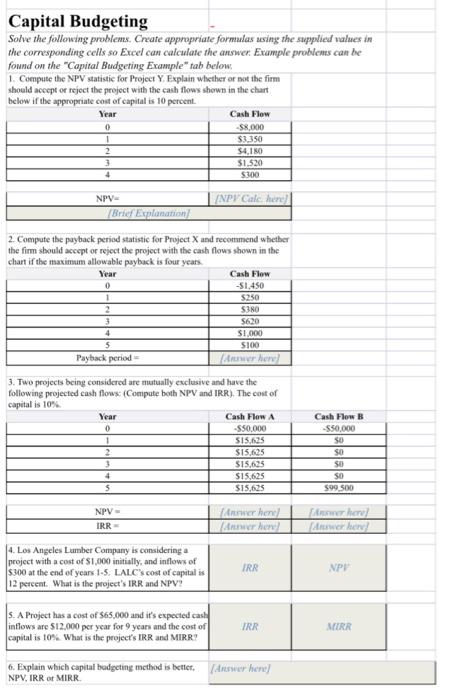
Capital Budgeting Solve the following problems. Create appropriate formulas using the supplied values in the corresponding cells so Excel can calculate the answer. Example problems can be found on the "Capital Budgeting Example* tab below 1. Compute the NPV statistic for Project Y. Explain whether or not the firm should accept or reject the project with the cash flows shown in the chart below if the appropriate cost of capital is 10 percent Year Cash Flow -$8.000 $3.350 $4,10 $1.520 0 1 2 3 4 $300 ANDY Cal here) NPV- Brief Explanation 2. Compute the payback period statistic for Project X and recommend whether the firm should accept or reject the project with the cash flows shown in the chart if the maximum allowable payback is four years Year Cash Flow 0 -51.450 1 $2.50 5380 3 $620 $1.000 5 S100 Payback period There 2 4 3. Two projects being considered are mutually exclusive and have the following projected cash flows (Compute both NPV and IRR). The cost of capital is 10% Year Cash Flow A 0 -S50,000 1 SI5.25 2 $15.625 3 $15.625 $15,625 5 S15,625 Cash Flow B $50,000 SO SO SO SO 599 500 4 NPV Anwer home Anne here recher IRR 4. Los Angeles Lumber Company is considering a project with a cost of $1.000 initially, and inflows of $300 at the end of years 1-5. LALC's cost of capital is 12 percent. What is the project's IRR and NPV? TRR NPV S. A Project has a cost of $65.000 and it's expected cash inflows are $12.000 per year for years and the cost of capital is 10%. What is the project's IRR and MIRR? IRR MIRR 6. Explain which capital budgeting method is better NPV, IRR or MIRR Answer here
Step by Step Solution
There are 3 Steps involved in it

Get step-by-step solutions from verified subject matter experts
 Study Help