



Question: Capital mandates In this section, we discuss the mandates that we will use to compute the total investment cost (TIC), or I for short. Recall
Capital mandates
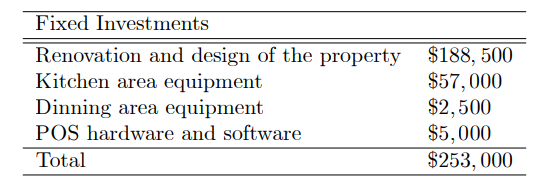
In this section, we discuss the mandates that we will use to compute the total investment cost (TIC), or I for short. Recall that TIC or= I = F C + NWC; where FC is fixed capital, which is the sum of xed investments and pre-production capital costs, and NW C is the net working capital. 2 Fixed Capital consists of xed investments and pre-production capital costs. The xed investments in our project consist of 4 categories: renovation and design of the property, kitchen area equipment, dinning are equipment and a retail point of sale (POS) system. The renovation and design of the property cost a minimum of CAD$85 per square foot and a maximum of CAD$250 per square foot (Build it, 2017). The geometric mean is $CAD145 per square foot approximately; that is, p 85 250 $145: Total renovation and design of the property is, therefore, $145 per square foot 1300 feet = $188; 500: The projections of all other items in xed investments are explained in Appendix A. Below is a summary of the xed investments costs
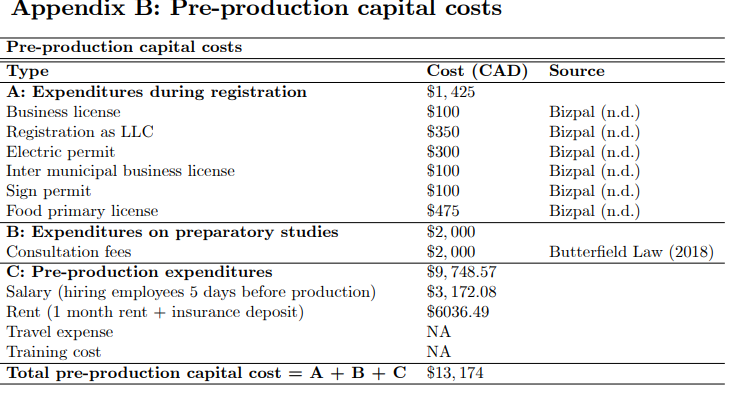
Pre-production capital costs include expenditures during registration and formation, expenditure for preparatory studies, and pre-production expenditures. For opening a small burger restaurant in BC, we need several licences and registration fees, e.g., Limited Liability Company (LLC) registration, electric permit, municipal business licence, and other pre-production expenses. The total of all these expenditures is CAD$13; 174 (see Appendix B).
As for the estimation of the net working capital, we entertain the following assumptions. In the retail business, the main payment methods are cash, debit and credit cards. According to a recent report issued by the Bank of Canada (Henry et al., 2018), approximately 67% of the total value of transactions are paid by credit card in BC. We will use this estimate to project the percentage of total revenue in eq. (7) that is paid by credit cards. This value is to be taken as the annual cost of operations in the net working capital calculations. Credit card payment creates accounts receivables, which cover the gap between selling products and receiving funds from the bank. The coverage period for credit card payments varies between two or three business days. In this project, we will assume 3 days as the coverage period for account receivables. We will entertain the assumption that the fast-food industry follows the make-to-order production strategy. This implies that companies in this industry do not hold inventory and, therefore, no capital is needed to nance inventory of nal products. As for the inventory of raw materials, because most of the food items are perishable goods, we will use a 1 week coverage period for the inventory of raw materials. The annual cost of raw materials is assumed to be 30% of total revenue. Finally, we assume 1 month coverage period for accounts payable.
Questions:

Fixed Investments Renovation and design of the property $188, 500 Kitchen area equipment $57,000 Dinning area equipment $2,500 POS hardware and software $5,000 Total $253,000 Appendix B: Pre-production capital costs Pre-production capital costs Type Cost (CAD) Source A: Expenditures during registration $1, 425 Business license $100 Bizpal (n.d.) Registration as LLC $350 Bizpal (n.d.) Electric permit $300 Bizpal (n.d.) Inter municipal business license $100 Bizpal (n.d.) Sign permit $100 Bizpal (n.d.) Food primary license $475 Bizpal (n.d.) B: Expenditures on preparatory studies $2,000 Consultation fees $2,000 Butterfield Law (2018) C: Pre-production expenditures $9, 748.57 Salary (hiring employees 5 days before production) $3, 172.08 Rent (1 month rent + insurance deposit) $6036.49 Travel expense NA Training cost NA Total pre-production capital cost = A + B + C $13, 174 [3] Use the capital mandates to compute the coverage period, turnover coefficient, and the working capital needed for accounts receivables, inventory of final products, inventory of raw material, and accounts payable. Report your calculations in a table, then compute the new working capital required. [1] Use your finding in part 3 and the capital mandates to compute the total investment cost (TIC) or I. Fixed Investments Renovation and design of the property $188, 500 Kitchen area equipment $57,000 Dinning area equipment $2,500 POS hardware and software $5,000 Total $253,000 Appendix B: Pre-production capital costs Pre-production capital costs Type Cost (CAD) Source A: Expenditures during registration $1, 425 Business license $100 Bizpal (n.d.) Registration as LLC $350 Bizpal (n.d.) Electric permit $300 Bizpal (n.d.) Inter municipal business license $100 Bizpal (n.d.) Sign permit $100 Bizpal (n.d.) Food primary license $475 Bizpal (n.d.) B: Expenditures on preparatory studies $2,000 Consultation fees $2,000 Butterfield Law (2018) C: Pre-production expenditures $9, 748.57 Salary (hiring employees 5 days before production) $3, 172.08 Rent (1 month rent + insurance deposit) $6036.49 Travel expense NA Training cost NA Total pre-production capital cost = A + B + C $13, 174 [3] Use the capital mandates to compute the coverage period, turnover coefficient, and the working capital needed for accounts receivables, inventory of final products, inventory of raw material, and accounts payable. Report your calculations in a table, then compute the new working capital required. [1] Use your finding in part 3 and the capital mandates to compute the total investment cost (TIC) or
Step by Step Solution
There are 3 Steps involved in it

Get step-by-step solutions from verified subject matter experts