







Question: Carefully read the P&G short case article and answer the following questions based on your learning and observation. Make sure to provide at least one
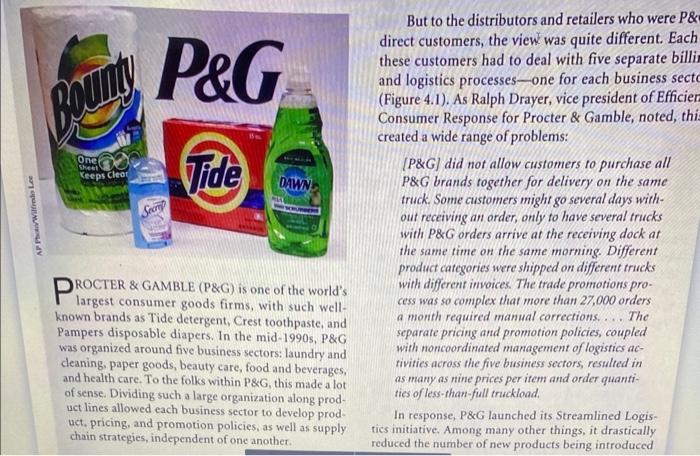
But to the distributors and retailers who were P \& direct customers, the view was quite different. Each these customers had to deal with five separate billi and logistics processes -one for each business sect (Figure 4.1). As Ralph Drayer, vice president of Efficie Consumer Response for Procter \& Gamble, noted, th created a wide range of problems: [P&G] did not allow customers to purchase all P&G brands together for delivery on the same truck. Some customers might go several days without receiving an order, only to have several trucks with P&G orders arrive at the receiving dock at the same time on the same morning. Different product categories were shipped on different trucks with different invoices. The trade promotions prolargest consumer goods firms, with such well- Cess was so complex that more than 27,000 orders known brands as Tide detergent, Crest toothpaste, and a month required manual corrections.... The Pampers disposable diapers. In the mid-1990s, P\&G separate pricing and promotion policies, coupled was organized around five business sectors: laundry and with noncoordinated management of logistics ac deaning, paper goods, beauty care, food and beverages, tivities across the five business sectors, resulted in and health care. To the folks within P\&G, this made a lot as many as nine prices per item and order quantiof sense. Dividing such a large organization along prod-_ ties of less-than-full trickload. uct lines allowed each business sector to develop prod- In response, P\&G launched its Streamlined Logisuct, pricing, and promotion policies, as well as supply tics initiative. Among many other things, it drastically chain strategies, independent of one another. reduced the number of new products being introduced
Step by Step Solution
There are 3 Steps involved in it

Get step-by-step solutions from verified subject matter experts
 Study Help