Question: Carolina Pad and the Bloggers A few weeks before the start of the September 2009 Type-A Mom Conference in Asheville, North Carolina, April Whitlock received
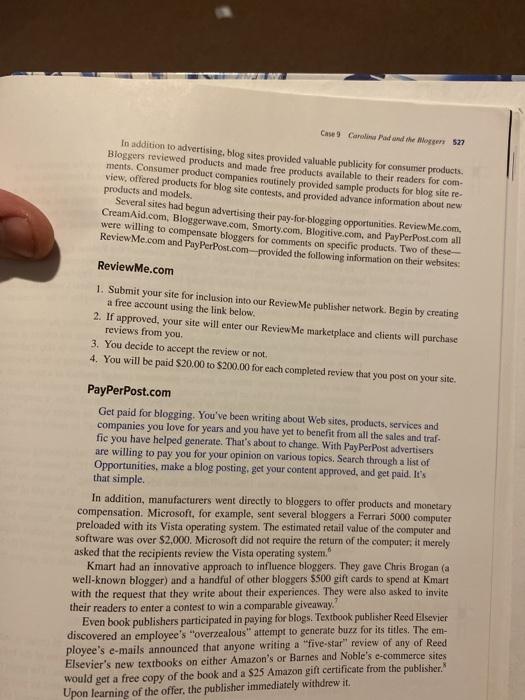
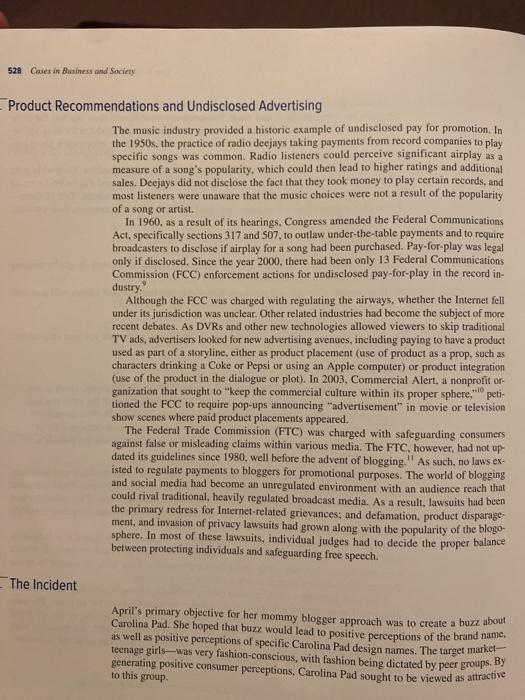
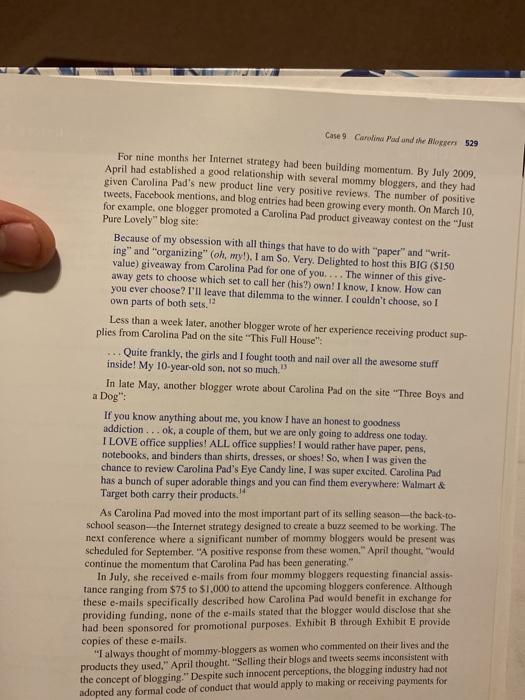
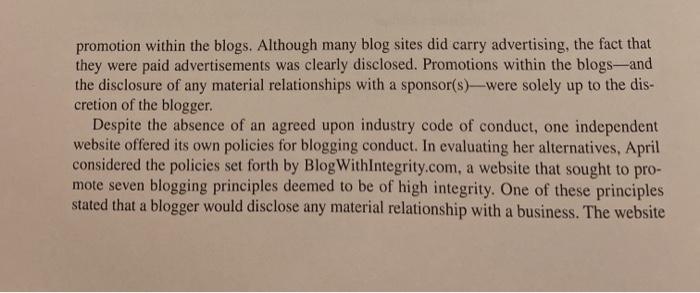
Carolina Pad and the Bloggers A few weeks before the start of the September 2009 Type-A Mom Conference in Asheville, North Carolina, April Whitlock received yet another pay-for-blog request. Whitlock had only been with Carolina Pad, a maker and distributor of school supplies, for nine months. As the company's first director of brand management, she had been hired for her knowledge of social media and innovative uses of the Internet. A major part of her Internet strategy was the creative use of blogs and bloggers, especially mommy bloggers. Mommy bloggers were typically stay-at-home mothers who wrote about their lives and the products they used. Providing these individuals with products to review or occasionally to give away in contests on their blogs seemed like a reasonable way to release information to the public about new Carolina Pad designs and products. Mommy bloggers had tradition- ally disclosed on their blogs when they had received free samples for review. Their reviews then ranged from very positive to very negative. With Carolina Pad's limited promotional budget (no money was budgeted for tradi- tional media), Whitlock believed that blogs offered a tool for increasing exposure for Carolina Pad's product designs at a relatively low cost compared to advertising in tra- ditional media. Carolina Pad was able to provide product samples to select bloggers for a few hundred dollars while the expenditure for many advertising options was cost prohibitive. April received several requests from mommy bloggers for financial support to cover their travel expenses to attend the Type-A Mom Conference. These requests also contained specific commitments to promote Carolina Pad's products at the conference and to write blogs about Carolina Pad products. "What are the ethies of fulfilling such requests?" April wondered. She wondered if she should request additional funding to pay the bloggers or if she should refuse the requests. She believed bloggers' writings about Carolina Pad's prod- ucts were effective, and she felt certain that competitors had received similar requests. Carolina Pad In 1945. Joseph Joe) K. Hall Jr. and several business associates managed to scrape up enough money and equipment to start a school supply manufacturing company in Charlotte, North Carolina. Joe, a former teacher, principal, and coach, owned and operated Hall & Morris 524 Cases in Business and Society a school supply wholesale business in nearby Belmont, North Carolina. Hall & Morris transformed into a new company, Carolina Pad, that both manufactured and distributed school supplies. As a manufacturer, Carolina Pad offered composition books, notebook paper, primary tablets, pencils, crayons, and other school supplies. To gain an edge over larger, more es- tablished counterparts, Joe sold products directly to schools in the Carolinas and Virginia-often out of the back of his truck, When Clay Presley joined Carolina Pad as president in 2000, he quickly realized that business as usual was not an option. In the 1980s and 1990s. Carolina Pad, like many other paper product manufacturers, faced the twin challenges of declining profit margins and stiff competition from overseas. During Presley's first back-to-school season, sales had been very disappointing, revenues had declined, and margins had shrunk. In a pivotal staff meeting. Presley asked everyone. "What would the company look like if it started today The team decided it needed to move toward designing fashionable products and away from manufacturing traditional pads of paper. They decided to target high school-age girls. For the next back-to-school season, Carolina Pad added a plaid designer notebook to its tradi- tional lineup. Retailers loved it. That season the new designs became the top seller at Wal-Mart Stores, Inc. In 2003. Carolina Pad began outsourcing its manufacturing to locations in other countries at significantly lower costs. The resulting savings allowed Carolina Pad to invest more money in creative designs, branding, and marketing. That same year, Carolina Pad hired designer Jacqueline McFee to lead its creative design efforts. With a focus on the latest fads, the company developed new lines of stationery that included popular text messaging phrases to publicize environmentally friendly messages. A buyer at Family Dollar Stores, Inc., said Carolina Pad's designs had become a peren- nial bestseller. "Carolina Pad and Paper is the fashion and trend leader for this cate- gory." the buyer noted.' Carolina Pad was widely credited with making fashion and design a key ingredient in the industry by creating a series of designs for its notebooks and binders intended to ap- peal to teenage girls. The company displayed the design name on the front of each note- book or binder and the Carolina Pad name on the back and/or the inside cover. (Sec Exhibit A for a description of the 2009 fashions and designs found on Carolina Pad's notebooks and pads.) Company sales grew from $30 million in 2000 to $104 million in 2008. By 2009. Carolina Pad products were sold in retail stores across North America and in parts of Europe and Asia. April Whitlock A Duke University graduate, April Whitlock was a marketing veteran with a variety of experiences. Prior to accepting a position with Carolina Pad, April had been responsible for developing the national brand and marketing strategy for Mom Corps, a company that recruited talented moms who had outstanding professional experience (especially lawyers, CPAS, MBAs, etc.) and had opted to stay at home as their children's primary caregiver. Mom Corps worked with companies to identify flexible contract or part-time opportuna- ties for these women. Prior to Mom Corps. April had spent seven and a half years with Lending Tree, where she had led key business-to-business marketing efforts. In her new role with Carolina Pad, April worked directly with its marketing, sales, and creative teams to shape the brand identities for all products. In her thirties, April belonged to the first generation to be considered Internet natives rather than immigrants. As a member of the Public Relations Society of America (PRSA). she understood the power of Internet-based publicity. Websites such as Facebook and Twitter" were reporting huge numbers of users. Facebook recently had reported over 400 million active users (users who had returned to the site within the last 30 days). In ad- dition, online product reviews posted by online product evaluators and users on sites such as Epinions, cnet, consumer search, and Amazon were playing a more important role in the information search and decision process of consumers. Knowing that Carolina Pad's target market, teen girls, were heavy users of Internet social media, an Internet-based promo- tional strategy seemed a natural choice. Within weeks of April's arrival, Carolina Pad had a presence on several major social media sites, including Facebook and YouTube. In addition, Carolina Pad became actively discussed on several blog sites such as Auntie Thesis, Eighty MPH Mom, A Bookish Mom. and Classy Mom Blog. April had been key in the development of product packages for 525 526 Cases in Business and Society bloggers to review, and several blog sites had sponsored contests where the prizes were Carolina Pad products that April bad supplied. History of Blogging Modern blogging began in the mid-1990s as nothing more than individuals keeping online diaries of their personal lives. The term "blog" is a contraction of "web logor "weblog." In the late 1990s, a number of online tools paved the way for modern blog sites. By 2001, blogging had become popular enough that researchers began identifying the differences between blogging and journalism. Bloggers began reporting on current events. Unfettered by traditional journalists' needs for multiple sources and accuracy. bloggers were free to address topics and events more quickly than the mainstream media could. A classic example occurred in 2002 when bloggers first broke the story of Senator Trent Lott honoring Senator Strom Thurmond by suggesting that the United States would have been better off if Thurmond had been elected president in 1948. The history of Thurmond's racial views created a flurry of comments, which eventually forced Lott to resign as majority leader. Recognizing the effect of blogs on public opinion, by 2004 many politicians, pundits, and opinion leaders were active bloggers. More recently, tweets (micro blogs in the form of text-based posts of up to 140 characters) from Iran were the first to break the story that the election of Mahmoud Ahmadinejad might have been rigged. By 2008, the United States had an estimated 26.4 million blog sites accessed by 77.7 million unique visitors, and 77 percent of Internet users were reading blogs." Blogging and Business This new word-of-mouth (WOM) method to share one's personal life and opinions caught the attention of marketers. Businesses increasingly embraced social media as many blog- gers began reaching large audiences. Blog sites sold advertisements at rates that were often more attractive than traditional print media. Forbes magazine provided an example rate comparison in 2007 And while blog networks are quickly gaining scale, even their most coveted offer- ings are cost-competitive. To make a back-of-the-napkin comparison based on rate cards: A start-up looking to get attention will grab a third-of-a-page color ad in a magazine with a rate base of 600,000 and might pay $27,300; or it can pay $21,000 for 600,000 impressions for its ads on TechCrunch-a site covering start-ups repre- sented by Battelle's Federated Media-assuming they take the priciest ad slot on one of tech's hottest sites. Case Carolina Padand the Blogger 527 In addition to advertising, blog sites provided valuable publicity for consumer products. Bloggers reviewed products and made free products available to their readers for com- ments. Consumer product companies routinely provided sample products for blog site re- view. offered products for blog site contests, and provided advance information about new products and models. Several sites had begun advertising their pay-for-blogging opportunities. ReviewMe.com CreamAid.com, Bloggerwave.com, Smorty.com, Blogitive.com, and PayPerPost.com all were willing to compensate bloggers for comments on specific products. Two of these- ReviewMe.com and PayPer Post.com provided the following information on their websites ReviewMe.com 1. Submit your site for inclusion into our Review Me publisher network. Begin by creating a free account using the link below. 2. If approved, your site will enter our Review Me marketplace and clients will purchase reviews from you. 3. You decide to accept the review or not 4. You will be paid $20.00 to $200.00 for each completed review that you post on your site. PayPerPost.com Get paid for blogging. You've been writing about Web sites, products, services and companies you love for years and you have yet to benefit from all the sales and traf- fic you have helped generate. That's about to change. With Pay Per Post advertisers are willing to pay you for your opinion on various topics. Search through a list of Opportunities, make a blog posting, get your content approved, and get paid. It's that simple. In addition, manufacturers went directly to bloggers to offer products and monetary compensation. Microsoft, for example, sent several bloggers a Ferrari 5000 computer preloaded with its Vista operating system. The estimated retail value of the computer and software was over $2,000, Microsoft did not require the return of the computer, it merely asked that the recipients review the Vista operating system. Kmart had an innovative approach to influence bloggers. They gave Chris Brogan (a well-known blogger) and a handful of other bloggers $500 gift cards to spend at Kmart with the request that they write about their experiences. They were also asked to invite their readers to enter a contest to win a comparable giveaway. Even book publishers participated in paying for blogs. Textbook publisher Reed Elsevier discovered an employee's "overzealous" attempt to generate buzz for its titles. The em- ployee's e-mails announced that anyone writing a "five-star" review of any of Reed Elsevier's new textbooks on either Amazon's or Barnes and Noble's e-commerce sites would get a free copy of the book and a $25 Amazon gift certificate from the publisher." Upon learning of the offer, the publisher immediately withdrew it. 528 Cases in Business and Society Product Recommendations and Undisclosed Advertising The music industry provided a historic example of undisclosed pay for promotion. In the 1950s, the practice of radio deejays taking payments from record companies to play specific songs was common. Radio listeners could perceive significant airplay as a measure of a song's popularity, which could then lead to higher ratings and additional sales, Deejays did not disclose the fact that they took money to play certain records, and most listeners were unaware that the music choices were not a result of the popularity of a song or artist. In 1960, as a result of its hearings, Congress amended the Federal Communications Act, specifically sections 317 and 507, to outlaw under-the-table payments and to require broadcasters to disclose if airplay for a song had been purchased. Pay-for-play was legal only if disclosed. Since the year 2000, there had been only 13 Federal Communications Commission (FCC) enforcement actions for undisclosed pay-for-play in the record in- dustry Although the FCC was charged with regulating the airways, whether the Internet fell under its jurisdiction was unclear. Other related industries had become the subject of more recent debates. As DVRs and other new technologies allowed viewers to skip traditional TV ads, advertisers looked for new advertising avenues, including paying to have a product used as part of a storyline, either as product placement (use of product as a prop, such as characters drinking a Coke or Pepsi or using an Apple computer) or product integration (use of the product in the dialogue or plot). In 2003, Commercial Alert, a nonprofit or ganization that sought to "keep the commercial culture within its proper sphere, * peti- tioned the FCC to require pop-ups announcing "advertisement" in movie or television show scenes where paid product placements appeared. The Federal Trade Commission (FTC) was charged with safeguarding consumers against false or misleading claims within various media. The FTC, however, had not up dated its guidelines since 1980, well before the advent of blogging." As such, no laws ex- isted to regulate payments to bloggers for promotional purposes. The world of blogging and social media had become an unregulated environment with an audience reach that could rival traditional, heavily regulated broadcast media. As a result, lawsuits had been the primary redress for Internet-related grievances, and defamation, product disparage- ment, and invasion of privacy lawsuits had grown along with the popularity of the blogo- sphere. In most of these lawsuits, individual judges had to decide the proper balance between protecting individuals and safeguarding free speech. The Incident April's primary objective for her mommy blogger approach was to create a buzz about Carolina Pad. She hoped that buzz would lead to positive perceptions of the brand name as well as positive perceptions of specific Carolina Pad design names. The target market teenage girls was very fashion-conscious, with fashion being dictated by peer groups. By generating positive consumer perceptions. Carolina Pad sought to be viewed as attractive to this group Case 9 Carolina Padand the Bloggers 529 13 For nine months her Internet strategy had been building momentum. By July 2009. April had established a good relationship with several mommy bloggers, and they had given Carolina Pad's new product line very positive reviews. The number of positive tweets, Facebook mentions, and blog entries had been growing every month. On March 10, for example, one blogger promoted a Carolina Pad product giveaway contest on the "Just Pure Lovely" blog site: Because of my obsession with all things that have to do with "paper" and "writ- ing" and "organizing" Coh, my!). I am So. Very. Delighted to host this BIG ($150 value) giveaway from Carolina Pad for one of you. ... The winner of this give- away gets to choose which set to call her (his?) own! I know, I know. How can you ever choose? I'll leave that dilemma to the winner. I couldn't choose, so I own parts of both sets. Less than a week later, another blogger wrote of her experience receiving product sup- plies from Carolina Pad on the site "This Full House": Quite frankly, the girls and I fought tooth and nail over all the awesome stuff inside! My 10-year-old son, not so much." In late May, another blogger wrote about Carolina Pad on the site "Three Boys and a Dog": If you know anything about me, you know I have an honest to goodness addiction... ok, a couple of them, but we are only going to address one today. I LOVE office supplies! ALL office supplies! I would rather have paper, pens, notebooks, and binders than shirts, dresses, or shoes! So, when I was given the chance to review Carolina Pad's Eye Candy line, I was super excited. Carolina Pad has a bunch of super adorable things and you can find them everywhere: Walmart & 14 Target both carry their products. As Carolina Pad moved into the most important part of its selling season the back-to- school season-the Internet strategy designed to create a buzz seemed to be working. The next conference where a significant number of mommy bloggers would be present was scheduled for September. "A positive response from these women." April thought would continue the momentum that Carolina Pad has been generating," In July, she received e-mails from four mommy bloggers requesting financial assis. tance ranging from $75 to $1,000 to attend the upcoming bloggers conference. Although these e-mails specifically described how Carolina Pad would benefit in exchange for providing funding, none of the e-mails stated that the blogger would disclose that she had been sponsored for promotional purposes. Exhibit B through Exhibit E provide copies of these e-mails. "I always thought of mommy-bloggers as women who commented on their lives and the products they used." April thought. "Selling their blogs and tweets seems inconsistent with the concept of blogging." Despite such innocent perceptions, the blogging industry had not adopted any formal code of conduct that would apply to making or receiving payments for promotion within the blogs. Although many blog sites did carry advertising, the fact that they were paid advertisements was clearly disclosed. Promotions within the blogs-and the disclosure of any material relationships with a sponsor(s)- were solely up to the dis- cretion of the blogger. Despite the absence of an agreed upon industry code of conduct, one independent website offered its own policies for blogging conduct. In evaluating her alternatives, April considered the policies set forth by Blog With Integrity.com, a website that sought to pro- mote seven blogging principles deemed to be of high integrity. One of these principles stated that a blogger would disclose any material relationship with a business. The website had created a "Blog with Integrity" badge that it offered for websites of bloggers who agreed with its principles." (The seven principles and a copy of the badge are presented in Exhibit F.) April had only seen this badge displayed on a few mommy blogger websites. Of the nine websites specifically represented within the four blogger requests she had re- ceived, none of them displayed this badge. Although none of these requests was for more than $1,000, April felt that the amount was not really the issue. April firmly believed the promotional considerations these blog- gers were offering could provide a significantly higher rate of return for Carolina Pad than the company could receive from other, more traditional forms of promotion, such as adver- tising. In addition, she realized that her competitors were likely receiving similar requests from these or other bloggers, and many of them were probably benefiting already from paying such requests. April did not think that the fact that others would make such pay- ments made it inherently acceptable for her to do so. April spoke to Carolina Pad's vice president of marketing who agreed with her on this point, even though no one at Carolina Pad had previously faced this decision. April was torn as she thought about her decision. The bloggers had not promised fa- vorable reviews, just reviews. So wasn't she just putting forth advertising dollars to get her product visible? And yet, she worried there was something dishonest about this: wasn't it implicit that the reviews would be favorable? Was this ethical? Was it like pay- ing radio disc jockeys to play your records? Would the payments be in violation of Caro- lina Pad's Mission and Values Statement (see Exhibit G)? And if she declined the bloggers' requests while questioning their ethical standards, would her relationship with any of the bloggers become strained? Whatever she decided to do, she needed to make a decision soon, as the conference was in September 1. What is April Whitlock's dilemma? In your answer, include the relevant facts that Whitlock must consider and the assumptions she has made. 2. What alternative actions could Whitlock take? That is, what are her options? 3. For each of these options, identify which stakeholders would be affected, and how they would be affected. 4. Apply the four methods of ethical reasoning-utilitarianism, rights, justice, and virtueto this situation. What would each of these methods suggest Whitlock should do? 5. What do you think Whitlock should do, and why









 Study Help