Question: Case 1-9 Cleveland Custom Cabinets Please include the following sections in the HW slides: Introduction (1 slide): Provide a brief overview of the case and
Case 1-9 Cleveland Custom Cabinets
Please include the following sections in the HW slides:
Introduction (1 slide):Provide a brief overview of the case and its context.
Case Facts (1-2 slides):List the relevant facts of the case.
Stakeholders (1-2 slides):Identify the individuals or groups directly or indirectly involved or affected by the case.
Ethical Issue (1-2 slides):Identify the primary ethical or legal issue in the case.
Textbook Discussion Questions & Answers (2-3 slides): Convert the discussion question into a brief slide title. Use bullet points to present key answers and implications. Full sentences should only be included in the PowerPoint notes section.
One Quiz (1 slide):Create one multiple-choice question with four answer choices based on the case's major issues. Include the correct answer in the PPT note section.
Key Takeaways (1 slide):Summarize the main lessons or insights from the case
Everything has to be in your own words.
Please use bullet points only; avoid full sentences on PowerPoint slides.
Text Content Rules for Slide Assignments: For class assignments involving PowerPoint or Google Slides, please do not use text captured as images from other websites. All content must be based on your own work and research. Only visible text will count toward the minimum word requirement.
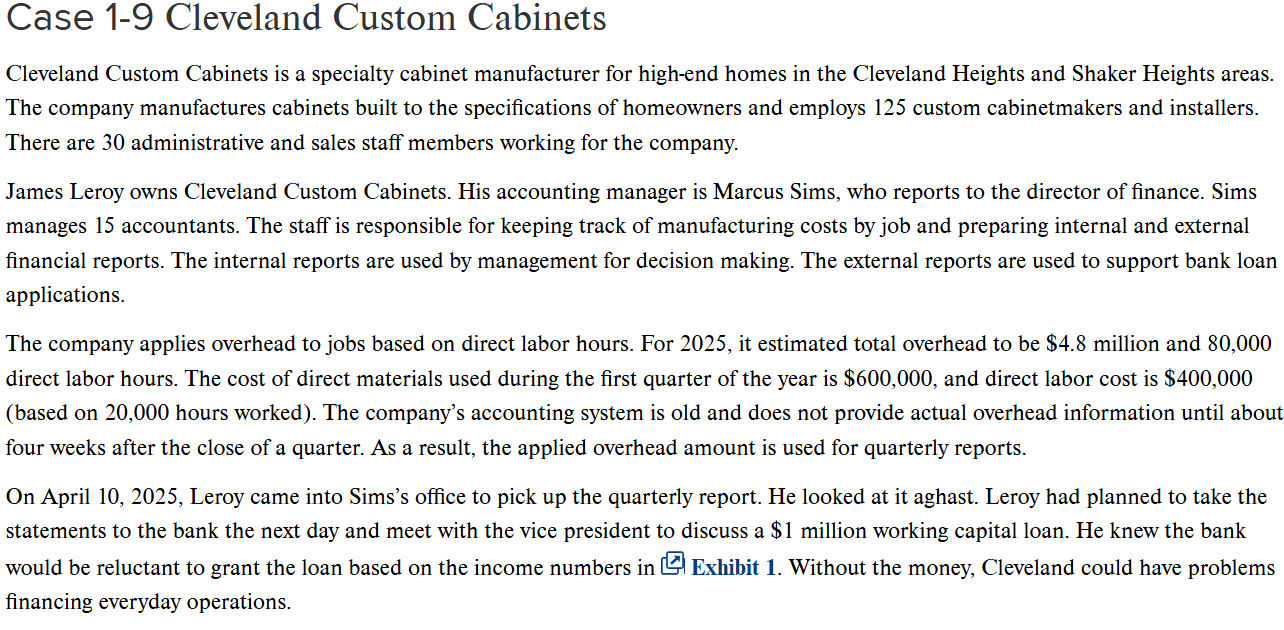
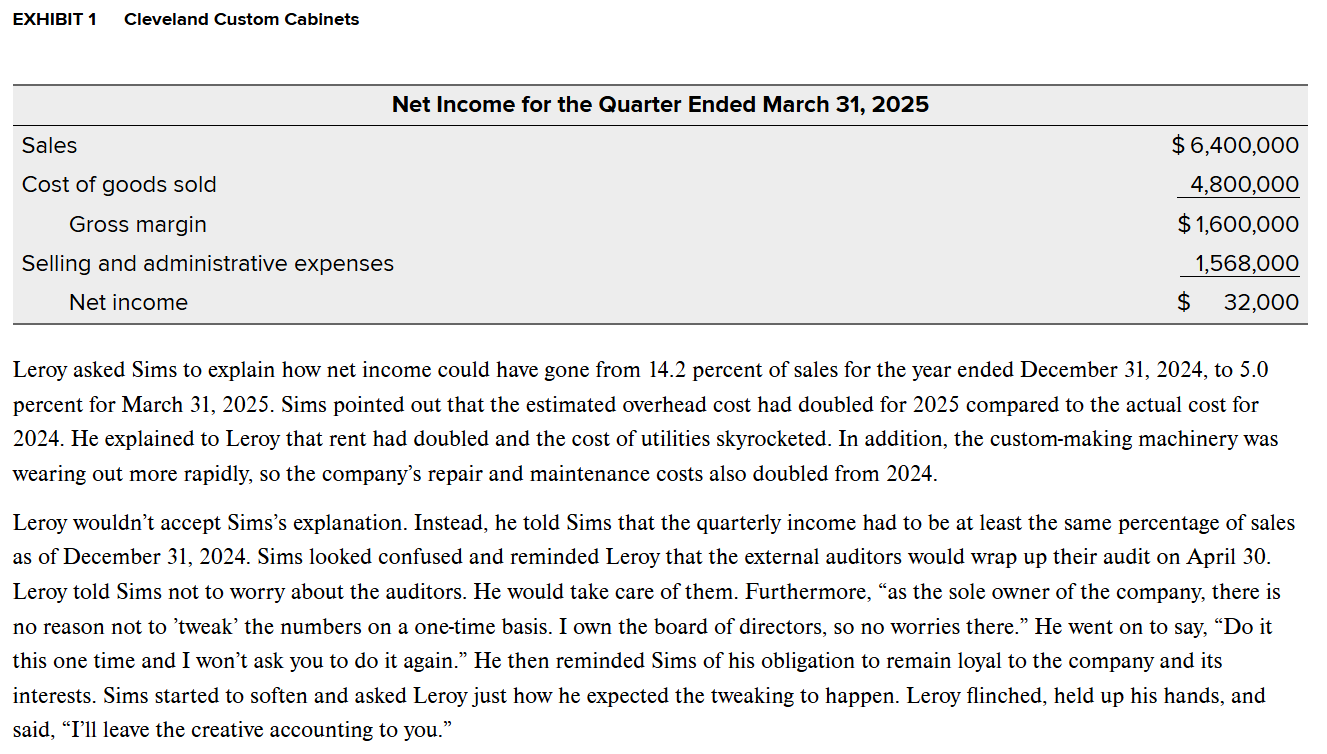
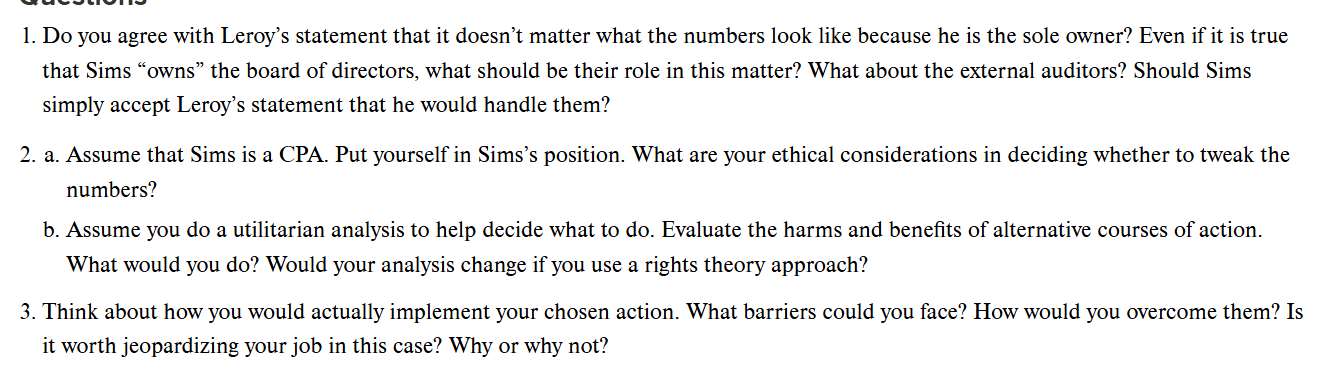
Case 1-9 Cleveland Custom Cabinets Cleveland Custom Cabinets is a specialty cabinet manufacturer for high-end homes in the Cleveland Heights and Shaker Heights areas. The company manufactures cabinets built to the specifications of homeowners and employs 125 custom cabinetmakers and installers. There are 30 administrative and sales staff members working for the company. James Leroy owns Cleveland Custom Cabinets. His accounting manager is Marcus Sims, who reports to the director of finance. Sims manages 15 accountants. The staff is responsible for keeping track of manufacturing costs by job and preparing internal and external financial reports. The internal reports are used by management for decision making. The external reports are used to support bank loan applications. The company applies overhead to jobs based on direct labor hours. For 2025, it estimated total overhead to be $4.8 million and 80,000 direct labor hours. The cost of direct materials used during the first quarter of the year is $600,000, and direct labor cost is $400,000 (based on 20,000 hours worked). The company's accounting system is old and does not provide actual overhead information until about four weeks after the close of a quarter. As a result, the applied overhead amount is used for quarterly reports. On April 10, 2025, Leroy came into Sims's office to pick up the quarterly report. He looked at it aghast. Leroy had planned to take the statements to the bank the next day and meet with the vice president to discuss a $1 million working capital loan. He knew the bank would be reluctant to grant the loan based on the income numbers in lS! Exhibit 1. Without the money, Cleveland could have problems financing everyday operations. EXHIBIT1 Cleveland Custom Cabinets Net Income for the Quarter Ended March 31, 2025 Sales $ 6,400,000 Cost of goods sold 4,800,000 Gross margin $ 1,600,000 Selling and administrative expenses 1,568,000 Net income $ 32,000 Leroy asked Sims to explain how net income could have gone from 14.2 percent of sales for the year ended December 31, 2024, to 5.0 percent for March 31, 2025. Sims pointed out that the estimated overhead cost had doubled for 2025 compared to the actual cost for 2024. He explained to Leroy that rent had doubled and the cost of utilities skyrocketed. In addition, the custom-making machinery was wearing out more rapidly, so the company's repair and maintenance costs also doubled from 2024. Leroy wouldn't accept Sims's explanation. Instead, he told Sims that the quarterly income had to be at least the same percentage of sales as of December 31, 2024. Sims looked confused and reminded Leroy that the external auditors would wrap up their audit on April 30. Leroy told Sims not to worry about the auditors. He would take care of them. Furthermore, \"as the sole owner of the company, there is no reason not to tweak' the numbers on a one-time basis. I own the board of directors, so no worries there.\" He went on to say, \"Do it this one time and I won't ask you to do it again.\" He then reminded Sims of his obligation to remain loyal to the company and its interests. Sims started to soften and asked Leroy just how he expected the tweaking to happen. Leroy flinched, held up his hands, and said, \"I'll leave the creative accounting to you.\" 1. Do you agree with Leroy's statement that it doesn't matter what the numbers look like because he is the sole owner? Even if it is true that Sims \"owns\" the board of directors, what should be their role in this matter? What about the external auditors? Should Sims simply accept Leroy's statement that he would handle them? 2. a. Assume that Sims is a CPA. Put yourself in Sims's position. What are your ethical considerations in deciding whether to tweak the numbers? b. Assume you do a utilitarian analysis to help decide what to do. Evaluate the harms and benefits of alternative courses of action. What would you do? Would your analysis change if you use a rights theory approach? 3. Think about how you would actually implement your chosen action. What barriers could you face? How would you overcome them? Is it worth jeopardizing your job in this case? Why or why not
Step by Step Solution
There are 3 Steps involved in it
1 Expert Approved Answer
Step: 1 Unlock
Question Has Been Solved by an Expert!
Get step-by-step solutions from verified subject matter experts
Step: 2 Unlock
Step: 3 Unlock
Students Have Also Explored These Related Accounting Questions!









 Study Help