







Question: Case 2 . 1 Robert M . Nelson v . National Aeronautics and Space Administration 5 3 0 F . 3 d 8 6 5
Case
Robert M Nelson v National Aeronautics and Space Administration
Fd ; US App. LEXIS th Circuit
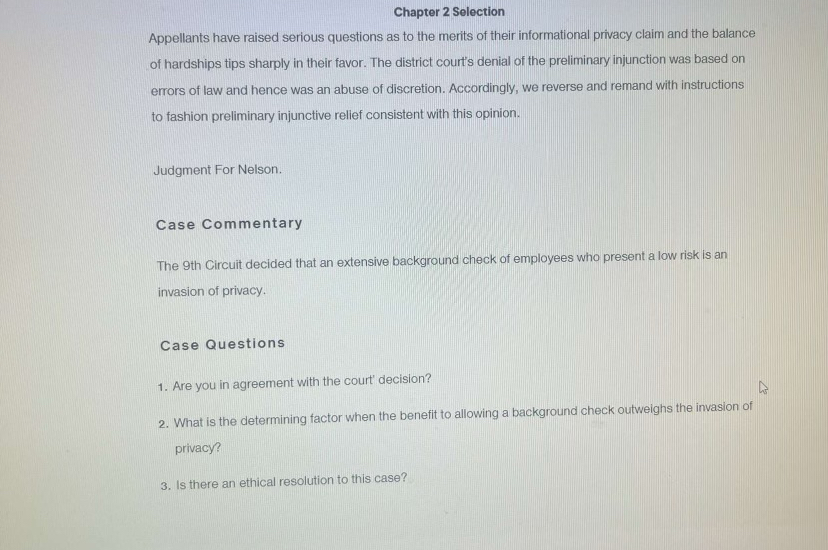
The issue in this case is whether the background check of lowrisk contract employees is an invasion of privacy.
WARDLAW, Circuit Judge.
The named appellants in this action Appellants are scientists, engineers, and administrative support personnel at the Jet Propulsion Laboratory JPL a research laboratory run jointly by the National Aeronautics and Space Administration NASA and the California Institute of Technology Caltech Appellants sued NASA, Caltech, and the Department of Commerce collectively "Appellees" challenging NASA's recently adopted requirement that "low risk" contract employees like themselves submit to indepth background investigations. The district court denled Appellants' request for a preliminary injunction, finding they were unlikely to succeed on the merits and unable to demonstrate irreparable harm. Because Appellants raise serious legal and constitutional questions and because the balance of hardships tips sharply in their favor, we reverse and remand.
JPL is located on federally owned land, but operated entirely by Caltech pursuant to a contract with NASA.
Search
JPL is located on federally owned land, but operated entirely by Caltech pursuant to a contract with NASA. Like all JPL personnel, Appellants are employed by Caltech, not the government. Appellants are designated by the government as "low risk" contract employees. They do not work with classified material.
Appellants contest NASA's newly instated procedures requiring "low risk" JPL personnel to yield to broad background investigations as a condition of retaining access to JPLs facilities. NASA's new policy requires that every JPL employee undergo a National Agency Check with Inquiries NACI the same background investigation required of government civil service employees, before he or she can obtain an identification badge needed for access to JPLs facilities. The NACI investigation requires the applicant to complete and submit Standard Form SF which asks for background information, including residential, educational, employment, and military histories; the names of three references that "know you well;" and disclosure of any illegal drug use, possession, supply, or manufacture within the past year, along with the nature and circumstances of any such activities and any treatment or counseling received. This information is then checked against four government databases: SecuritySuitability Investigations Index; the Defense Clearance and Investigation Index; the FBI Name Check; and the FBI National Criminal History Fingerprint Check. Finally, SF requires the applicant to sign an "Authorization for Release of Information" that authorizes the government to collect "any information relating to his or her activities from schools, residential management agents, employers, criminal justice agencies, retail business establishments, or other sources of information." The information sought "may include, but is not limited tothe applicant's academic, residential, achievement, performance, attendance, disciplinary, employment history, and criminal history record information." The record is vague as to the exact extent to and manner in which the government will seek this information, but it is undisputed that each of the applicants' references, employers, and landlords will be sent an "Investigative Request for Personal Information" Form which asks whether the recipient has "any reason to question the applicant's
pagesfeefeaecaffbafuserPreferred Type read
Chapter Selection
applicants' references, employers, and landlords will be sent an "Investigative Request for Personal Information" Form which asks whether the recipient has "any reason to question the applicant's honesty or trustworthiness" or has "any adverse information about the applicant's employment, residence, or activities" concerning "violations of law," "financial integrity," "abuse of alcohol andor drugs," "mental or emotional stability," "general behavior or conduct," or "other matters." The recipient is asked to explain any adverse information noted on the form. Once the information has been collected, NASA and the federal Office of Personnel Management determine whether the employee is "suitable" for continued access to NASA's facilities, though the exact mechanics of this suitability determination are in dispute.
Since it was first created in NASA, like all other federal agencies, has conducted NACl investigations of its civil servant employees but not of its contract employees. Around the year however, NASA "determined that the incomplete screening of contractor employees posed a security vulnerability for the agency' and began
Step by Step Solution
There are 3 Steps involved in it
1 Expert Approved Answer
Step: 1 Unlock

Question Has Been Solved by an Expert!
Get step-by-step solutions from verified subject matter experts
Step: 2 Unlock
Step: 3 Unlock
 Study Help