







Question: Case 2 Cafeteria I.C . E . The cafeteria for employees of I.C . E . ( the national electric company of Costa Rica:Instituto Costarricense
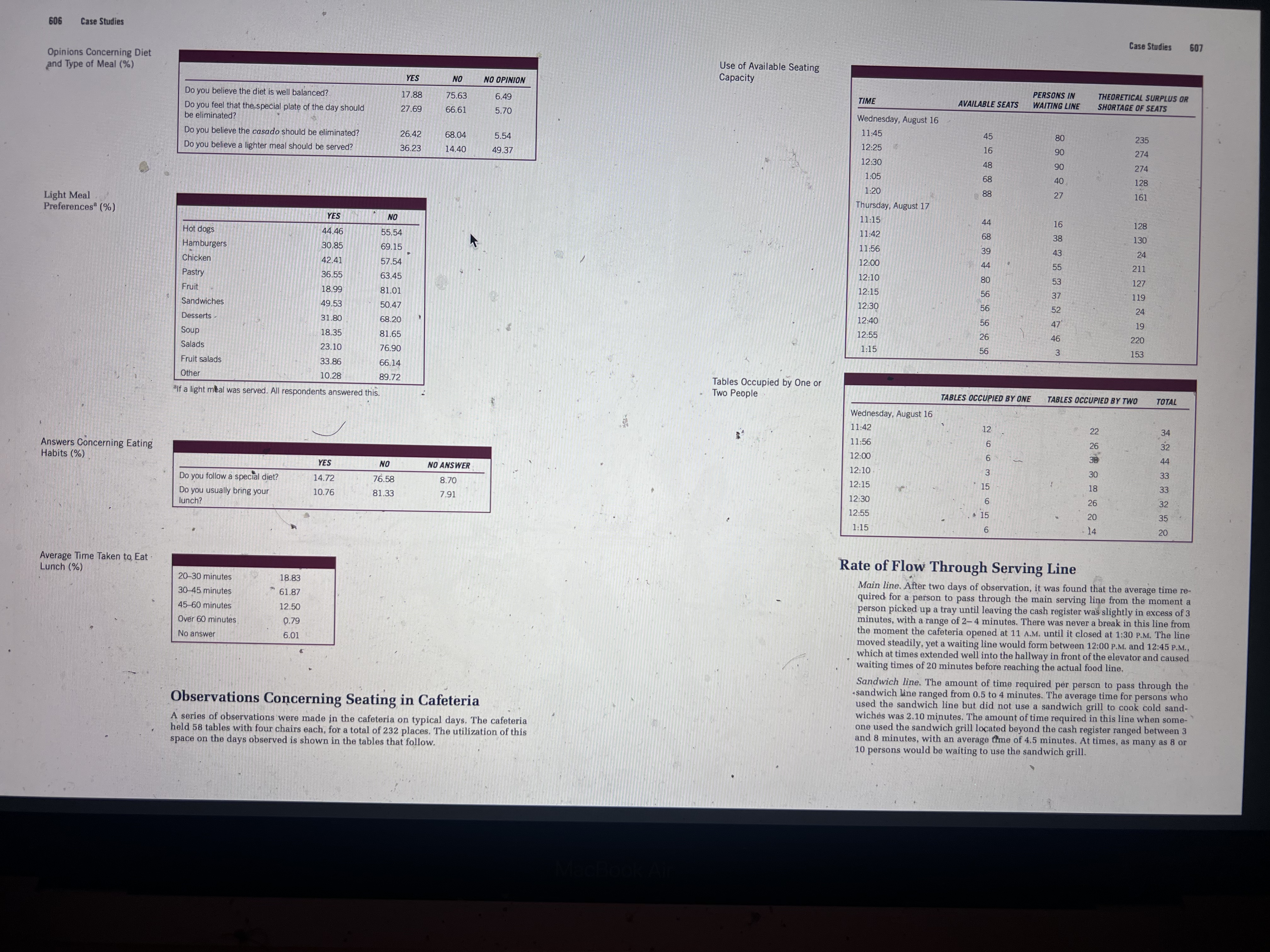
Case Cafeteria I.CEThe cafeteria for employees of I.CEthe national electric company of Costa Rica:Instituto Costarricense de Electricidad was experiencing difficulties, and top management felt compelled to see what corrective actions could be taken. Responsibility for correcting the problems had been assigned to Antonio F Caas Mora, assistant. manager for telecommunications. The problems were of two types. First, no one was satisfied with the time required for lunch. The time often extended beyond the allocated half hour, resulting in loss of productivity. The second, related problem was how to change the lunchtime eating habits of the employees. The majority of employees used the main serving line, where they purchased a heavy traditional Latin meal. This required a considerable amount of tim and also made the employees sleepy after eating. As a result, afternoon productivity among office personnel declined.Background on I.CE and the Cafeteria I.GE was the largest electric utility and the only telephone company in the nation of Costa Rica. It was owned and operated by the government of Costa Rica.Although I.CE had field office locations throughout Costa Rica, the central administrative offices were located in the city of San Jos in a modern story building.A total of persons were employed by LCE and of these worked in the central office building. This group used the cafeteria facilities.The cafeteria had been in operation for five years. It was under the management of an employee cooperative. This cooperative was managed by an elected board of directors consisting of employees of I.CE The board of directors of the cooperative hired a fulltime manager who had direct responsibility for the cafeteria operation.Description of EmployeesEmployees who worked in the I.CE building and used the cafeteria were primarily whitecollar personnel. A minority of bluecollar employees such as maintenance personnel used the cafeteria. Employees who worked in the I.CE building consisted primarily of administrators, staff specialists, engineers, clerical personnel, secretaries and receptionists.The Menu and Eating HabitsThe cafeteria consisted of two serving lines; the main serving line was the most popular with the employees and was the one with the long waiting lines. This line served what was known as the casado, a typical Latin meal. The menu changed each day. A typical meal consisted of a meat dish such as a small steak, sausage, or liver. This was accom panied with rice, beans, and a vegetable such as corn or more commonly, potatoes.The meals served in the main serving line reflected the cultural habits of Costa Ricans with traditional food. The noontime meal historically had been eaten with the family and required two or three hours, including family conversation and sometimes a short nap. This custom was the basis for closing stores during midday. It was still the custom in many parts oLatin America for all types of businesses to close until or PM The traditional long lunch hour meant that employees would arrive for work early in the morning, take a long lunch break, return for work, and stay late in the evening until or : PM The management of I.CE had decided to break with this tradition to allow as smooth a workday as possible without the interruption of a long lunch break. The I.CE system closely paralleled that found in the United States.There was evidence of change in eating habits in San Jos Several USstyle restaurants had entered the market and did a brisk business at lunch with hamburgers, pizza, and other quick foods. McDonald's, Hardee's, and Pizza Hut were popular noontime restaurants, especially with younger people. After witnessing the success of restaurants such as McDonald's, the board of directors of the cooperative decided to open a sandwich line in the Cafeteria. This was seprate from the main serving line.If consisted of a long counter. Plastic food trays were placed on the counter and filled with stacks of unwrapped cold sandwiches such as cheese or ham and cheese. Other trays contained slices of fruits such as papaya or watermelon and cake. Coffee, milk, and carbonated beverages were available from dispensers located on the counter.Two cash registers were located at the end of the main serving line, and ore at the end of the sandwich line. Information was not recorded concerning the number of employees who used each line or the average expenditure per person in the sandwich line. However, it was felt that the average lunch expenditure per employee would probably be about twothirds of the perperson expenditure in the main serving line.Working Hours and Office RulesThe office hours at I.CE extended from : AM to : PM with half an hour for lunch. Employees were expected to arrive on time. This meant that some employees had to rise as early as : AM and few could rise later than : AMCoffee breaks were not officially permitted, and there were no vending machines in the building. The policy of no coffee breaks had been instituted because many employees spilled coffee or other liquids on reports. It was also felt that a coffee break was unnecessary because half an hour was given for lunch. Workers would occasionally bring a cake or cookie focaly rod share them with employees in their work area, even though this was officially frowned upon.A system had been devised to prevent all employees from crowding into the cafeteria at one time. The doors of the cafeteria were locked until AM at which time employees began to arrive on a set schedule by floors. The line closed promptly at : PMSurvey ResultsBefore attempting to make changes to correct the situation in the cafeteria, management felt it would be wise to conduct a survey among the employees. This was done through the use of a written questionnaire, which was given to all persons using the cafeteria on a selected day. The results of this questionnaire follow.Rate of Flow Through Serving LineMain line. After two days of observation, it was found that the average time required for a person to pass through the main serving line from the moment a person picked up a tray until leaving the cash register was slightly in excess of minutes, with a range of minutes. There was never a break in this line from the moment the cafeteria opened at AM until it closed at : PM The line moved steadily, yet a waiting line would form between : PM and : PM which at times extended well into the hallway in front of the elevator and caused waiting times of minutes before reaching the actual food line.Sandwich line. The amount of time required per person to pass through the sandwich line ranged from to minutes. The average time for persons who used the sandwich line but did not use a sandwich grill to cook cold sandwiches was minutes. The amount of time required in this line when someone used the sandwich grill located beyond the cash register ranged between and minutes, with an average me of minutes. At times, as many as or persons would be waiting to use the sandwich grill.QUESTIONS FOR DISCUSSIONChapter Can the use of marketing conceptsstrategies be of use in solving the problem with Cafeteria I.CE What effect can an individual organization such asI.CE have on changing ingrained cultural habits such as those of noontime dining? What would you suggest be done to increase patronage of the sandwich and fruit line
Step by Step Solution
There are 3 Steps involved in it
1 Expert Approved Answer
Step: 1 Unlock

Question Has Been Solved by an Expert!
Get step-by-step solutions from verified subject matter experts
Step: 2 Unlock
Step: 3 Unlock
 Study Help