







Question: Case 2 Capital budgeting analysis A scientific testing laboratory has developed a new test protocol and is evaluating the value of implementing it. It believes
Case 2 Capital budgeting analysis
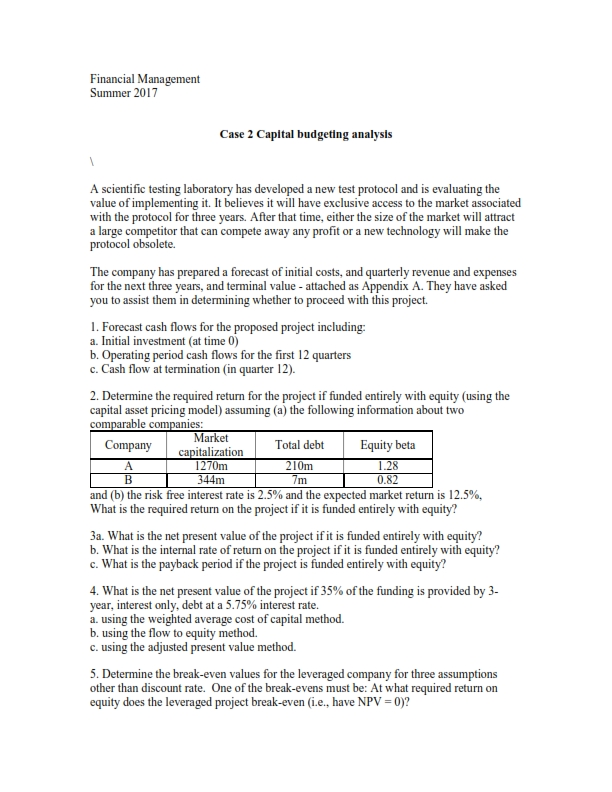
A scientific testing laboratory has developed a new test protocol and is evaluating the value of implementing it. It believes it will have exclusive access to the market associated with the protocol for three years. After that time, either the size of the market will attract a large competitor that can compete away any profit or a new technology will make the protocol obsolete.
The company has prepared a forecast of initial costs, and quarterly revenue and expenses for the next three years, and terminal value - attached as Appendix A. They have asked you to assist them in determining whether to proceed with this project.
1. Forecast cash flows for the proposed project including:
a. Initial investment (at time 0)
b. Operating period cash flows for the first 12 quarters
c. Cash flow at termination (in quarter 12).
2. Determine the required return for the project if funded entirely with equity (using the capital asset pricing model) assuming (a) the following information about two comparable companies:
| Company | Market capitalization | Total debt | Equity beta |
| A | 1270m | 210m | 1.28 |
| B | 344m | 7m | 0.82 |
and (b) the risk free interest rate is 2.5% and the expected market return is 12.5%,
What is the required return on the project if it is funded entirely with equity?
3a. What is the net present value of the project if it is funded entirely with equity?
b. What is the internal rate of return on the project if it is funded entirely with equity?
c. What is the payback period if the project is funded entirely with equity?
4. What is the net present value of the project if 35% of the funding is provided by 3-year, interest only, debt at a 5.75% interest rate.
a. using the weighted average cost of capital method.
b. using the flow to equity method.
c. using the adjusted present value method.
5. Determine the break-even values for the leveraged company for three assumptions other than discount rate. One of the break-evens must be: At what required return on equity does the leveraged project break-even (i.e., have NPV = 0)?
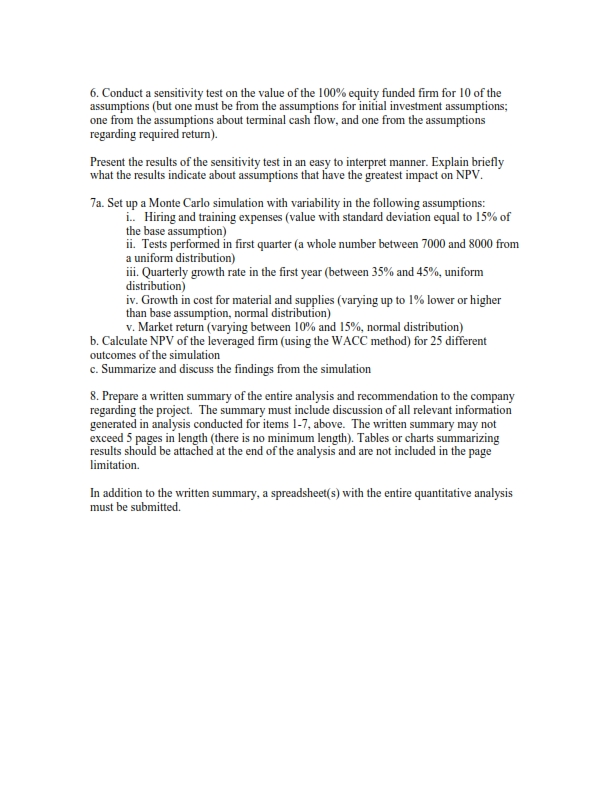
6. Conduct a sensitivity test on the value of the 100% equity funded firm for 10 of the assumptions (but one must be from the assumptions for initial investment assumptions; one from the assumptions about terminal cash flow, and one from the assumptions regarding required return).
Present the results of the sensitivity test in an easy to interpret manner. Explain briefly what the results indicate about assumptions that have the greatest impact on NPV.
7a. Set up a Monte Carlo simulation with variability in the following assumptions:
i.. Hiring and training expenses (value with standard deviation equal to 15% of the base assumption)
ii. Tests performed in first quarter (a whole number between 7000 and 8000 from a uniform distribution)
iii. Quarterly growth rate in the first year (between 35% and 45%, uniform distribution)
iv. Growth in cost for material and supplies (varying up to 1% lower or higher than base assumption, normal distribution)
v. Market return (varying between 10% and 15%, normal distribution)
b. Calculate NPV of the leveraged firm (using the WACC method) for 25 different outcomes of the simulation
c. Summarize and discuss the findings from the simulation
8. Prepare a written summary of the entire analysis and recommendation to the company regarding the project. The summary must include discussion of all relevant information generated in analysis conducted for items 1-7, above. The written summary may not exceed 5 pages in length (there is no minimum length). Tables or charts summarizing results should be attached at the end of the analysis and are not included in the page limitation.
In addition to the written summary, a spreadsheet(s) with the entire quantitative analysis must be submitted.
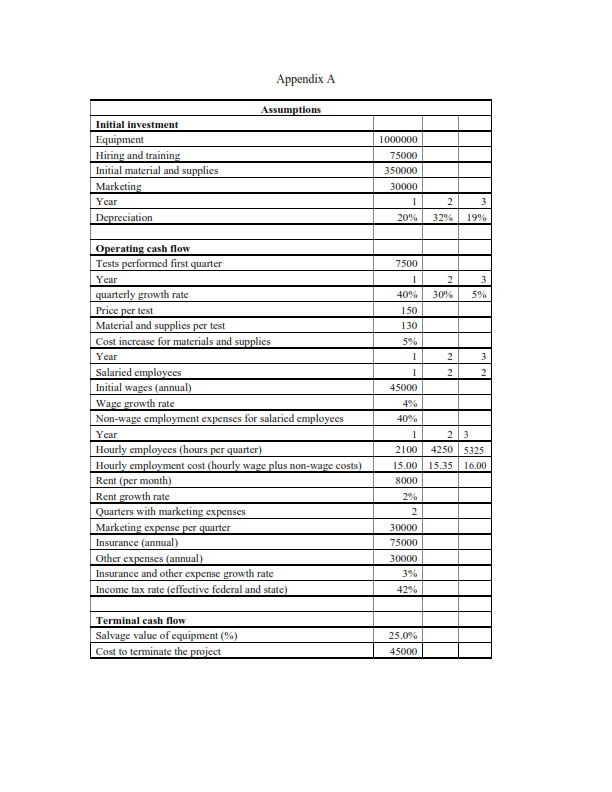
Appendix A
| Assumptions | |||
| Initial investment | |||
| Equipment | 1000000 | ||
| Hiring and training | 75000 | ||
| Initial material and supplies | 350000 | ||
| Marketing | 30000 | ||
| Year | 1 | 2 | 3 |
| Depreciation | 20% | 32% | 19% |
| Operating cash flow | |||
| Tests performed first quarter | 7500 | ||
| Year | 1 | 2 | 3 |
| quarterly growth rate | 40% | 30% | 5% |
| Price per test | 150 | ||
| Material and supplies per test | 130 | ||
| Cost increase for materials and supplies | 5% | ||
| Year | 1 | 2 | 3 |
| Salaried employees | 1 | 2 | 2 |
| Initial wages (annual) | 45000 | ||
| Wage growth rate | 4% | ||
| Non-wage employment expenses for salaried employees | 40% | ||
| Year | 1 | 2 | 3 |
| Hourly employees (hours per quarter) | 2100 | 4250 | 5325 |
| Hourly employment cost (hourly wage plus non-wage costs) | 15.00 | 15.35 | 16.00 |
| Rent (per month) | 8000 | ||
| Rent growth rate | 2% | ||
| Quarters with marketing expenses | 2 | ||
| Marketing expense per quarter | 30000 | ||
| Insurance (annual) | 75000 | ||
| Other expenses (annual) | 30000 | ||
| Insurance and other expense growth rate | 3% | ||
| Income tax rate (effective federal and state) | 42% | ||
| Terminal cash flow | |||
| Salvage value of equipment (%) | 25.0% | ||
| Cost to terminate the project | 45000 | ||
Financial Management Summer 2017 Case 2 Capital budgeting analysis A scientific testing laboratory has developed a new test protocol and is evaluating the with the protocol for three years. After that time, either the size of the market will attract protocol obsolete. The company has prepared a forecast of initial costs, and quarterly revenue and expenses value of implementing it. It believes it will have exclusive access to the market associated a large competitor that can compete away any profit or a new technology will make the for the next three years, and terminal value- attached as Appendix A. They have asked you to assist them in determining whether to proceed with this project. 1. Forecast cash flows for the proposed project including: a. Initial investment (at time 0) c. Cash flow at termination (in quarter 12). capital asset pricing model) assuming (a) the following information about two b. Operating period cash flows for the first 12 quarters 2. Determine the required return for the project if funded entirely with equity (using the comparable companies: Market Company capitalization I Equity beta Total debt 1270m lOm lm and (b) the risk free interest rate is 2.5% and the expected market return is 12.5%, What is the required return on the project if it is funded entirely with equity? 3a. What is the net present value of the project if it is funded entirely with equity? b. What is the internal rate of return on the project if it is funded entirely with equity? c. What is the payback period if the project is funded entirely with equity? 4. What is the net present value of the project if 35% of the funding is provided by 3- year, interest only, debt at a 5.75% interest rate. a. using the weighted average cost of capital method. b. using the flow to equity method. c. using the adjusted present value method. 5. Determine the break-even values for the leveraged company for three assumptions other than discount rate. One of the break-evens must be: At what required return on equity does the leveraged project break-even (i.e., have NPV-0)
Step by Step Solution
There are 3 Steps involved in it

Get step-by-step solutions from verified subject matter experts
 Study Help