Question: case 29 Counting cubes in cubes Bobbie GRADE 4, SEPTEMBER Early in the school year, I asked my class to build an object out of
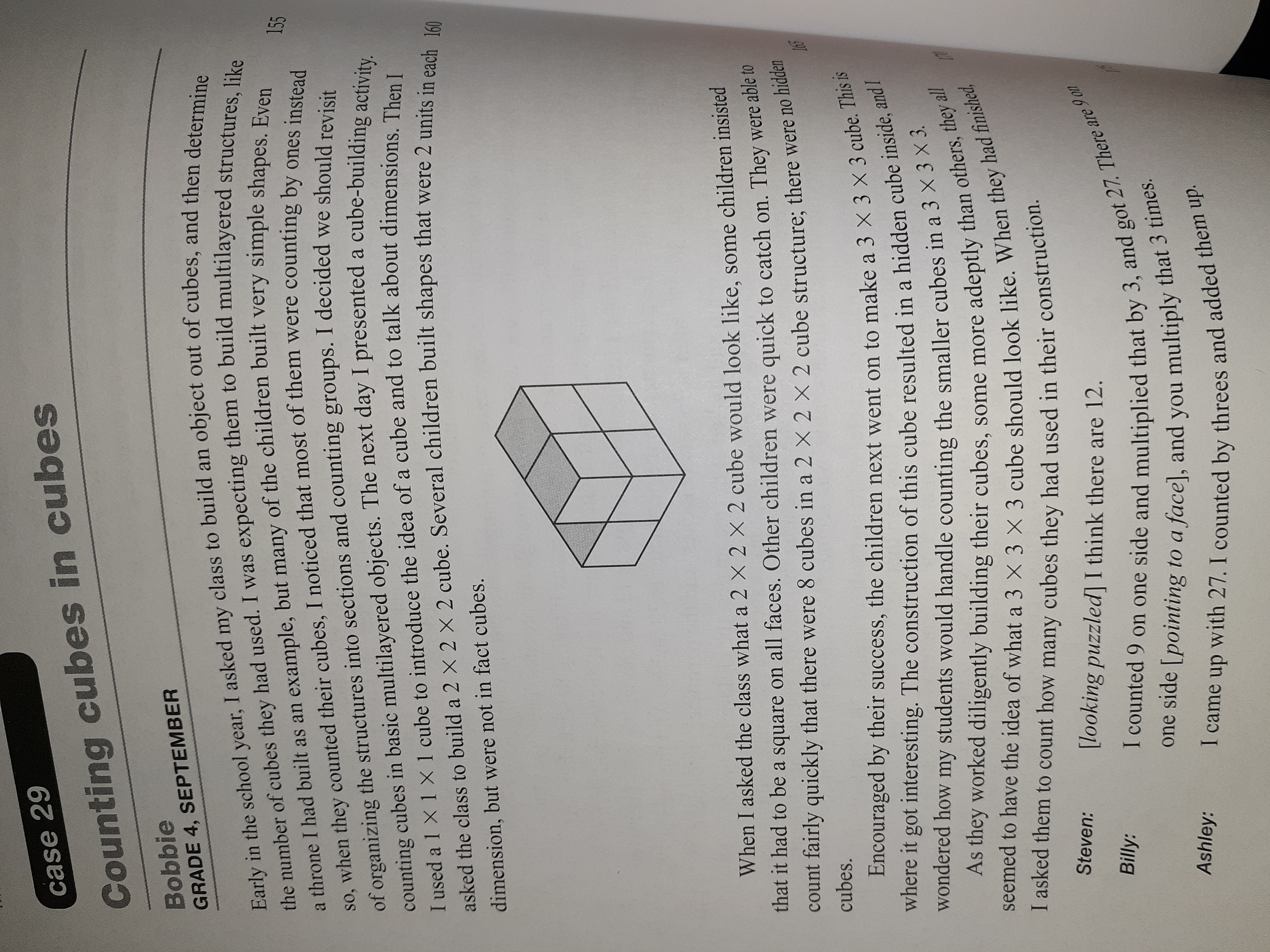
case 29 Counting cubes in cubes Bobbie GRADE 4, SEPTEMBER Early in the school year, I asked my class to build an object out of cubes, and then determine the number of cubes they had used. I was expecting them to build multilayered structures, like a throne I had built as an example, but many of the children built very simple shapes. Even 155 so, when they counted their cubes, I noticed that most of them were counting by ones instead of organizing the structures into sections and counting groups. I decided we should revisit I presented a cube-building activity , I used a 1 X 1 X 1 cube to introduce the idea of a cube and to talk about dimensions. Then I asked the class to build a 2 X 2 X 2 cube. Several children built shapes that were 2 units in each 160 dimension, but were not in fact cubes. When I asked the class what a 2 X 2 X 2 cube would look like, some children insisted that it had to be a square on all faces. Other children were quick to catch on. They were able to count fairly quickly that there were 8 cubes in a 2 X 2 X 2 cube structure; there were no hidden 165 cubes. Encouraged by their success, the children next went on to make a 3 X 3 X 3 cube. This is where it got interesting. The construction of this cube resulted in a hidden cube inside, and wondered how my students would handle counting the smaller cubes in a 3 X 3 X 3. As they worked diligently building their cubes, some more adeptly than others, they all seemed to have the idea of what a 3 X 3 X 3 cube should look like. When they had finished, I asked them to count how many cubes they had used in their construction. Steven: [looking puzzled] I think there are 12. Billy: I counted 9 on one side and multiplied that by 3, and got 27. There are one side [pointing to a face], and you multiply that 3 times. Ashley: I came up with 27. I counted by threes and added them up.Chapter 7: Same shape, different measures Sophia: I counted by ones and got 27. I had to open up the middle. I got 54. Christine: Iasked Christine to show me how she got 54, and she began to count each square off each face. "amie had used a similar strategy. When you added the 9 individual squares on each face of The 3 X 3 X 3 cube, they added up to 54. These children weren't recognizing that their strategy 180 was faulty or that they had neglected to count the middle cube and were counting some cubes nice and even three times. Christine muttered that she felt it wasn't right, but she wasn't quite sure why not. Theld up a 3 X 3 X 3 cube and asked the class if counting each square on each side would 18 he an accurate strategy. The class was quiet for a few moments; then a few hands shot up. Brenda rather emphatically insisted that it wouldn't work. She protested that you would end up counting some cubes twice and end up double the amount. Indeed, 54, the number of square units showing on the 3 X 3 X 3 cube, is double 27, the count of its volume. Some children seemed to be contemplating what Brenda had said. I could see some heads nodding; others looked puzzled; and a few looked indifferent. Just then the recess bell rang, and it was time to stop. Reflecting upon that math session, I realize that the children shared an incredible amount of information with me. Initially I had not intended this activity to be focused on surface area and volume, yet these issues came up in the process of their counting. How do children come to envision the cubes that compose a shape and see that they're not necessarily the same as the squares we see on the surface? What do they need to understand about surface area and volume in order to distinguish one from the other? What helps us know when there are objects to count that we cannot see? The children's confusions have caused me to reflect further upon my understanding of surface area and volume, and I feel the ideas are still somewhat fuzzy in my own head. Brenda pointed out that when you count the squares for surface area, some cubes are counted twice, and you end up with double the number of cubes in the structure. Does it always work out that way? I think not! When I look at the 2 X 2 X 2 cube, I see that the volume is 8 but there are 24 squares showing on the surface area, and 8 X 3 = 24. With a unit cube, the volume is 1 and the surface area is 6: 1 X 6 = 6. I wonder what happens with 4 X 4 X 4 or 5 X 5 X 5 cubes. Will I find a pattern
Step by Step Solution
There are 3 Steps involved in it
1 Expert Approved Answer
Step: 1 Unlock
Question Has Been Solved by an Expert!
Get step-by-step solutions from verified subject matter experts
Step: 2 Unlock
Step: 3 Unlock
Students Have Also Explored These Related Mathematics Questions!









 Study Help