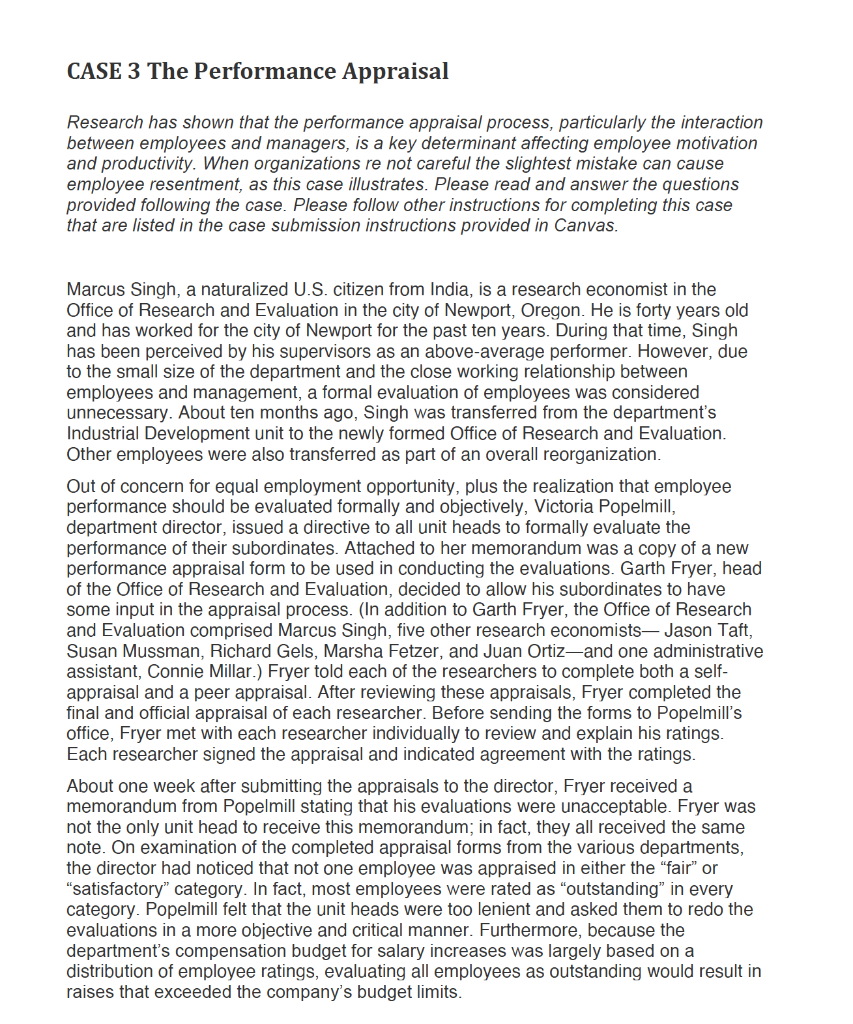
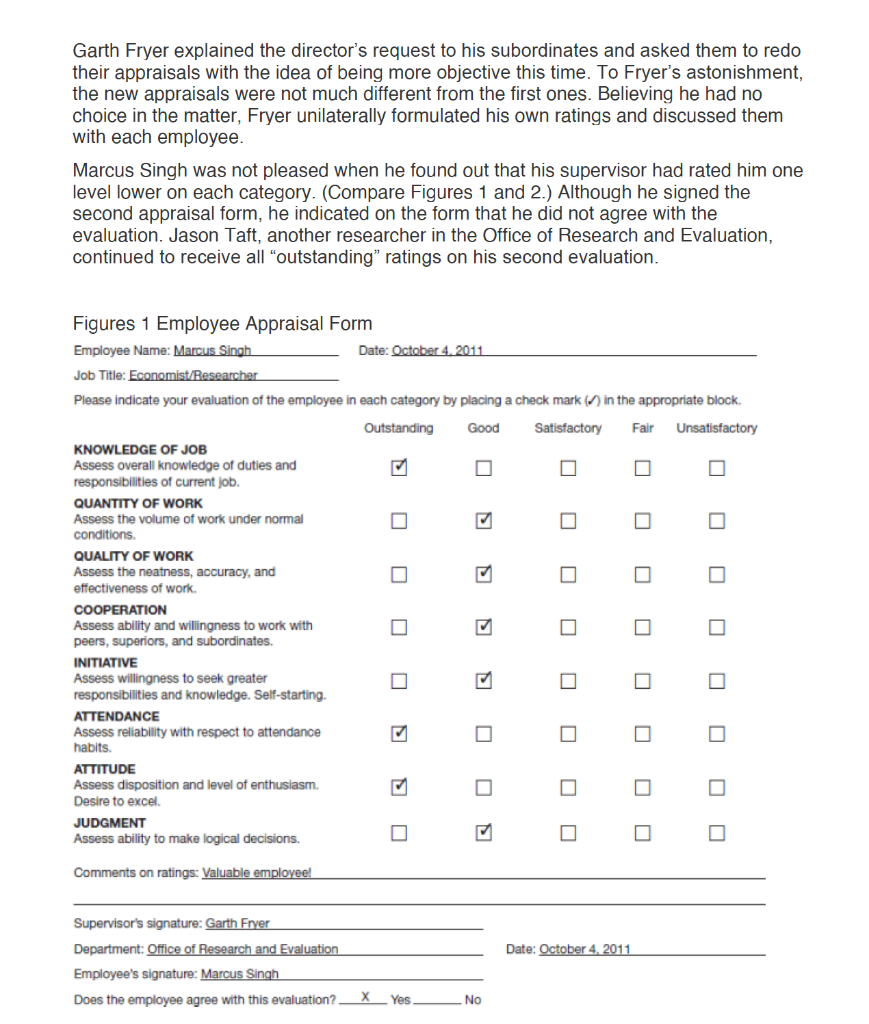
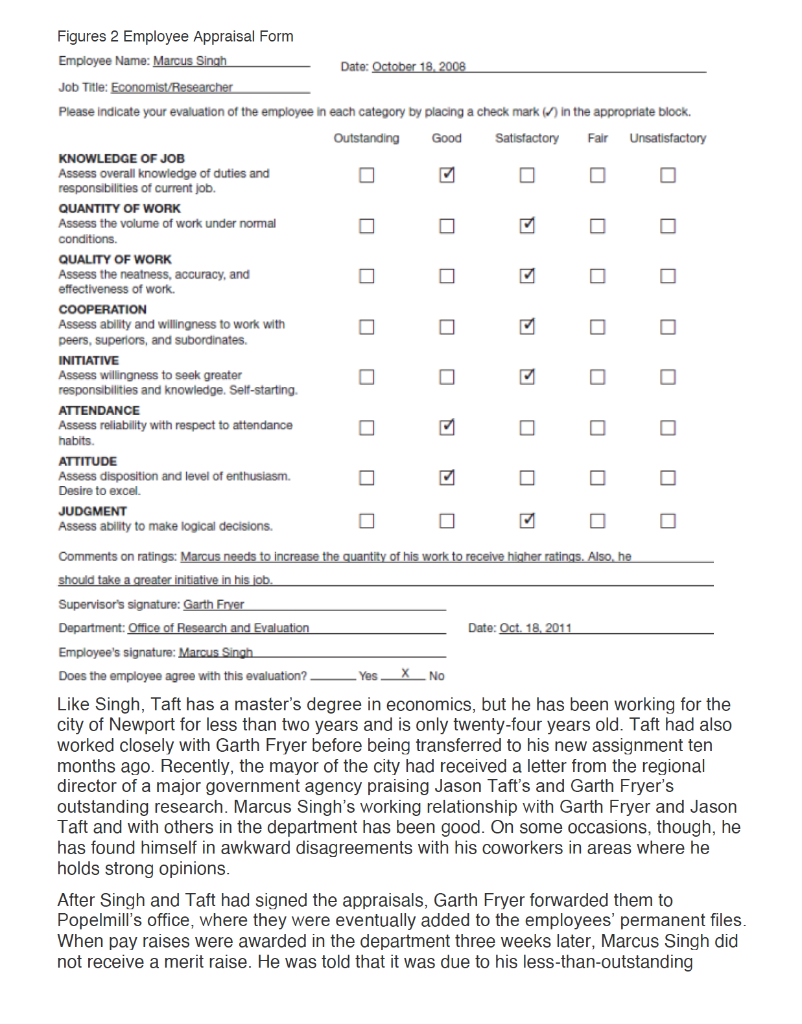
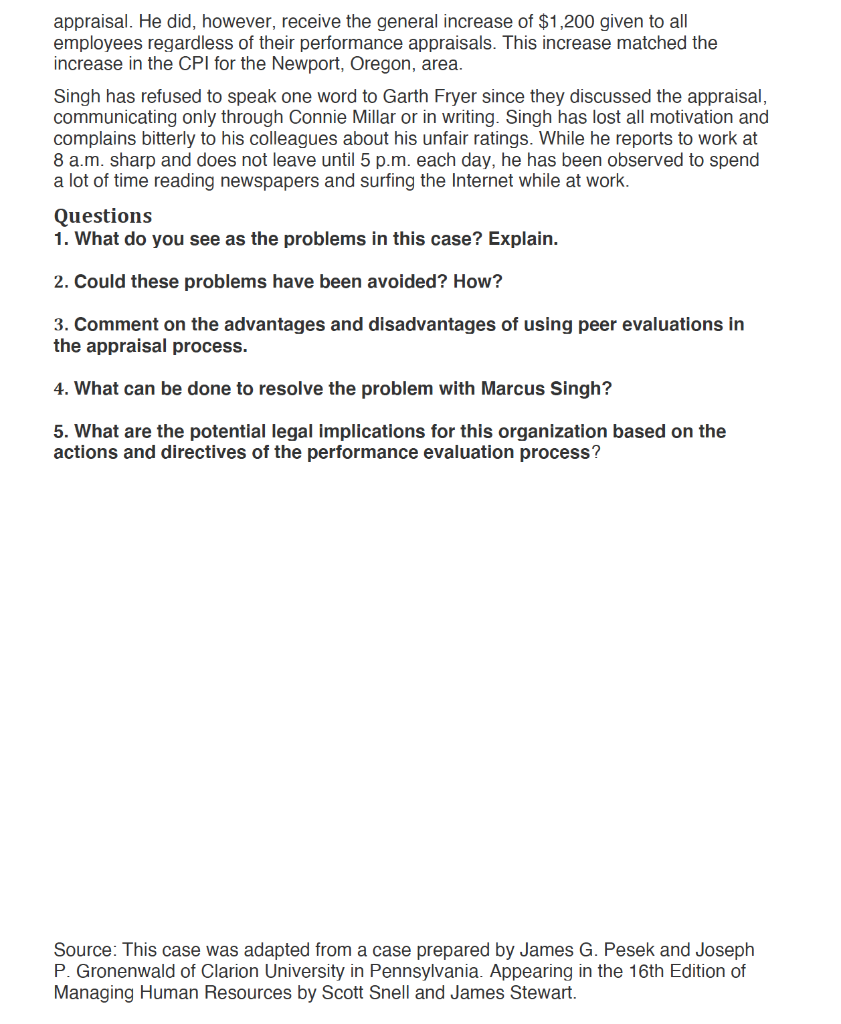
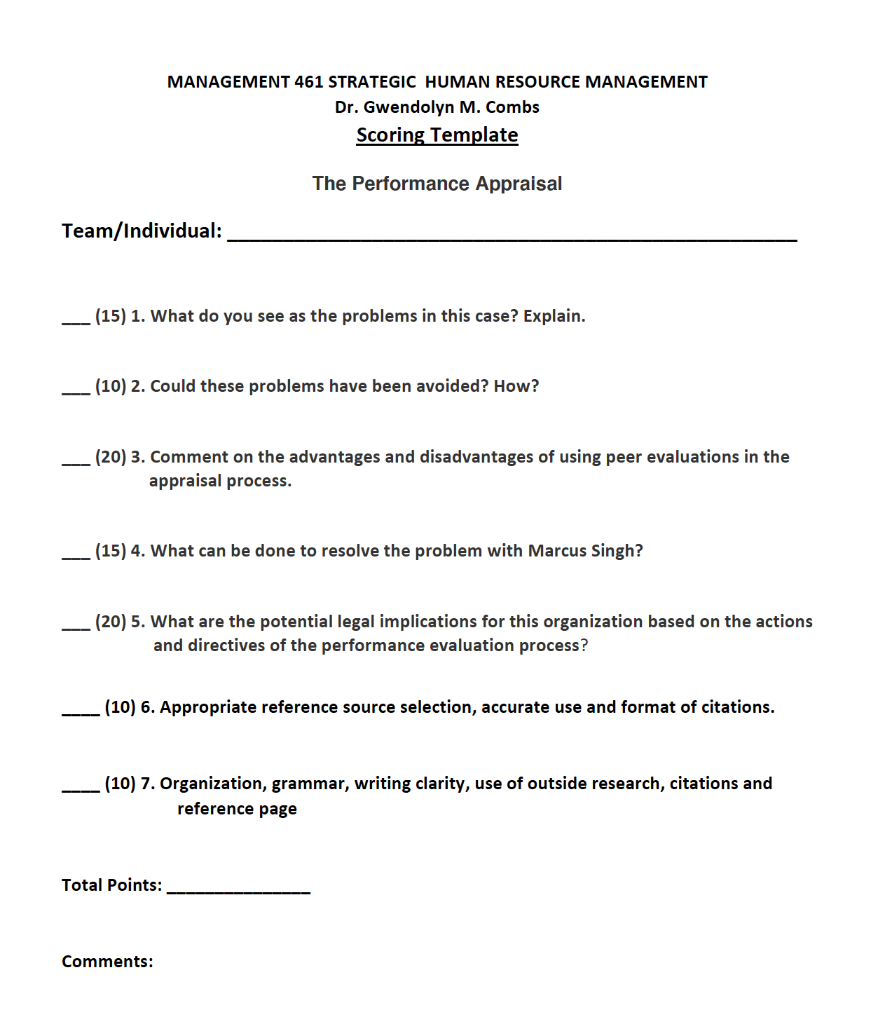
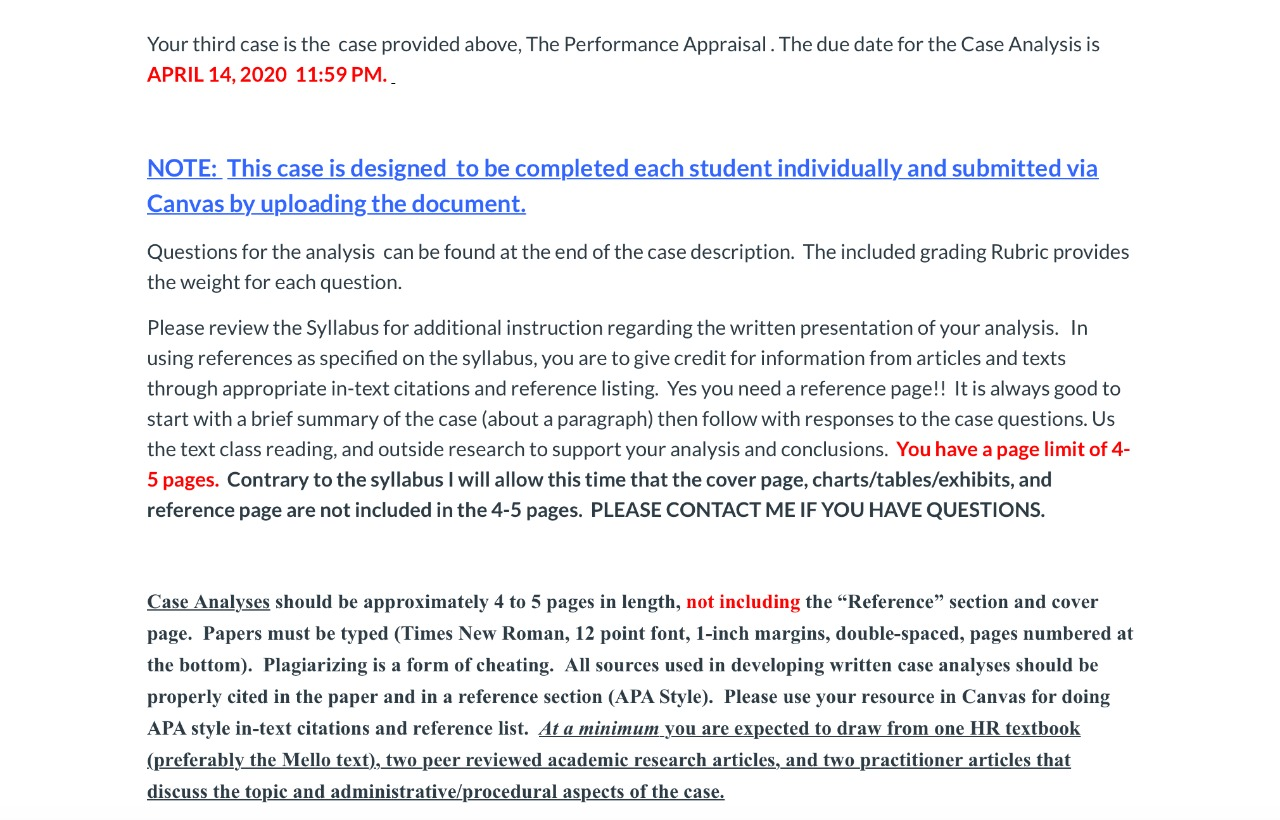
CASE 3 The Performance Appraisal Research has shown that the performance appraisal process, particularly the interaction between employees and managers, is a key determinant affecting employee motivation and productivity. When organizations re not careful the slightest mistake can cause employee resentment, as this case illustrates. Please read and answer the questions provided following the case. Please follow other instructions for completing this case that are listed in the case submission instructions provided in Canvas. Marcus Singh, a naturalized U.S. citizen from India, is a research economist in the Office of Research and Evaluation in the city of Newport, Oregon. He is forty years old and has worked for the city of Newport for the past ten years. During that time, Singh has been perceived by his supervisors as an above-average performer. However, due to the small size of the department and the close working relationship between employees and management, a formal evaluation of employees was considered unnecessary. About ten months ago, Singh was transferred from the department's Industrial Development unit to the newly formed Office of Research and Evaluation. Other employees were also transferred as part of an overall reorganization. Out of concern for equal employment opportunity, plus the realization that employee performance should be evaluated formally and objectively, Victoria Popelmill, department director, issued a directive to all unit heads to formally evaluate the performance of their subordinates. Attached to her memorandum was a copy of a new performance appraisal form to be used in conducting the evaluations. Garth Fryer, head of the Office of Research and Evaluation, decided to allow his subordinates to have some input in the appraisal process. In addition to Garth Fryer, the Office of Research and Evaluation comprised Marcus Singh, five other research economists- Jason Taft, Susan Mussman, Richard Gels, Marsha Fetzer, and Juan Ortizand one administrative assistant, Connie Millar.) Fryer told each of the researchers to complete both a self- appraisal and a peer appraisal. After reviewing these appraisals, Fryer completed the final and official appraisal of each researcher. Before sending the forms to Popelmill's office. Fryer met with each researcher individually to review and explain his ratings. Each researcher signed the appraisal and indicated agreement with the ratings. About one week after submitting the appraisals to the director, Fryer received a memorandum from Popelmill stating that his evaluations were unacceptable. Fryer was not the only unit head to receive this memorandum, in fact, they all received the same note. On examination of the completed appraisal forms from the various departments, the director had noticed that not one employee was appraised in either the "fair" or "satisfactory" category. In fact, most employees were rated as "outstanding" in every category. Popelmill felt that the unit heads were too lenient and asked them to redo the evaluations in a more objective and critical manner. Furthermore, because the department's compensation budget for salary increases was largely based on a distribution of employee ratings, evaluating all employees as outstanding would result in raises that exceeded the company's budget limits. Garth Fryer explained the director's request to his subordinates and asked them to redo their appraisals with the idea of being more objective this time. To Fryer's astonishment, the new appraisals were not much different from the first ones. Believing he had no choice in the matter, Fryer unilaterally formulated his own ratings and discussed them with each employee. Marcus Singh was not pleased when he found out that his supervisor had rated him one level lower on each category. (Compare Figures 1 and 2.) Although he signed the second appraisal form, he indicated on the form that he did not agree with the evaluation. Jason Taft, another researcher in the Office of Research and Evaluation, continued to receive all "outstanding ratings on his second evaluation. 0 0 Figures 1 Employee Appraisal Form Employee Name: Marcus Singh Date: October 4, 2011 Job Title: Economist/Researcher Please indicate your evaluation of the employee in each category by placing a check mark in the appropriate block. Outstanding Good Satisfactory Fair Unsatisfactory KNOWLEDGE OF JOB Assess overall knowledge of duties and responsibilities of current job. QUANTITY OF WORK Assess the volume of work under normal conditions QUALITY OF WORK Assess the neatness, accuracy, and effectiveness of work. COOPERATION Assess ability and willingness to work with peers, superiors, and subordinates. INITIATIVE Assess willingness to seek greater responsibilities and knowledge. Self-starting. ATTENDANCE Assess reliability with respect to attendance habits. ATTITUDE Assess disposition and level of enthusiasm. Desire to excel JUDGMENT Assess ability to make logical decisions. 0 0 0 0 0 0 0 0 Oo 0 Comments on ratings: Valuable employee! Supervisor's signature: Garth Fryer Date: Date: October 4, 2011 Department: Office of Research and Evaluation Employee's signature: Marcus Singh Does the employee agree with this evaluation?_X_Yes _ No 0 0 0 0 Figures 2 Employee Appraisal Form Employee Name: Marcus Singh Date: October 18, 2008 Job Title: Economist/Researcher Please indicate your evaluation of the employee in each category by placing a check mark in the appropriate block. Outstanding Good Satisfactory Fair Unsatisfactory KNOWLEDGE OF JOB Assess overall knowledge of duties and responsibilities of current job. QUANTITY OF WORK Assess the volume of work under normal conditions. QUALITY OF WORK Assess the neatness, accuracy, and effectiveness of work. COOPERATION Assess ability and willingness to work with peers, superiors, and subordinates. INITIATIVE Assess willingness to seek greater responsibilities and knowledge. Self-starting. ATTENDANCE Assess reliability with respect to attendance habits. ATTITUDE Assess disposition and level of enthusiasm. Desire to excel. JUDGMENT Assess ability to make logical decisions. 0 0 0 0 0 0 0 Comments on ratings: Marcus needs to increase the quantity of his work to receive higher ratings. Also, he should take a greater initiative in his job. Supervisor's signature: Garth Fryer Department: Office of Research and Evaluation Date: Oct. 18, 2011 Employee's signature: Marcus Singh Does the employee agree with this evaluation? Yes No Like Singh, Taft has a master's degree in economics, but he has been working for the city of Newport for less than two years and is only twenty-four years old. Taft had also worked closely with Garth Fryer before being transferred to his new assignment ten months ago. Recently, the mayor of the city had received a letter from the regional director of a major government agency praising Jason Taft's and Garth Fryer's outstanding research. Marcus Singh's working relationship with Garth Fryer and Jason Taft and with others in the department has been good. On some occasions, though, he has found himself in awkward disagreements with his coworkers in areas where he holds strong opinions. After Singh and Taft had signed the appraisals, Garth Fryer forwarded them to Popelmill's office, where they were eventually added to the employees' permanent files. When pay raises were awarded in the department three weeks later, Marcus Singh did not receive a merit raise. He was told that it was due to his less-than-outstanding appraisal. He did, however, receive the general increase of $1,200 given to all employees regardless of their performance appraisals. This increase matched the increase in the CPI for the Newport, Oregon, area. Singh has refused to speak one word to Garth Fryer since they discussed the appraisal, communicating only through Connie Millar or in writing. Singh has lost all motivation and complains bitterly to his colleagues about his unfair ratings. While he reports to work at 8 a.m. sharp and does not leave until 5 p.m. each day, he has been observed to spend a lot of time reading newspapers and surfing the Internet while at work. Questions 1. What do you see as the problems in this case? Explain. 2. Could these problems have been avoided? How? 3. Comment on the advantages and disadvantages of using peer evaluations in the appraisal process. 4. What can be done to resolve the problem with Marcus Singh? 5. What are the potential legal implications for this organization based on the actions and directives of the performance evaluation process? Source: This case was adapted from a case prepared by James G. Pesek and Joseph P. Gronenwald of Clarion University in Pennsylvania. Appearing in the 16th Edition of Managing Human Resources by Scott Snell and James Stewart. MANAGEMENT 461 STRATEGIC HUMAN RESOURCE MANAGEMENT Dr. Gwendolyn M. Combs Scoring Template The Performance Appraisal Team/Individual: (15) 1. What do you see as the problems in this case? Explain. __ (10) 2. Could these problems have been avoided? How? __(20) 3. Comment on the advantages and disadvantages of using peer evaluations in the appraisal process. _ (15) 4. What can be done to resolve the problem with Marcus Singh? (20) 5. What are the potential legal implications for this organization based on the actions and directives of the performance evaluation process? (10) 6. Appropriate reference source selection, accurate use and format of citations. __ (10) 7. Organization, grammar, writing clarity, use of outside research, citations and reference page Total Points: Comments: Your third case is the case provided above, The Performance Appraisal. The due date for the Case Analysis is APRIL 14, 2020 11:59 PM. NOTE: This case is designed to be completed each student individually and submitted via Canvas by uploading the document. Questions for the analysis can be found at the end of the case description. The included grading Rubric provides the weight for each question. Please review the Syllabus for additional instruction regarding the written presentation of your analysis. In using references as specified on the syllabus, you are to give credit for information from articles and texts through appropriate in-text citations and reference listing. Yes you need a reference page!! It is always good to start with a brief summary of the case (about a paragraph) then follow with responses to the case questions. Us the text class reading, and outside research to support your analysis and conclusions. You have a page limit of 4- 5 pages. Contrary to the syllabus I will allow this time that the cover page, charts/tables/exhibits, and reference page are not included in the 4-5 pages. PLEASE CONTACT ME IF YOU HAVE QUESTIONS. Case Analyses should be approximately 4 to 5 pages in length, not including the Reference section and cover page. Papers must be typed (Times New Roman, 12 point font, 1-inch margins, double-spaced, pages numbered at the bottom). Plagiarizing is a form of cheating. All sources used in developing written case analyses should be properly cited in the paper and in a reference section (APA Style). Please use your resource in Canvas for doing APA style in-text citations and reference list. At a minimum you are expected to draw from one HR textbook (preferably the Mello text), two peer reviewed academic research articles, and two practitioner articles that discuss the topic and administrative/procedural aspects of the case. CASE 3 The Performance Appraisal Research has shown that the performance appraisal process, particularly the interaction between employees and managers, is a key determinant affecting employee motivation and productivity. When organizations re not careful the slightest mistake can cause employee resentment, as this case illustrates. Please read and answer the questions provided following the case. Please follow other instructions for completing this case that are listed in the case submission instructions provided in Canvas. Marcus Singh, a naturalized U.S. citizen from India, is a research economist in the Office of Research and Evaluation in the city of Newport, Oregon. He is forty years old and has worked for the city of Newport for the past ten years. During that time, Singh has been perceived by his supervisors as an above-average performer. However, due to the small size of the department and the close working relationship between employees and management, a formal evaluation of employees was considered unnecessary. About ten months ago, Singh was transferred from the department's Industrial Development unit to the newly formed Office of Research and Evaluation. Other employees were also transferred as part of an overall reorganization. Out of concern for equal employment opportunity, plus the realization that employee performance should be evaluated formally and objectively, Victoria Popelmill, department director, issued a directive to all unit heads to formally evaluate the performance of their subordinates. Attached to her memorandum was a copy of a new performance appraisal form to be used in conducting the evaluations. Garth Fryer, head of the Office of Research and Evaluation, decided to allow his subordinates to have some input in the appraisal process. In addition to Garth Fryer, the Office of Research and Evaluation comprised Marcus Singh, five other research economists- Jason Taft, Susan Mussman, Richard Gels, Marsha Fetzer, and Juan Ortizand one administrative assistant, Connie Millar.) Fryer told each of the researchers to complete both a self- appraisal and a peer appraisal. After reviewing these appraisals, Fryer completed the final and official appraisal of each researcher. Before sending the forms to Popelmill's office. Fryer met with each researcher individually to review and explain his ratings. Each researcher signed the appraisal and indicated agreement with the ratings. About one week after submitting the appraisals to the director, Fryer received a memorandum from Popelmill stating that his evaluations were unacceptable. Fryer was not the only unit head to receive this memorandum, in fact, they all received the same note. On examination of the completed appraisal forms from the various departments, the director had noticed that not one employee was appraised in either the "fair" or "satisfactory" category. In fact, most employees were rated as "outstanding" in every category. Popelmill felt that the unit heads were too lenient and asked them to redo the evaluations in a more objective and critical manner. Furthermore, because the department's compensation budget for salary increases was largely based on a distribution of employee ratings, evaluating all employees as outstanding would result in raises that exceeded the company's budget limits. Garth Fryer explained the director's request to his subordinates and asked them to redo their appraisals with the idea of being more objective this time. To Fryer's astonishment, the new appraisals were not much different from the first ones. Believing he had no choice in the matter, Fryer unilaterally formulated his own ratings and discussed them with each employee. Marcus Singh was not pleased when he found out that his supervisor had rated him one level lower on each category. (Compare Figures 1 and 2.) Although he signed the second appraisal form, he indicated on the form that he did not agree with the evaluation. Jason Taft, another researcher in the Office of Research and Evaluation, continued to receive all "outstanding ratings on his second evaluation. 0 0 Figures 1 Employee Appraisal Form Employee Name: Marcus Singh Date: October 4, 2011 Job Title: Economist/Researcher Please indicate your evaluation of the employee in each category by placing a check mark in the appropriate block. Outstanding Good Satisfactory Fair Unsatisfactory KNOWLEDGE OF JOB Assess overall knowledge of duties and responsibilities of current job. QUANTITY OF WORK Assess the volume of work under normal conditions QUALITY OF WORK Assess the neatness, accuracy, and effectiveness of work. COOPERATION Assess ability and willingness to work with peers, superiors, and subordinates. INITIATIVE Assess willingness to seek greater responsibilities and knowledge. Self-starting. ATTENDANCE Assess reliability with respect to attendance habits. ATTITUDE Assess disposition and level of enthusiasm. Desire to excel JUDGMENT Assess ability to make logical decisions. 0 0 0 0 0 0 0 0 Oo 0 Comments on ratings: Valuable employee! Supervisor's signature: Garth Fryer Date: Date: October 4, 2011 Department: Office of Research and Evaluation Employee's signature: Marcus Singh Does the employee agree with this evaluation?_X_Yes _ No 0 0 0 0 Figures 2 Employee Appraisal Form Employee Name: Marcus Singh Date: October 18, 2008 Job Title: Economist/Researcher Please indicate your evaluation of the employee in each category by placing a check mark in the appropriate block. Outstanding Good Satisfactory Fair Unsatisfactory KNOWLEDGE OF JOB Assess overall knowledge of duties and responsibilities of current job. QUANTITY OF WORK Assess the volume of work under normal conditions. QUALITY OF WORK Assess the neatness, accuracy, and effectiveness of work. COOPERATION Assess ability and willingness to work with peers, superiors, and subordinates. INITIATIVE Assess willingness to seek greater responsibilities and knowledge. Self-starting. ATTENDANCE Assess reliability with respect to attendance habits. ATTITUDE Assess disposition and level of enthusiasm. Desire to excel. JUDGMENT Assess ability to make logical decisions. 0 0 0 0 0 0 0 Comments on ratings: Marcus needs to increase the quantity of his work to receive higher ratings. Also, he should take a greater initiative in his job. Supervisor's signature: Garth Fryer Department: Office of Research and Evaluation Date: Oct. 18, 2011 Employee's signature: Marcus Singh Does the employee agree with this evaluation? Yes No Like Singh, Taft has a master's degree in economics, but he has been working for the city of Newport for less than two years and is only twenty-four years old. Taft had also worked closely with Garth Fryer before being transferred to his new assignment ten months ago. Recently, the mayor of the city had received a letter from the regional director of a major government agency praising Jason Taft's and Garth Fryer's outstanding research. Marcus Singh's working relationship with Garth Fryer and Jason Taft and with others in the department has been good. On some occasions, though, he has found himself in awkward disagreements with his coworkers in areas where he holds strong opinions. After Singh and Taft had signed the appraisals, Garth Fryer forwarded them to Popelmill's office, where they were eventually added to the employees' permanent files. When pay raises were awarded in the department three weeks later, Marcus Singh did not receive a merit raise. He was told that it was due to his less-than-outstanding appraisal. He did, however, receive the general increase of $1,200 given to all employees regardless of their performance appraisals. This increase matched the increase in the CPI for the Newport, Oregon, area. Singh has refused to speak one word to Garth Fryer since they discussed the appraisal, communicating only through Connie Millar or in writing. Singh has lost all motivation and complains bitterly to his colleagues about his unfair ratings. While he reports to work at 8 a.m. sharp and does not leave until 5 p.m. each day, he has been observed to spend a lot of time reading newspapers and surfing the Internet while at work. Questions 1. What do you see as the problems in this case? Explain. 2. Could these problems have been avoided? How? 3. Comment on the advantages and disadvantages of using peer evaluations in the appraisal process. 4. What can be done to resolve the problem with Marcus Singh? 5. What are the potential legal implications for this organization based on the actions and directives of the performance evaluation process? Source: This case was adapted from a case prepared by James G. Pesek and Joseph P. Gronenwald of Clarion University in Pennsylvania. Appearing in the 16th Edition of Managing Human Resources by Scott Snell and James Stewart. MANAGEMENT 461 STRATEGIC HUMAN RESOURCE MANAGEMENT Dr. Gwendolyn M. Combs Scoring Template The Performance Appraisal Team/Individual: (15) 1. What do you see as the problems in this case? Explain. __ (10) 2. Could these problems have been avoided? How? __(20) 3. Comment on the advantages and disadvantages of using peer evaluations in the appraisal process. _ (15) 4. What can be done to resolve the problem with Marcus Singh? (20) 5. What are the potential legal implications for this organization based on the actions and directives of the performance evaluation process? (10) 6. Appropriate reference source selection, accurate use and format of citations. __ (10) 7. Organization, grammar, writing clarity, use of outside research, citations and reference page Total Points: Comments: Your third case is the case provided above, The Performance Appraisal. The due date for the Case Analysis is APRIL 14, 2020 11:59 PM. NOTE: This case is designed to be completed each student individually and submitted via Canvas by uploading the document. Questions for the analysis can be found at the end of the case description. The included grading Rubric provides the weight for each question. Please review the Syllabus for additional instruction regarding the written presentation of your analysis. In using references as specified on the syllabus, you are to give credit for information from articles and texts through appropriate in-text citations and reference listing. Yes you need a reference page!! It is always good to start with a brief summary of the case (about a paragraph) then follow with responses to the case questions. Us the text class reading, and outside research to support your analysis and conclusions. You have a page limit of 4- 5 pages. Contrary to the syllabus I will allow this time that the cover page, charts/tables/exhibits, and reference page are not included in the 4-5 pages. PLEASE CONTACT ME IF YOU HAVE QUESTIONS. Case Analyses should be approximately 4 to 5 pages in length, not including the Reference section and cover page. Papers must be typed (Times New Roman, 12 point font, 1-inch margins, double-spaced, pages numbered at the bottom). Plagiarizing is a form of cheating. All sources used in developing written case analyses should be properly cited in the paper and in a reference section (APA Style). Please use your resource in Canvas for doing APA style in-text citations and reference list. At a minimum you are expected to draw from one HR textbook (preferably the Mello text), two peer reviewed academic research articles, and two practitioner articles that discuss the topic and administrative/procedural aspects of the case




