



Question: Case 3-2: Capacity Concerns Bentley Hamilton throws the business section of The New York Times onto the conference room table and watches as his associates
Case 3-2: Capacity Concerns
Bentley Hamilton throws the business section of The New York Times onto the conference room table and watches as his associates jolt upright in their overstuffed chairs.
Mr. Hamilton wants to make a point.
He throws the front page of The Wall Street Journal on top of The New York Times and watches as his associates widen their eyes once heavy with boredom.
Mr. Hamilton wants to make a big point.
He then throws the front page of the Financial Times on top of the newspaper pile and watches as his associates dab the fine beads of sweat off their brows.
Mr. Hamilton wants his point indelibly etched into his associates minds.
I have just presented you with three leading financial newspapers carrying todays top business story, Mr. Hamilton declares in a tight, angry voice. My dear associates, our company is going to hell in a handbasket! Shall I read you the headlines? From The New York Times, CommuniCorp stock drops to lowest in 52 weeks. From The Wall Street Journal, CommuniCorp loses 25 percent of the wireless router market in only one year. Oh, and my favorite, from the Financial Times, CommuniCorp cannot CommuniCate: CommuniCorp stock drops because of internal communications disarray. How did our company fall into such dire straits?
Mr. Hamilton next points at a line sloping slightly upward on the conference room display. This is a graph of our productivity over the last 12 months. As you can see from the graph, productivity in our router production facility has increased steadily over the last year. Clearly, productivity is not the cause of our problem.
Mr. Hamilton next displays a second graph showing a line sloping steeply upward. This is a graph of our missed or late orders over the last 12 months. Mr. Hamilton hears an audible gasp from his associates. As you can see from the graph, our missed or late orders have increased steadily and significantly over the past 12 months. I think this trend explains why we have been losing market share, causing our stock to drop to its lowest level in 52 weeks. We have angered and lost the business of retailers, our customers who depend upon on-time deliveries to meet the demand of consumers.
Why have we missed our delivery dates when our productivity level should have allowed us to fill all orders? Mr. Hamilton asks. I called several departments to ask this question.
It turns out that we have been producing routers for the hell of it! Mr. Hamilton says in disbelief. The marketing and sales departments do not communicate with the manufacturing department, so manufacturing executives do not know what routers to produce to fill orders. The manufacturing executives want to keep the plant running, so they produce routers regardless of whether the routers have been ordered. Finished routers are sent to the warehouse, but marketing and sales executives do not know the number and styles of routers in the warehouse. They try to communicate with warehouse executives to determine if the routers in inventory can fill the orders, but they rarely receive answers to their questions.
Mr. Hamilton pauses and looks directly at his associates. Ladies and gentlemen, it seems to me that we have a serious internal communications problem. I intend to correct this problem immediately. I want to begin by installing a companywide computer network to ensure that all departments have access to critical documents and are able to communicate with each other more easily. Because this intranet will represent a large change from the current communications infrastructure, I expect some bugs in the system and some resistance from employees. I, therefore, want to phase in the installation of the intranet.
Mr. Hamilton passes the following timeline and requirements chart to his associates (IN = intranet).
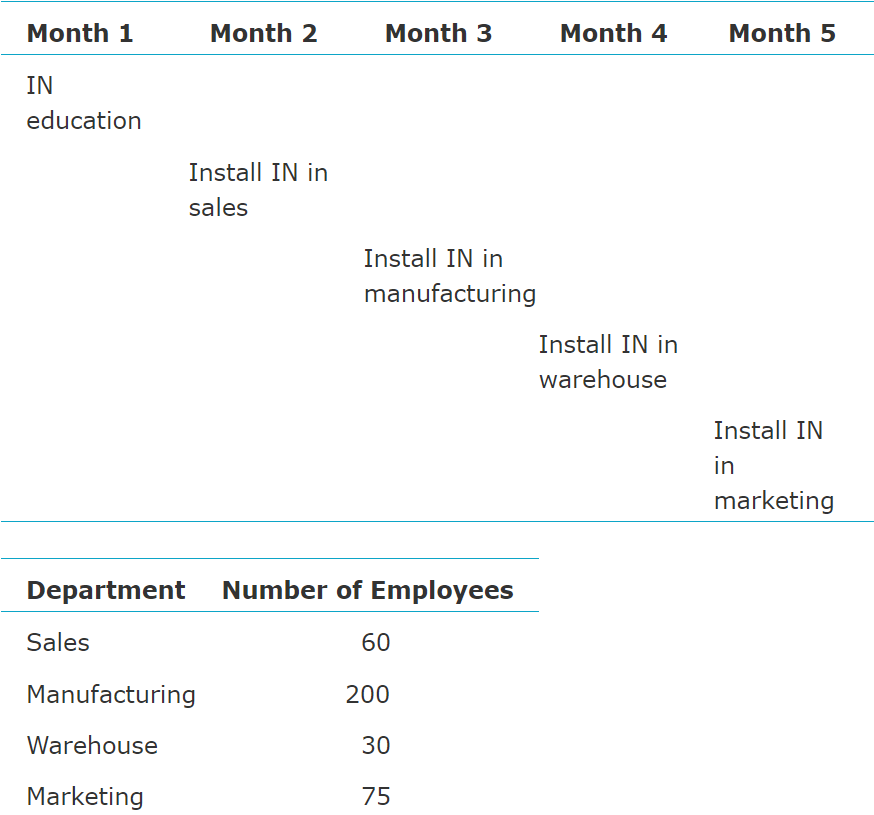
Mr. Hamilton proceeds to explain the timeline and requirements chart. In the first month, I do not want to bring any department onto the intranet; I simply want to disseminate information about it and get buy-in from employees. In the second month, I want to bring the sales department onto the intranet since the sales department receives all critical information from customers. In the third month, I want to bring the manufacturing department onto the intranet. In the fourth month, I want to install the intranet at the warehouse, and in the fifth and final month, I want to bring the marketing department onto the intranet. The requirements chart above lists the number of employees requiring access to the intranet in each department.
Mr. Hamilton turns to Emily Jones, the head of Corporate Information Management. I need your help in planning for the installation of the intranet. Specifically, the company needs to purchase servers for the internal network. Employees will connect to company servers and download information to their own desktop computers.
Mr. Hamilton passes Emily the following chart detailing the types of servers available, the number of employees each server supports, and the cost of each server.
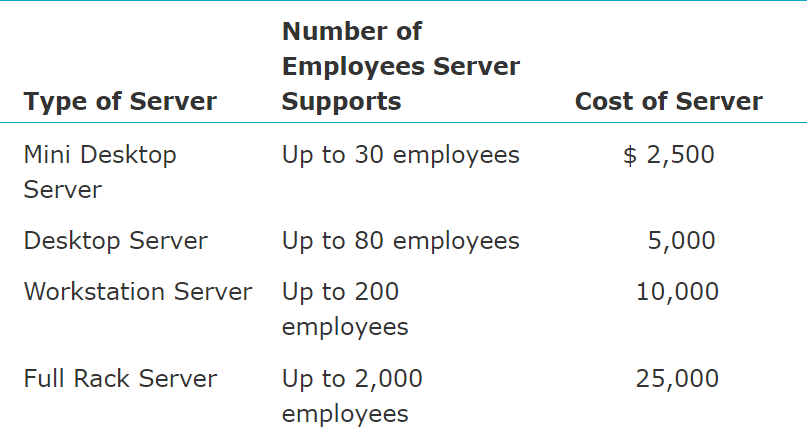
Emily, I need you to decide what servers to purchase and when to purchase them to minimize cost and to ensure that the company possesses enough server capacity to follow the intranet implementation timeline, Mr. Hamilton says. For example, you may decide to buy one large server during the first month to support all employees, or buy several small servers during the first month to support all employees, or buy one small server each month to support each new group of employees gaining access to the intranet.
There are several factors that complicate your decision, Mr. Hamilton continues. We can get a discount of 10 percent off each workstation server purchased, but only if we purchase servers in the first or second month. We can get a 25 percent discount off all full rack servers purchased in the first two months. You are also limited in the amount of money you can spend during the first month. CommuniCorp has already allocated much of the budget for the next two months, so you only have a total of $9,500 available to purchase servers in months 1 and 2. Finally, the manufacturing department requires at least one of the three more powerful servers. Have your decision on my desk at the end of the week.
a. Emily first decides to evaluate the number and type of servers to purchase on a month-to-month basis. For each month, formulate a spreadsheet model to determine which servers Emily should purchase in that month to minimize costs in that month and support the new users given your results for the preceding months. How many and which types of servers should she purchase in each month? How much is the total cost of the plan?
b. Emily realizes that she could perhaps achieve savings if she bought a larger server in the initial months to support users in the final months. She, therefore, decides to evaluate the number and type of servers to purchase over the entire planning period. Formulate a spreadsheet model to determine which servers Emily should purchase in which months to minimize total cost and support all new users. How many and which types of servers should she purchase in each month? How much is the total cost of the plan?
c. Why is the answer using the first method different from that using the second method?
d. Are there other costs for which Emily is not accounting in her problem formulation? If so, what are they?
e. What further concerns might the various departments of CommuniCorp have regarding the intranet?
Month 1 Month 2 Month 3 Month 4 Month 5 IN education Install IN in sales Install IN in manufacturing Install IN in warehouse Install IN in marketing Department Number of Employees Sales 60 Manufacturing 200 Warehouse 30 Marketing 75 Number of Employees Server Supports Type of Server Cost of Server Mini Desktop Server Up to 30 employees $ 2,500 Desktop Server Up to 80 employees 5,000 10,000 Workstation Server Up to 200 employees Full Rack Server 25,000 Up to 2,000 employeesStep by Step Solution
There are 3 Steps involved in it

Get step-by-step solutions from verified subject matter experts