







Question: CASE # 4 (BUILDING A BETTER BOSS) Google doesnt do anything halfway. So when it decided to build a better boss, it did what it
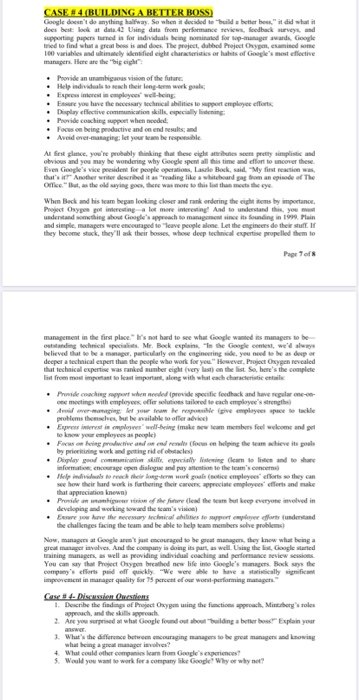
CASE # 4 (BUILDING A BETTER BOSS)
Google doesnt do anything halfway. So when it decided to build a better boss, it did what it does best: look at data.42 Using data from performance reviews, feedback surveys, and supporting papers turned in for individuals being nominated for top-manager awards, Google tried to find what a great boss is and does. The project, dubbed Project Oxygen, examined some 100 variables and ultimately identified eight characteristics or habits of Googles most effective managers. Here are the big eight:
Provide an unambiguous vision of the future;
Help individuals to reach their long-term work goals;
Express interest in employees well-being;
Ensure you have the necessary technical abilities to support employee efforts;
Display effective communication skills, especially listening;
Provide coaching support when needed;
Focus on being productive and on end results; and
Avoid over-managing; let your team be responsible.
At first glance, youre probably thinking that these eight attributes seem pretty simplistic and obvious and you may be wondering why Google spent all this time and effort to uncover these. Even Googles vice president for people operations, Laszlo Bock, said, My first reaction was, thats it? Another writer described it as reading like a whiteboard gag from an episode of The Office. But, as the old saying goes, there was more to this list than meets the eye.
When Bock and his team began looking closer and rank ordering the eight items by importance, Project Oxygen got interestinga lot more interesting! And to understand this, you must understand something about Googles approach to management since its founding in 1999. Plain and simple, managers were encouraged to leave people alone. Let the engineers do their stuff. If they become stuck, theyll ask their bosses, whose deep technical expertise propelled them to
Page 7 of 8
management in the first place. Its not hard to see what Google wanted its managers to be outstanding technical specialists. Mr. Bock explains, In the Google context, wed always believed that to be a manager, particularly on the engineering side, you need to be as deep or deeper a technical expert than the people who work for you. However, Project Oxygen revealed that technical expertise was ranked number eight (very last) on the list. So, heres the complete list from most important to least important, along with what each characteristic entails:
Provide coaching support when needed (provide specific feedback and have regular one-on- one meetings with employees; offer solutions tailored to each employees strengths)
Avoid over-managing; let your team be responsible (give employees space to tackle problems themselves, but be available to offer advice)
Express interest in employees well-being (make new team members feel welcome and get to know your employees as people)
Focus on being productive and on end results (focus on helping the team achieve its goals by prioritizing work and getting rid of obstacles)
Display good communication skills, especially listening (learn to listen and to share information; encourage open dialogue and pay attention to the teams concerns)
Help individuals to reach their long-term work goals (notice employees efforts so they can see how their hard work is furthering their careers; appreciate employees efforts and make that appreciation known)
Provide an unambiguous vision of the future (lead the team but keep everyone involved in developing and working toward the teams vision)
Ensure you have the necessary technical abilities to support employee efforts (understand the challenges facing the team and be able to help team members solve problems)
Now, managers at Google arent just encouraged to be great managers, they know what being a great manager involves. And the company is doing its part, as well. Using the list, Google started training managers, as well as providing individual coaching and performance review sessions. You can say that Project Oxygen breathed new life into Googles managers. Bock says the companys efforts paid off quickly. We were able to have a statistically significant improvement in manager quality for 75 percent of our worst-performing managers.
Case # 4- Discussion Questions
1. Describe the findings of Project Oxygen using the functions approach, Mintzbergs roles approach, and the skills approach.
2. Are you surprised at what Google found out about building a better boss? Explain your answer.
3. Whats the difference between encouraging managers to be great managers and knowing what being a great manager involves?
4. What could other companies learn from Googles experiences?
5. Would you want to work for a company like Google? Why or why not?
i want the answer to be from the text if you can !!
 this is the question , you need to solve the question below according to the prograph
 there is no reference
CASE # 4 (BUILDING A BETTER BOSS) Google doesn't do anything halfway, So when it decided to build a better bor." it did what it dees best look at duta. Using data from performance reviews feedback surveys, and supporting papers turned in for individuals being nominated for top-manager awards, Google med to find what a great besis and does. The project, dubbed Project Oxygen, examined some 100 variables and ultimately wentfied eighe characteristikos ar lahes of Google's mest effective managers. Here are the big eight Provide an unambigeous vision of the future Help individuals to reach their long-term work goale Express interest in cmployees' wall-being Ensure you have the necessary technical abilities opport employee efforts Diply effective communication skills, capecially idening Provide coaching support when needed Focus on being productive and on end results, and Avoid over-maapinglet your team be responsible A fest glance, you're probably thinking that these sighet attributes sem pretty simplistic and obvious and you may be wondering why Google spent all this time and effort to uncover these Even Google's vice president for people operations. Laszle Heck said. "My first reactie was that's itt Another write described it as reading like a whiteboard pas from an episode of The Office." But, as the old saying goes, there was more to this list than meets the ye When Beck and his team began looking closer and rank ordering the eight items by importance. Project Oxygen got interesting lot more interesting! And to understand this, you must undenstand something about Google's approach to management since its founding in 1999. Pain and simple managers were encouraged to leave people alone. Let the engineers do the stuff they become stuck, they'll ask their bosses, whose deep technical expertise propelled them to Photo management in the first place." I's not hard to see what Google wanted its managers to be outstanding technical specialists Me Beck explains in the Google content, we'd lys believed that to be a manager, particularly on the engineering you need to be as deep deeper a technical expert than the people who work for you. However, Project Oxygen revealed that technical expertise was ranked number eight (very last on the listSo here's the complete list from most important to least important, along with what each characteristicile Provide coaching rapport when needed (provide specific foodlock and have regular one-on- ne meetings with employees offer solutions tailored to each employee's strength Adevering where give employeespace to take problems thensche, but be available to offer advice) Express interest in employees' well-being make new leam members feel welcome and get to know your employees as people) Fac en bring product and on and rele (fom en helping the team achieve its pools by prioriting work and ignobles) Display i skill percially istening cam to listen and to share information encourage open dialogue and pay attention to the team's concern Help individuals to reach their long-term word goals (stice employees efforts so they can e how their hard work is furthering their career appreciate employees oferts and make that appreciation new Provide an anger if the future lead the team but keep everyone involved in developing and working toward the w') . En how the way cicales to support player for understand the challenges facing the team and be able to help team members solve problems) Now, managers at Google aren't just encouraged to be great managers, they know what being a great manager involves. And the company is doing its part, as well. Using the list Google started training managers, as well as providing individual coaching and performance review sessions You can say that Project Oxyp breathed new life into Google's managers. Beck says the company's efforts paid off quickly "We were able to have a statistically significant improvement in manager quality 75 percent of our was performing manager." Cos # - Discussion Ouestions 1. Describe the findings of Project Orygom using the functions approach. Mintzberg roles approach, and the approach 2. Are you surprised at what Google found out about building a better boss Explain your 3. What's the difference between encouraging managers to be great mange and knowing what being a great manager inves? + What could other companies are from Google's experiences 5. Would you want to work for a company like Google? Why why not Step by Step Solution
There are 3 Steps involved in it
1 Expert Approved Answer
Step: 1 Unlock

Question Has Been Solved by an Expert!
Get step-by-step solutions from verified subject matter experts
Step: 2 Unlock
Step: 3 Unlock
 Study Help