



Question: Case 4: PRISCILLA D. WEBSTER v. BLUE SHIP TEA ROOM, INC. Supreme Judicial Court of Massachusetts FACTS: Priscilla Webster, a restaurant patron who ordered seafood
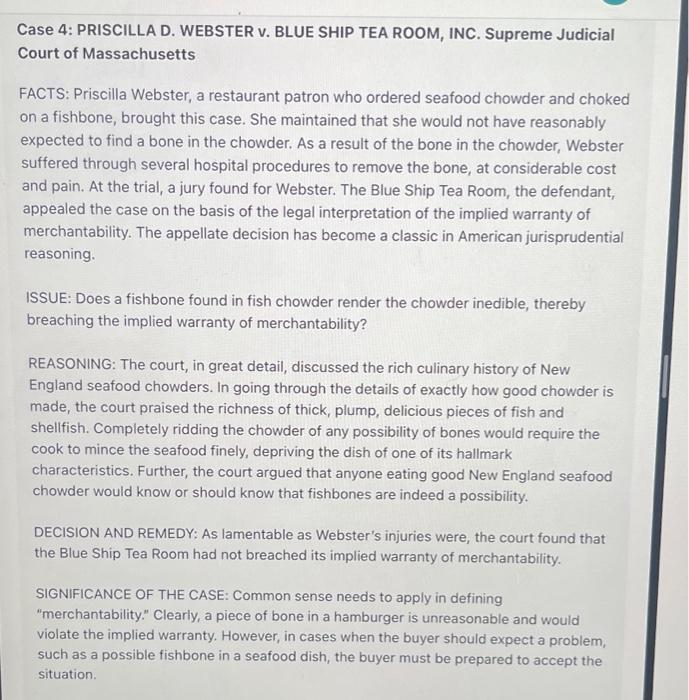
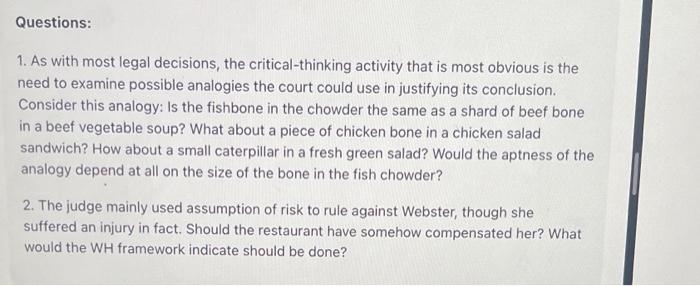
Case 4: PRISCILLA D. WEBSTER v. BLUE SHIP TEA ROOM, INC. Supreme Judicial Court of Massachusetts FACTS: Priscilla Webster, a restaurant patron who ordered seafood chowder and choked on a fishbone, brought this case. She maintained that she would not have reasonably expected to find a bone in the chowder. As a result of the bone in the chowder, Webster suffered through several hospital procedures to remove the bone, at considerable cost and pain. At the trial, a jury found for Webster. The Blue Ship Tea Room, the defendant, appealed the case on the basis of the legal interpretation of the implied warranty of merchantability. The appellate decision has become a classic in American jurisprudential reasoning. ISSUE: Does a fishbone found in fish chowder render the chowder inedible, thereby breaching the implied warranty of merchantability? REASONING: The court, in great detail, discussed the rich culinary history of New England seafood chowders. In going through the details of exactly how good chowder is made, the court praised the richness of thick, plump, delicious pieces of fish and shellfish. Completely ridding the chowder of any possibility of bones would require the cook to mince the seafood finely, depriving the dish of one of its hallmark characteristics. Further, the court argued that anyone eating good New England seafood chowder would know or should know that fishbones are indeed a possibility. DECISION AND REMEDY: As lamentable as Webster's injuries were, the court found that the Blue Ship Tea Room had not breached its implied warranty of merchantability. SIGNIFICANCE OF THE CASE: Common sense needs to apply in defining "merchantability." Clearly, a piece of bone in a hamburger is unreasonable and would violate the implied warranty. However, in cases when the buyer should expect a problem, such as a possible fishbone in a seafood dish, the buyer must be prepared to accept the situation. Questions: 1. As with most legal decisions, the critical-thinking activity that is most obvious is the need to examine possible analogies the court could use in justifying its conclusion. Consider this analogy: Is the fishbone in the chowder the same as a shard of beef bone in a beef vegetable soup? What about a piece of chicken bone in a chicken salad sandwich? How about a small caterpillar in a fresh green salad? Would the aptness of the analogy depend at all on the size of the bone in the fish chowder? 2. The judge mainly used assumption of risk to rule against Webster, though she suffered an injury in fact. Should the restaurant have somehow compensated her? What would the WH framework indicate should be done
Step by Step Solution
There are 3 Steps involved in it

Get step-by-step solutions from verified subject matter experts