







Question: Case 5: Capital Budgeting 2 - REQUIRED CASE - The existing line of cleats has unit sales of 20,000 at a price of $26. Cost
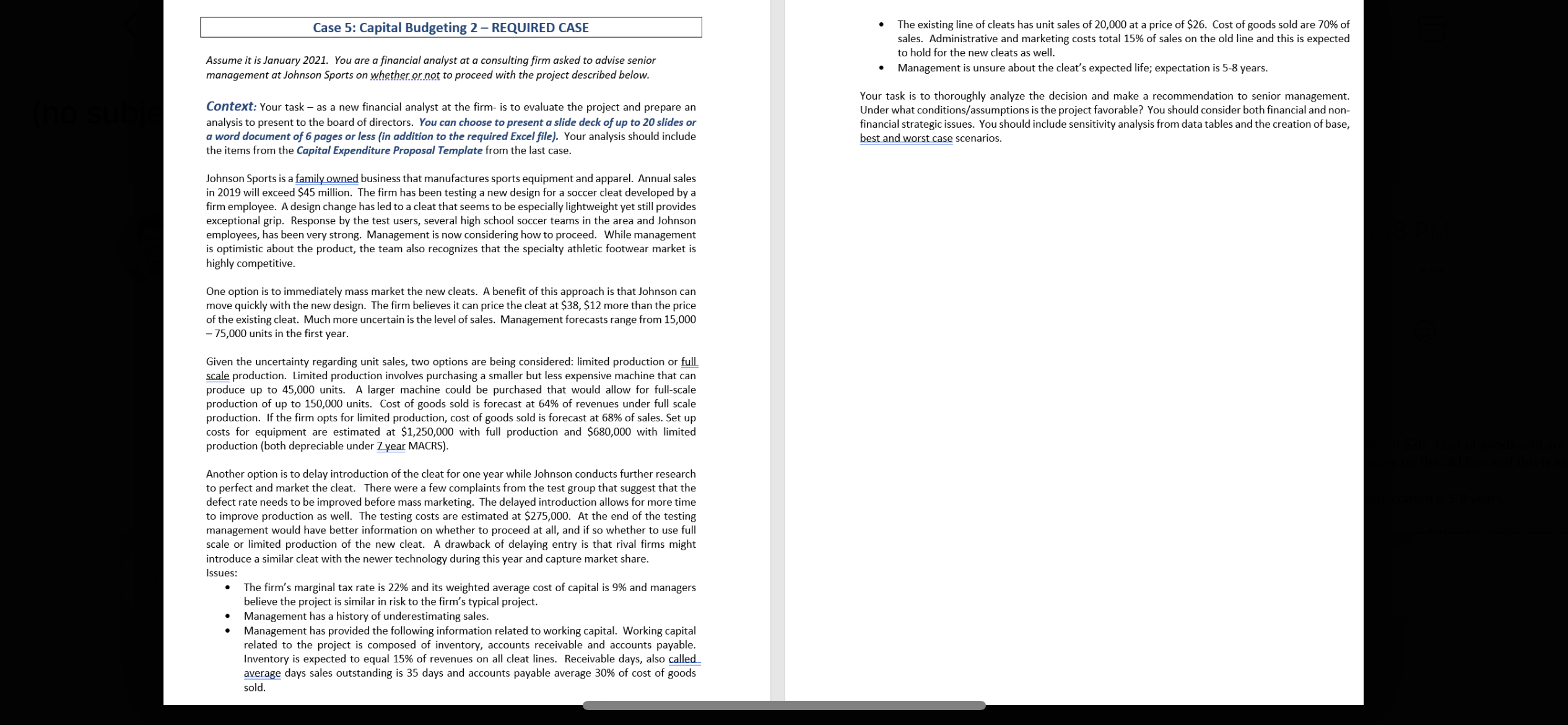
Case 5: Capital Budgeting 2 - REQUIRED CASE - The existing line of cleats has unit sales of 20,000 at a price of $26. Cost of goods sold are 70% of sales. Administrative and marketing costs total 15% of sales on the old line and this is expected Assume it is January 2021. You are a financial analyst at a consulting firm asked to advise senior to hold for the new cleats as well. management at Johnson Sports on whether. or not to proceed with the project described below. - Management is unsure about the cleat's expected life; expectation is 5-8 years. Your task is to thoroughly analyze the decision and make a recommendation to senior management. Context: Your task - as a new financial analyst at the firm- is to evaluate the project and prepare an Under what conditions/assumptions is the project favorable? You should consider both financial and nonanalysis to present to the board of directors. You can choose to present a slide deck of up to 20 slides or financial strategic issues. You should include sensitivity analysis from data tables and the creation of base, a word document of 6 pages or less (in addition to the required Excel file). Your analysis should include the items from the Capital Expenditure Proposal Template from the last case. Johnson Sports is a family owned business that manufactures sports equipment and apparel. Annual sales in 2019 will exceed $45 million. The firm has been testing a new design for a soccer cleat developed by a firm employee. A design change has led to a cleat that seems to be especially lightweight yet still provides exceptional grip. Response by the test users, several high school soccer teams in the area and Johnson employees, has been very strong. Management is now considering how to proceed. While management is optimistic about the product, the team also recognizes that the specialty athletic footwear market is highly competitive. One option is to immediately mass market the new cleats. A benefit of this approach is that Johnson can move quickly with the new design. The firm believes it can price the cleat at $38,$12 more than the price of the existing cleat. Much more uncertain is the level of sales. Management forecasts range from 15,000 75,000 units in the first year. Given the uncertainty regarding unit sales, two options are being considered: limited production or full. scale production. Limited production involves purchasing a smaller but less expensive machine that can produce up to 45,000 units. A larger machine could be purchased that would allow for full-scale production of up to 150,000 units. Cost of goods sold is forecast at 64% of revenues under full scale production. If the firm opts for limited production, cost of goods sold is forecast at 68% of sales. Set up costs for equipment are estimated at $1,250,000 with full production and $680,000 with limited production (both depreciable under 7 year MACRS). Another option is to delay introduction of the cleat for one year while Johnson conducts further research to perfect and market the cleat. There were a few complaints from the test group that suggest that the defect rate needs to be improved before mass marketing. The delayed introduction allows for more time to improve production as well. The testing costs are estimated at $275,000. At the end of the testing management would have better information on whether to proceed at all, and if so whether to use full scale or limited production of the new cleat. A drawback of delaying entry is that rival firms might introduce a similar cleat with the newer technology during this year and capture market share. Issues: - The firm's marginal tax rate is 22% and its weighted average cost of capital is 9% and managers believe the project is similar in risk to the firm's typical project. - Management has a history of underestimating sales. - Management has provided the following information related to working capital. Working capital related to the project is composed of inventory, accounts receivable and accounts payable. Inventory is expected to equal 15% of revenues on all cleat lines. Receivable days, also called average days sales outstanding is 35 days and accounts payable average 30% of cost of goods Case 5: Capital Budgeting 2 - REQUIRED CASE - The existing line of cleats has unit sales of 20,000 at a price of $26. Cost of goods sold are 70% of sales. Administrative and marketing costs total 15% of sales on the old line and this is expected Assume it is January 2021. You are a financial analyst at a consulting firm asked to advise senior to hold for the new cleats as well. management at Johnson Sports on whether. or not to proceed with the project described below. - Management is unsure about the cleat's expected life; expectation is 5-8 years. Your task is to thoroughly analyze the decision and make a recommendation to senior management. Context: Your task - as a new financial analyst at the firm- is to evaluate the project and prepare an Under what conditions/assumptions is the project favorable? You should consider both financial and nonanalysis to present to the board of directors. You can choose to present a slide deck of up to 20 slides or financial strategic issues. You should include sensitivity analysis from data tables and the creation of base, a word document of 6 pages or less (in addition to the required Excel file). Your analysis should include the items from the Capital Expenditure Proposal Template from the last case. Johnson Sports is a family owned business that manufactures sports equipment and apparel. Annual sales in 2019 will exceed $45 million. The firm has been testing a new design for a soccer cleat developed by a firm employee. A design change has led to a cleat that seems to be especially lightweight yet still provides exceptional grip. Response by the test users, several high school soccer teams in the area and Johnson employees, has been very strong. Management is now considering how to proceed. While management is optimistic about the product, the team also recognizes that the specialty athletic footwear market is highly competitive. One option is to immediately mass market the new cleats. A benefit of this approach is that Johnson can move quickly with the new design. The firm believes it can price the cleat at $38,$12 more than the price of the existing cleat. Much more uncertain is the level of sales. Management forecasts range from 15,000 75,000 units in the first year. Given the uncertainty regarding unit sales, two options are being considered: limited production or full. scale production. Limited production involves purchasing a smaller but less expensive machine that can produce up to 45,000 units. A larger machine could be purchased that would allow for full-scale production of up to 150,000 units. Cost of goods sold is forecast at 64% of revenues under full scale production. If the firm opts for limited production, cost of goods sold is forecast at 68% of sales. Set up costs for equipment are estimated at $1,250,000 with full production and $680,000 with limited production (both depreciable under 7 year MACRS). Another option is to delay introduction of the cleat for one year while Johnson conducts further research to perfect and market the cleat. There were a few complaints from the test group that suggest that the defect rate needs to be improved before mass marketing. The delayed introduction allows for more time to improve production as well. The testing costs are estimated at $275,000. At the end of the testing management would have better information on whether to proceed at all, and if so whether to use full scale or limited production of the new cleat. A drawback of delaying entry is that rival firms might introduce a similar cleat with the newer technology during this year and capture market share. Issues: - The firm's marginal tax rate is 22% and its weighted average cost of capital is 9% and managers believe the project is similar in risk to the firm's typical project. - Management has a history of underestimating sales. - Management has provided the following information related to working capital. Working capital related to the project is composed of inventory, accounts receivable and accounts payable. Inventory is expected to equal 15% of revenues on all cleat lines. Receivable days, also called average days sales outstanding is 35 days and accounts payable average 30% of cost of goods
Step by Step Solution
There are 3 Steps involved in it

Get step-by-step solutions from verified subject matter experts
 Study Help