







Question: CASE 6. Answer Question 3 ONLY!!!!!! ISCUSSION QUESTIONS do you think of the concept of converting the top Floors of the YMCA to a budget
CASE 6. Answer Question 3 ONLY!!!!!!
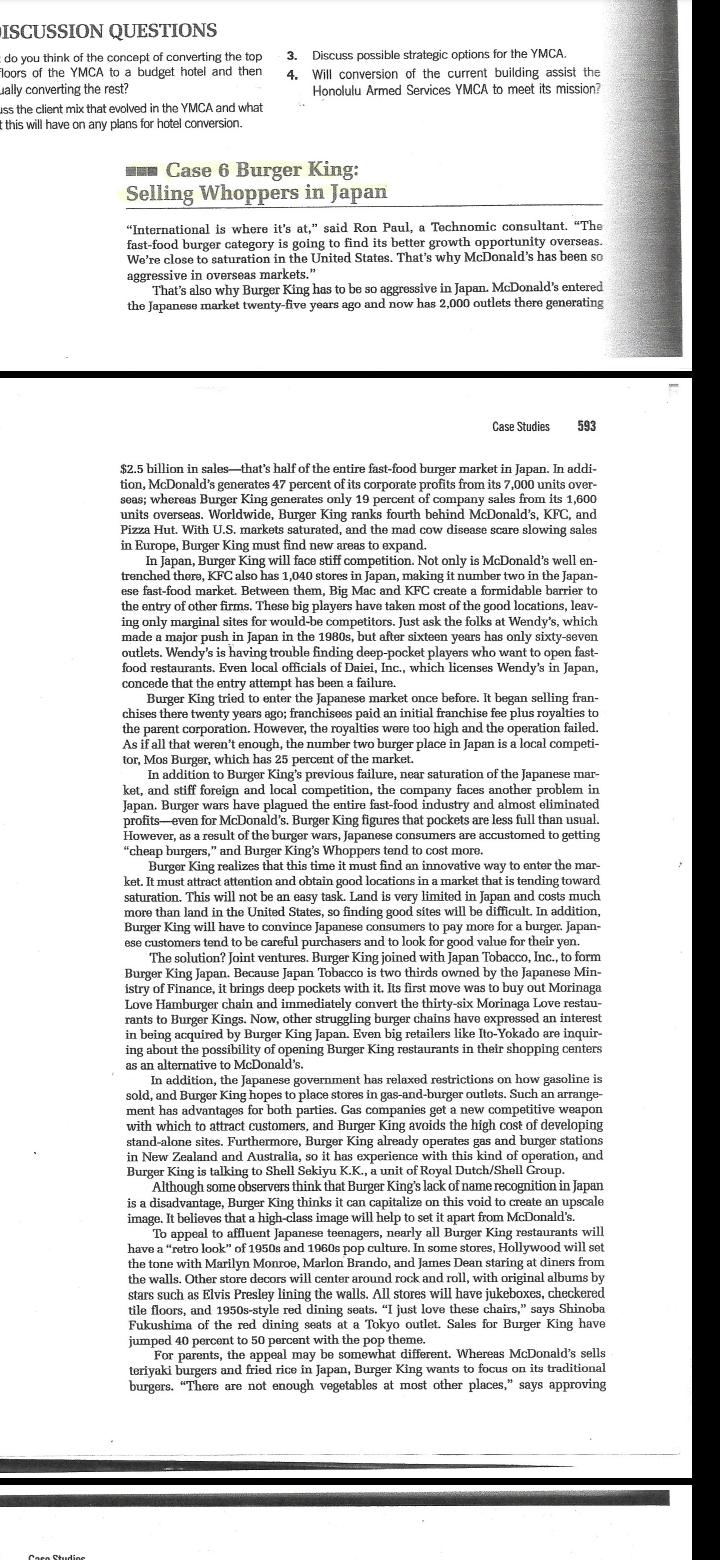
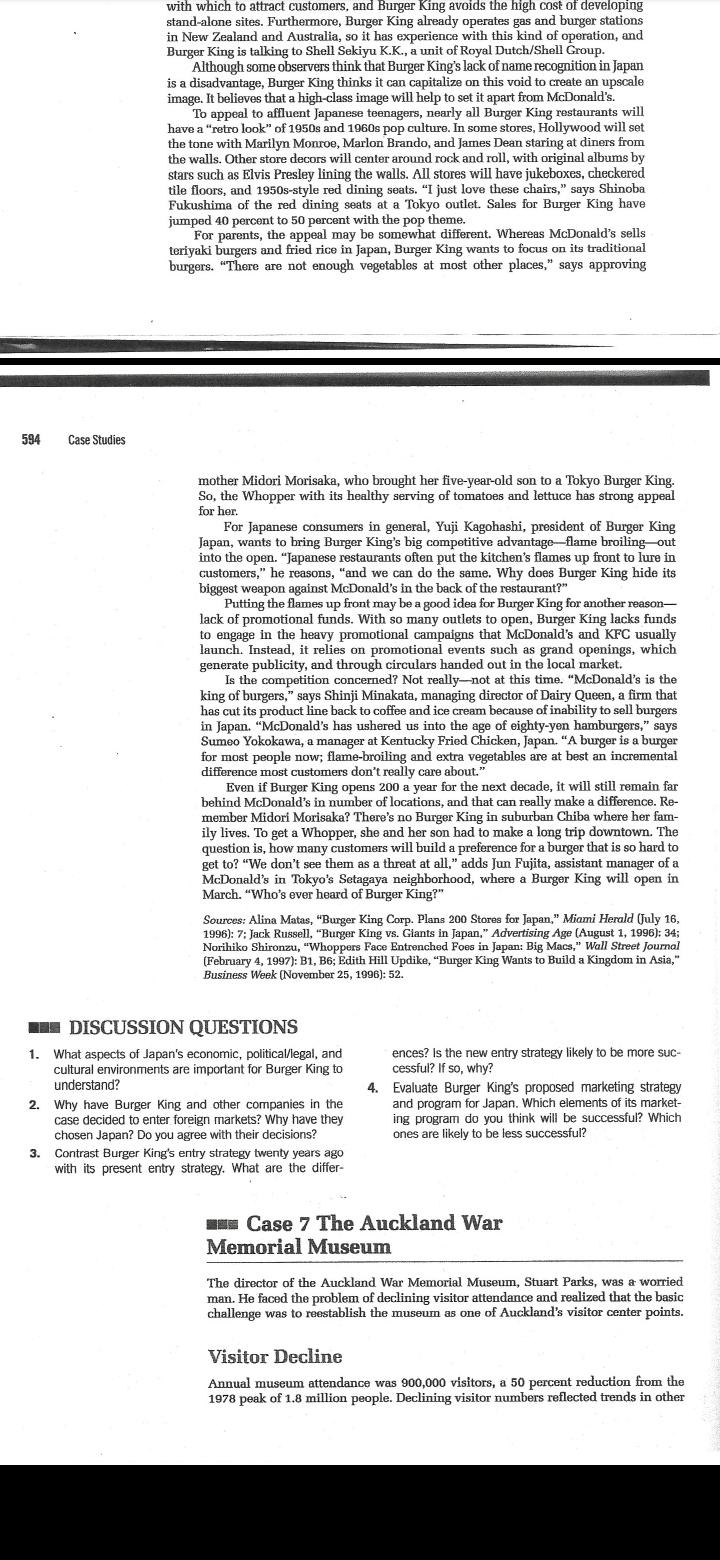
ISCUSSION QUESTIONS do you think of the concept of converting the top Floors of the YMCA to a budget hotel and then ally converting the rest? uss the client mix that evolved in the YMCA and what t this will have on any plans for hotel conversion. 3 Discuss possible strategic options for the YMCA. 4. Will conversion of the current building assist the Honolulu Armed Services YMCA to meet its mission? - Case 6 Burger King: Selling Whoppers in Japan "International is where it's at, said Ron Paul, a Technomic consultant. "The fast-food burger category is going to find its better growth opportunity overseas. We're close to saturation in the United States. That's why McDonald's has been so aggressive in overseas markets. That's also why Burger King has to be so aggressive in Japan. McDonald's entered the Japanese market twenty-five years ago and now has 2,000 outlets there generating Case Studies 593 made a $2.5 billion in sales-that's half of the entire fast-food burger market in Japan. In addi- tion, McDonald's generates 47 percent of its corporate profits from its 7,000 units over- seas; whereas Burger King generates only 19 percent of company sales from its 1,600 units overseas. Worldwide, Burger King ranks fourth behind McDonald's, KFC, and Pizza Hut. With U.S. markets saturated, and the mad cow disease scare slowing sales in Europe, Burger King must find new areas to expand. In Japan, Burger King will face stiff competition. Not only is McDonald's well en- trenched there, KFC also has 1,040 stores in Japan, making it number two in the Japan- ese fast-food market. Between them, Big Mac and KFC create a formidable barrier to the entry of other firms. These big players have taken most of the good locations, leav- ing only marginal sites for would be competitors. Just ask the folks at Wendy's, which a major push in Japan in the 1980s, but after sixteen years has only sixty-seven outlets. Wendy's is having trouble finding deep-pocket players who want to open fast- food restaurants. Even local officials of Daiei, Inc., which licenses Wendy's in Japan, concede that the entry attempt has been a failure. Burger King tried to enter the Japanese market once before. It began selling fran- chises there twenty years ago; franchisees paid an initial franchise fee plus royalties to the parent corporation. However, the royalties were too high and the operation failed. As if all that weren't enough, the number two burger place in Japan is a local competi- tor, Mos Burger, which has 25 percent of the market. In addition to Burger King's previous failure, near saturation of the Japanese mar- ket, and stiff foreign and local competition, the company faces another problem in Japan. Burger wars have plagued the entire fast-food industry and almost eliminated profitseven for McDonald's. Burger King figures that pockets are less full than usual. However, as a result of the burger wars, Japanese consumers are accustomed to getting "cheap burgers," and Burger King's Whoppers tend to cost more. Burger King realizes that this time it must find an innovative way to enter the mar- ket. It must attract attention and obtain good locations in a market that is tending toward saturation. This will not be an easy task. Land is very limited in Japan and costs much more than land in the United States, so finding good sites will be difficult . In addition, Burger King will have to convince Japanese consumers to pay more for a burger. Japan- tend to be careful purchasers and to look for good value for their yen. The solution? Joint ventures. Burger King joined with Japan Tobacco, Inc., to form Burger King Japan. Because Japan Tobacco is two thirds owned by the Japanese Min- istry of Finance, it brings deep pockets with it. Its first move was to buy out Morinaga Love Hamburger chain and immediately convert the thirty-six Morinaga Love restau- rants to Burger Kings. Now, other struggling burger chains have expressed an interest in being acquired by Burger King Japan. Even big retailers like Ito-Yokado are inquir- ing about the possibility of opening Burger King restaurants in their shopping centers as an alternative to McDonald's. In addition, the Japanese government has relaxed restrictions on how gasoline is sold, and Burger King hopes to place stores in gas-and-burger outlets. Such an arrange- ment has advantages for both parties. Gas companies get a new competitive weapon with which to attract customers, and Burger King avoids the high cost of developing stand-alone sites. Furthermore, Burger King already operates gas and burger stations in New Zealand and Australia, so it has experience with this kind of operation, and Burger King is talking to Shell Sekiyu K.K., a unit of Royal Dutch/Shell Group. Although some observers think that Burger King's lack of name recognition in Japan is a disadvantage, Burger King thinks it can capitalize on this void to create an upscale image. It believes that a high-class image will help to set it apart t from McDonald's appeal to afluent Japanese teenagers, nearly all Burger King restaurants will have a "retro look of 1950s and 1960s pop culture. In some stores, Hollywood will set the tone with Marilyn Monroe, Marlon Brando, and James Dean staring at diners from the walls. Other store decors will center around rock and roll, with original albums by stars such as Elvis Presley lining the walls. All stores will have jukeboxes, checkered tile floors, and 1950s-style red dining seats. I just love these chairs," says Shinoba Fukushima of the red dining seats at a Tokyo outlet. Sales for Burger King have jumped 40 percent to 50 percent with the pop theme. For parents, the appeal may be somewhat different. Whereas McDonald's sells teriyaki burgers and fried rice in Japan, Burger King wants to focus on its traditional burgers. "There are not enough vegetables at most other places," says approving ese customers tend Caca Studine with which to attract customers, and Burger King avoids the high cost of developing stand-alone sites. Furthermore, Burger King already operates gas and burger stations in New Zealand and Australia, so it has experience with this kind of operation, and Burger King is talking to Shell Sekiyu K.K., a unit of Royal Dutch/Shell Group. Although some observers think that Burger King's lack of name recognition in Japan is a disadvantage, Burger King thinks it can capitalize on this void to create an upscale image. It believes that a high-class image will help to set it apart from McDonald's. To appeal to affluent Japanese teenagers, nearly all Burger King restaurants will have a "retro look" of 1950s and 1960s pop culture. In some stores, Hollywood will set the tone with Marilyn Monroe, Marlon Brando, and James Dean staring at diners from the walls. Other store decors will center around rock and roll, with original albums by stars such as Elvis Presley lining the walls. All stores will have jukeboxes, checkered tile floors, and 1950s-style red dining seats. I just love these chairs," says Shinoba Fukushima of the red dining seats at a Tokyo outlet. Sales for Burger King have jumped 40 percent to 50 percent with the pop theme. For parents, the appeal may be somewhat different. Whereas McDonald's sells teriyaki burgers and fried rice in Japan, Burger King wants to focus on its traditional burgers. "There are not enough vegetables at most other places," says approving 594 Case Studies mother Midori Morisaka, who brought her five-year-old son to a Tokyo Burger King. So, the Whopper with its healthy serving of tomatoes and lettuce has strong appeal for her. For Japanese consumers in general, Yuji Kagohashi, president of Burger King Japan, wants to bring Burger King's big competitive advantageflame broiling-out into the open. Japanese restaurants often put the kitchen's flames up front to lure in customers," he reasons, "and we can do the same. Why does Burger King hide its biggest weapon against McDonald's in the back of the restaurant?" Putting the flames up front may be a good idea for Burger King for another reason- lack of promotional funds. With so many outlets to open, Burger King lacks funds to engage in the heavy promotional campaigns that McDonald's and KFC usually launch. Instead, it relies on promotional events such as grand openings, which generate publicity, and through circulars handed out in the local market. Is the e competition concerned? Not really-not at this time. McDonald's is the king of burgers," says Shinji Minakata, managing director of Dairy Queen, a firm that has cut its product line back to coffee and ice cream because of inability to sell burgers in Japan. "McDonald's has ushered us into the age of eighty-yen hamburgers," says Sumeo Yokokawa, a manager at Kentucky Fried Chicken, Japan. A burger is a burger for most people now; flame-broiling and extra vegetables are at best an incremental difference most customers don't really care about." Even if Burger King opens 200 a year for the next decade, it will still remain far behind McDonald's in number of locations, and that can really make a difference. Re- member Midori Morisaka? There's no Burger King in suburban Chiba where her fam- ily lives. To get a Whopper, she and her son had to make a long trip downtown. The question is, how many customers will build a preference for a burger that is so hard to get to? "We don't see them as a threat at all." adds Jun Fujita, assistant manager of a McDonald's in Tokyo's Setagaya neighborhood, where a Burger King will open in March. "Who's ever heard of Burger King?" Sources: Alina Matas, "Burger King Corp. Plans 200 Stores for Japan," Miami Herald (July 16, 1996): 7: Jack Russell, "Burger King vs. Giants in Japan," Advertising Age (August 1, 1996): 34; Norihiko Shironzu, "Whoppers Face Entrenched Foes in Japan: Big Macs," Wall Street Journal (February 4, 1997): B1, B6; Edith Hill Updike, Burger King Wants to Build a Kingdom in Asia," Business Week (November 25, 1996): 52. a A DISCUSSION QUESTIONS 1. What aspects of Japan's economic, political/legal, and cultural environments are important for Burger King to understand? 2. Why have Burger King and other companies in the case decided to enter foreign markets? Why have they chosen Japan? Do you agree with their decisions? 3. Contrast Burger King's entry strategy twenty years ago with its present entry strategy. What are the differ- ences? Is the new entry strategy likely to be more suc- cessful? If so, why? 4. Evaluate Burger King's proposed marketing strategy and program for Japan. Which elements of its market- ing program do you think will be successful? Which ones are likely to be less successful? e Case 7 The Auckland War Memorial Museum The director of the Auckland War Memorial Museum, Stuart Parks, was a worried man. He faced the problem of declining visitor attendance and realized that the basic challenge was to reestablish the museum as one of Auckland's visitor center points. Visitor Decline Annual museum attendance was 900,000 visitors, a 50 percent reduction from the 1978 peak of 1.8 million people. Declining visitor numbers reflected trends in otherStep by Step Solution
There are 3 Steps involved in it
1 Expert Approved Answer
Step: 1 Unlock

Question Has Been Solved by an Expert!
Get step-by-step solutions from verified subject matter experts
Step: 2 Unlock
Step: 3 Unlock
 Study Help