







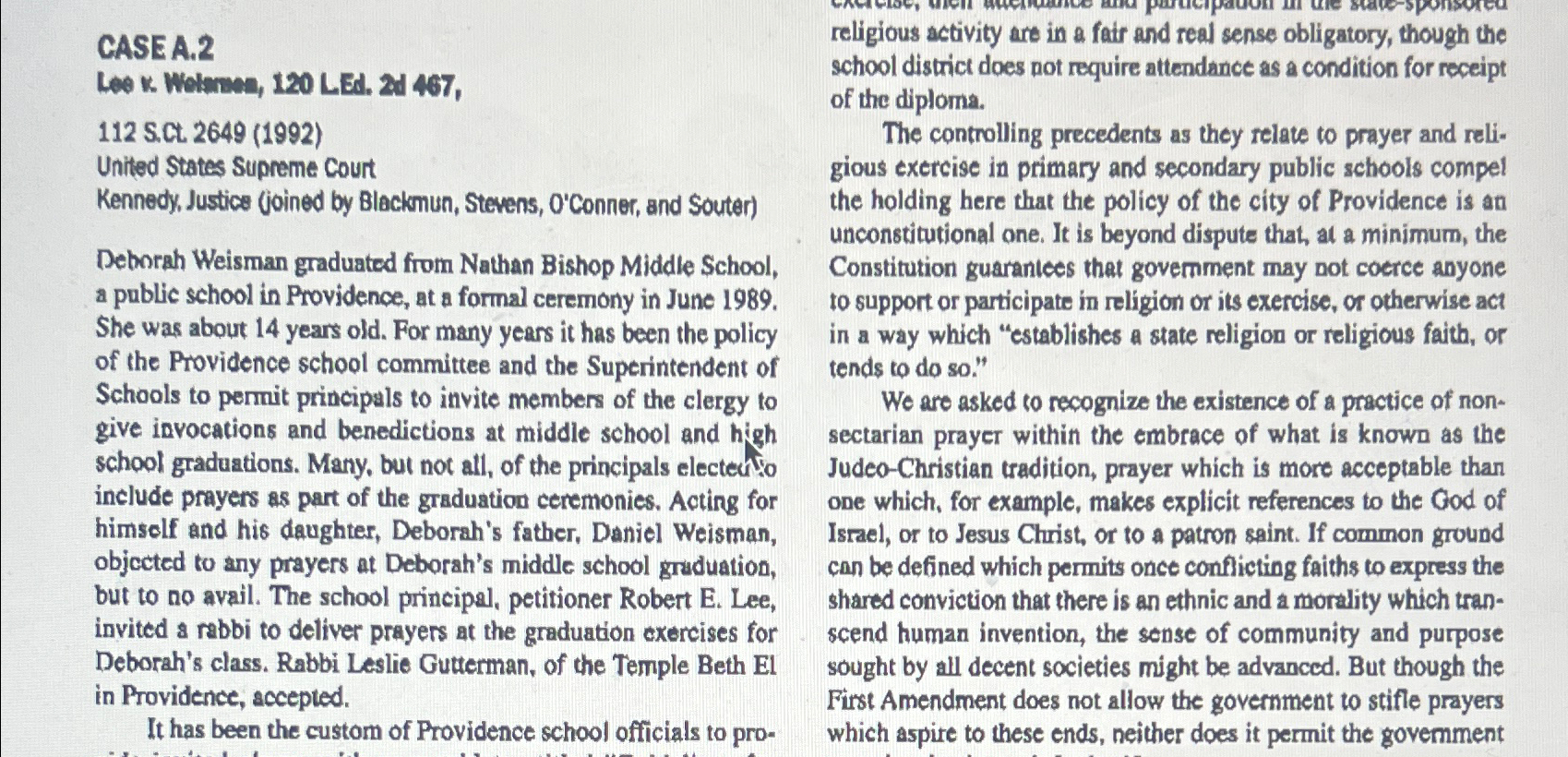
Question: CASE A . 2 Leo k . Wolmana, 1 2 0 LEd. 2 d 4 6 7 , 1 1 2 S . C .
CASE A
Leo k Wolmana, LEd. d
SC
United States Supreme Court
Kennedy, Justice joined by Blackmun, Stevens, Conner, and Souter
Deborah Weisman graduated from Nathan Bishop Middle School, a public school in Providence, at a formal ceremony in June She was about years old. For many years it has been the policy of the Providence school committee and the Superintendent of Schools to permit principals to invite members of the clergy to give invocations and benedictions at middle school and high school graduations. Many, but not all, of the principals electertso include prayers as part of the graduation ceremonies. Acting for himself and his daughter, Deborah's father, Daniel Weisman, objected to any prayers at Deborah's middle school graduation, but to no avail. The school principal, petitioner Robert E Lee, invited a rabbi to deliver prayers at the graduation exercises for Deborah's class. Rabbi Leslie Gutterman, of the Temple Beth EI in Providence, sccepted.
It has been the custom of Providence school officials to pro
religious activity are in a fair and real sense obligatory, though the school district does not require attendance as a condition for receipt of the diploma.
The controlling precedents as they relate to prayer and religious exercise in primary and secondary public schools compel the holding here that the policy of the city of Providence is an unconstitutional one. It is beyond dispute that at a minimum, the Constitution guarantees that government may not coerce anyone to support or participate in religion or its exercise, or otherwise act in a way which "establishes a state religion or religious faith, or tends to do so
We are asked to recognize the existence of a practice of nonsectarian prayer within the embrace of what is known as the JudeoChristian tradition, prayer which is more acceptable than one which, for example, makes explicit references to the God of Israel, or to Jesus Christ, or to a patron saint. If common ground can be defined which permits once conflicting faiths to express the shared conviction that there is an ethnic and a morality which transcend human invention, the sense of community and purpose sought by all decent societies might be advanced. But though the First Amendment does not allow the government to stifle prayers which aspire to these ends, neither does it permit the govemment
Step by Step Solution
There are 3 Steps involved in it
1 Expert Approved Answer
Step: 1 Unlock

Question Has Been Solved by an Expert!
Get step-by-step solutions from verified subject matter experts
Step: 2 Unlock
Step: 3 Unlock
 Study Help