







Question: Case Analysis Form Ivey (use this template to organize your research and thoughts) Background Information or synopsis (use point form) Select the most relevant facts
Case Analysis Form Ivey
(use this template to organize your research and thoughts)
| Background Information or synopsis (use point form)
|
| Immediate Issues/Symptoms | ||
| Explain (list from most to least severe) | Who is involved? What is their role and responsibility in creating or resolving this issue? | Impact on costs, quality, customer service, or innovation? |
| Root Cause/Basic UnderlyingIssues | ||
| Explain (list from most to least severe) | Who is involved? What is their role and responsibility in creating or resolving this issue? | Impact on costs, quality, customer service, or innovation? |
Analysis of Case Data
| Causes & Effects |
|
| Constraints |
|
| Opportunities |
|
| Quantitative Data |
|
| Qualitative Data |
|
| Course Concepts Relevant to Case |
|
Describe alternatives to resolve root cause/basic issues.
| Issue | Considerations/Support |
|
|
|
|
|
|
|
|
|
|
|
|
|
|
|
|
|
|
|
|
|
| Decision Criteria | |
| What are the criteria that are important to making this decision? | Justification for choosing this criterion |
|
|
|
|
|
|
|
|
|
|
|
|
|
|
|
Alternative Assessment
Note: You are not required to use 4 criteria or identify 5 alternatives; alter the table as required for your analysis.
| Alternative | Decision Criteria | |||
|
| Criterion 1 | Criterion 2 | Criterion 3 | Criterion 4 |
| Alternative 1 |
|
|
|
|
| Alternative 2 |
|
|
|
|
| Alternative 3 |
|
|
|
|
| Alternative 4 |
|
|
|
|
| Alternative 5 |
|
|
|
|
| Recommendations | |
| Recommendation | Justification for choosing this alternative |
| Implementation Plan | ||||
| What? | Who? | When? | Resources | Monitor/Audit |
| Short Term (
|
|
|
|
|
| Medium Term (3 months 2 years)
|
|
|
|
|
| Long Term (over 2 years)
|
|
|
|
|

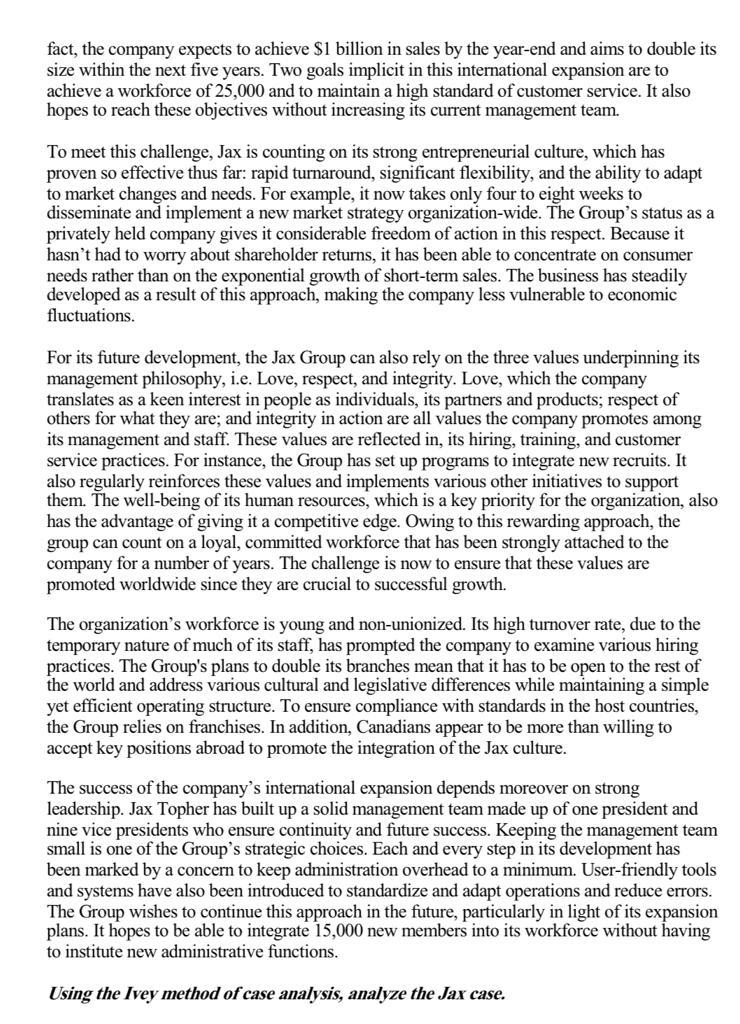
The Jax Group Background The Jax Group is a privately held Canadian company that has been active in fashion footwear and accessories since 1972. Under the leadership of its founder/owner Jax Topher, who is still actively involved in the organization, it has become the country's major player in its industry. The Group owes its reputation as a retailer to its ability to research and develop new concepts and create its own products. Jax Shoes started by setting up footwear concessions within the Manitoba clothing chain. It then expanded rapidly, opening four stores elsewhere in Canada. By 1980 it had some 30 stores to its credit and had launched its diversification and market segmentation program by acquiring stores operating under the Brees banner. Twenty-five years later, the Group now has a total of750 stores in North America, Europe, and 20 other countries, operating under such names as Jax, Orion, Jupiter, Pluto, Thorn, Blaze, and Jax Accessories. What's more, each banner supports a particular cause, for instance contributing to the fight against AIDs or breast cancer or participating in various other charitable initiatives. The company's commitment to community causes help make both its human resources and its clientele more aware of important social issues. Moreover, the Jax Group has built up a client base that includes all age brackets. While the Jax and Orion, Jupiter banners appeal mainly to 18-to-34 year-olds (primarily middle-class youth and students), Thorn and Pluto target families and an older age group The company's non-unionized workforce is made up of part-time (75%) and full-time (25%) personnel. The Group employs 15,000 people in all, including about 600 at its head office in Winnipeg. The head office team mainly focuses on product design and the analysis of fashion trends and marketing techniques. In addition, it is responsible for the design and development of the Group's stores worldwide, using material from local suppliers. Furthermore, in Winnipeg, the company's distribution center is staffed by a team of 400 people who are in charge of receiving and checking products made around the globe and overseeing orders and their delivery to the Group's stores all across North America. The company's operational structure is supported by leading-edge technology to ensure this strategic supply management. Each store is staffed by a manager, an assistant manager, salespeople, cashiers, and a merchandising clerk. Because of its high staff turnover, the group tries to recruit people who are interested in customer service and fashion. In addition to base pay, the company offers a generous incentive program for its full-time workforce. Part-time personnel can also earn good commissions when they reach their sales targets. Thanks to this approach, Jax Group has been able to keep its workforce highly motivated, reward its efforts and carry on its high standard of customer service. Challenges Having achieved such robust growth over the last five years, the Group now faces a substantial organizational challenge. In 2006, it plans to open 150 stores in the United States. In the meantime, it continues to expand globally, particularly through developing its network of franchises and licenses, marketing new concepts, and expanding its e-commerce sites. In fact, the company expects to achieve $1 billion in sales by the year-end and aims to double its size within the next five years. Two goals implicit in this international expansion are to achieve a workforce of 25,000 and to maintain a high standard of customer service. It also hopes to reach these objectives without increasing its current management team. To meet this challenge, Jax is counting on its strong entrepreneurial culture, which has proven so effective thus far: rapid turnaround, significant flexibility, and the ability to adapt to market changes and needs. For example, it now takes only four to eight weeks to disseminate and implement a new market strategy organization-wide. The Group's status as a privately held company gives it considerable freedom of action in this respect. Because it hasn't had to worry about shareholder returns, it has been able to concentrate on consumer needs rather than on the exponential growth of short-term sales. The business has steadily developed as a result of this approach, making the company less vulnerable to economic fluctuations. For its future development, the Jax Group can also rely on the three values underpinning its management philosophy, i.e. Love, respect, and integrity. Love, which the company translates as a keen interest in people as individuals, its partners and products; respect of others for what they are; and integrity in action are all values the company promotes among its management and staff. These values are reflected in, its hiring, training, and customer service practices. For instance, the Group has set programs to integrate new recruits. It also regularly reinforces these values and implements various other initiatives to support them. The well-being of its human resources, which is a key priority for the organization, also has the advantage of giving it a competitive edge. Owing to this rewarding approach, the group can count on a loyal, committed workforce that has been strongly attached to the company for a number of years. The challenge is now to ensure that these values are promoted worldwide since they are crucial to successful growth. The organization's workforce is young and non-unionized. Its high turnover rate, due to the temporary nature of much of its staff, has prompted the company to examine various hiring practices. The Group's plans to double its branches mean that it has to be open to the rest of the world and address various cultural and legislative differences while maintaining a simple yet efficient operating structure. To ensure compliance with standards in the host countries, the Group relies on franchises. In addition, Canadians appear to be more than willing to accept key positions abroad to promote the integration of the Jax culture. The success of the company's international expansion depends moreover on strong leadership. Jax Topher has built up a solid management team made up of one president and nine vice presidents who ensure continuity and future success. Keeping the management team small is one of the Group's strategic choices. Each and every step in its development has been marked by a concern to keep administration overhead to a minimum. User-friendly tools and systems have also been introduced to standardize and adapt operations and reduce errors. The Group wishes to continue this approach in the future, particularly in light of its expansion plans. It hopes to be able to integrate 15,000 new members into its workforce without having to institute new administrative functions. Using the Ivey method of case analysis, analyze the Jax case. The Jax Group Background The Jax Group is a privately held Canadian company that has been active in fashion footwear and accessories since 1972. Under the leadership of its founder/owner Jax Topher, who is still actively involved in the organization, it has become the country's major player in its industry. The Group owes its reputation as a retailer to its ability to research and develop new concepts and create its own products. Jax Shoes started by setting up footwear concessions within the Manitoba clothing chain. It then expanded rapidly, opening four stores elsewhere in Canada. By 1980 it had some 30 stores to its credit and had launched its diversification and market segmentation program by acquiring stores operating under the Brees banner. Twenty-five years later, the Group now has a total of750 stores in North America, Europe, and 20 other countries, operating under such names as Jax, Orion, Jupiter, Pluto, Thorn, Blaze, and Jax Accessories. What's more, each banner supports a particular cause, for instance contributing to the fight against AIDs or breast cancer or participating in various other charitable initiatives. The company's commitment to community causes help make both its human resources and its clientele more aware of important social issues. Moreover, the Jax Group has built up a client base that includes all age brackets. While the Jax and Orion, Jupiter banners appeal mainly to 18-to-34 year-olds (primarily middle-class youth and students), Thorn and Pluto target families and an older age group The company's non-unionized workforce is made up of part-time (75%) and full-time (25%) personnel. The Group employs 15,000 people in all, including about 600 at its head office in Winnipeg. The head office team mainly focuses on product design and the analysis of fashion trends and marketing techniques. In addition, it is responsible for the design and development of the Group's stores worldwide, using material from local suppliers. Furthermore, in Winnipeg, the company's distribution center is staffed by a team of 400 people who are in charge of receiving and checking products made around the globe and overseeing orders and their delivery to the Group's stores all across North America. The company's operational structure is supported by leading-edge technology to ensure this strategic supply management. Each store is staffed by a manager, an assistant manager, salespeople, cashiers, and a merchandising clerk. Because of its high staff turnover, the group tries to recruit people who are interested in customer service and fashion. In addition to base pay, the company offers a generous incentive program for its full-time workforce. Part-time personnel can also earn good commissions when they reach their sales targets. Thanks to this approach, Jax Group has been able to keep its workforce highly motivated, reward its efforts and carry on its high standard of customer service. Challenges Having achieved such robust growth over the last five years, the Group now faces a substantial organizational challenge. In 2006, it plans to open 150 stores in the United States. In the meantime, it continues to expand globally, particularly through developing its network of franchises and licenses, marketing new concepts, and expanding its e-commerce sites. In fact, the company expects to achieve $1 billion in sales by the year-end and aims to double its size within the next five years. Two goals implicit in this international expansion are to achieve a workforce of 25,000 and to maintain a high standard of customer service. It also hopes to reach these objectives without increasing its current management team. To meet this challenge, Jax is counting on its strong entrepreneurial culture, which has proven so effective thus far: rapid turnaround, significant flexibility, and the ability to adapt to market changes and needs. For example, it now takes only four to eight weeks to disseminate and implement a new market strategy organization-wide. The Group's status as a privately held company gives it considerable freedom of action in this respect. Because it hasn't had to worry about shareholder returns, it has been able to concentrate on consumer needs rather than on the exponential growth of short-term sales. The business has steadily developed as a result of this approach, making the company less vulnerable to economic fluctuations. For its future development, the Jax Group can also rely on the three values underpinning its management philosophy, i.e. Love, respect, and integrity. Love, which the company translates as a keen interest in people as individuals, its partners and products; respect of others for what they are; and integrity in action are all values the company promotes among its management and staff. These values are reflected in, its hiring, training, and customer service practices. For instance, the Group has set programs to integrate new recruits. It also regularly reinforces these values and implements various other initiatives to support them. The well-being of its human resources, which is a key priority for the organization, also has the advantage of giving it a competitive edge. Owing to this rewarding approach, the group can count on a loyal, committed workforce that has been strongly attached to the company for a number of years. The challenge is now to ensure that these values are promoted worldwide since they are crucial to successful growth. The organization's workforce is young and non-unionized. Its high turnover rate, due to the temporary nature of much of its staff, has prompted the company to examine various hiring practices. The Group's plans to double its branches mean that it has to be open to the rest of the world and address various cultural and legislative differences while maintaining a simple yet efficient operating structure. To ensure compliance with standards in the host countries, the Group relies on franchises. In addition, Canadians appear to be more than willing to accept key positions abroad to promote the integration of the Jax culture. The success of the company's international expansion depends moreover on strong leadership. Jax Topher has built up a solid management team made up of one president and nine vice presidents who ensure continuity and future success. Keeping the management team small is one of the Group's strategic choices. Each and every step in its development has been marked by a concern to keep administration overhead to a minimum. User-friendly tools and systems have also been introduced to standardize and adapt operations and reduce errors. The Group wishes to continue this approach in the future, particularly in light of its expansion plans. It hopes to be able to integrate 15,000 new members into its workforce without having to institute new administrative functions. Using the Ivey method of case analysis, analyze the Jax case
Step by Step Solution
There are 3 Steps involved in it

Get step-by-step solutions from verified subject matter experts
 Study Help