







Question: Case Analysis Guide Questions: 1. What is going right with this business? What concerns you? 2. Where is the cash going? 3. Will strong business
Case Analysis Guide Questions:
1. What is going right with this business? What concerns you?
2. Where is the cash going?
3. Will strong business performance in 2020 improve the cash position?
4. Do you agree with Christine Bartons accounts-payable policy?
5. What are the alternatives for solving the businesss cash problem?
6. What is the problem?
(Make an excel file on the computations made to personally analyze the case)
Read and analyze the case below:
Nelson Nurseries
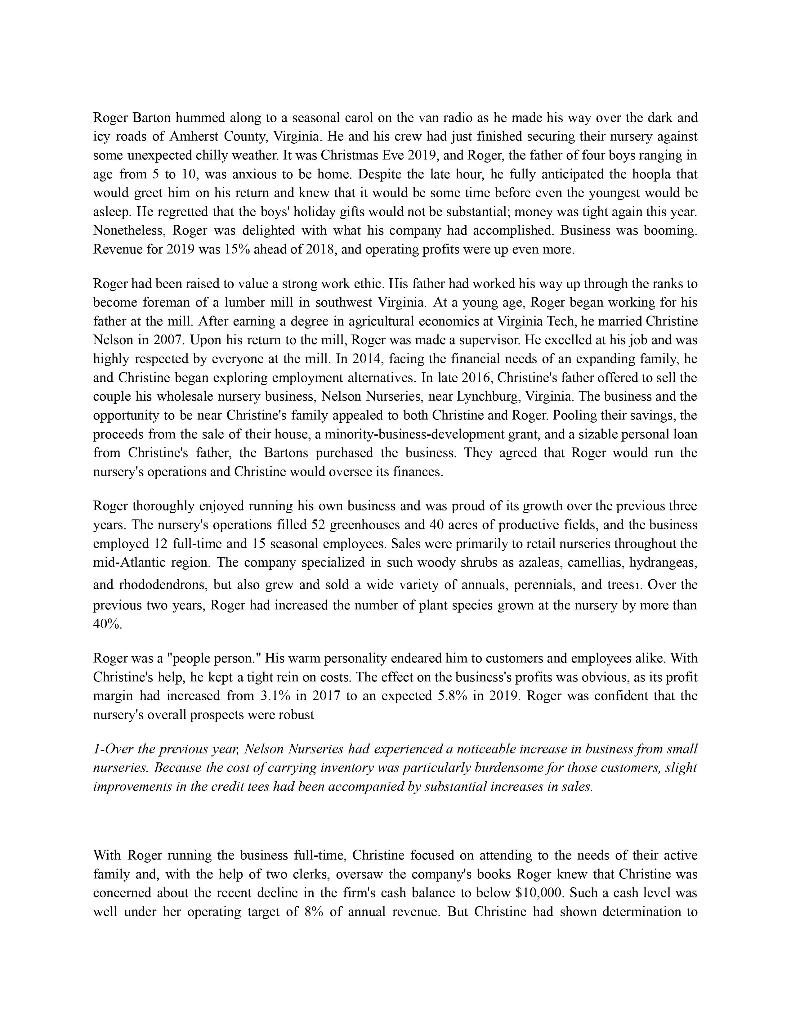
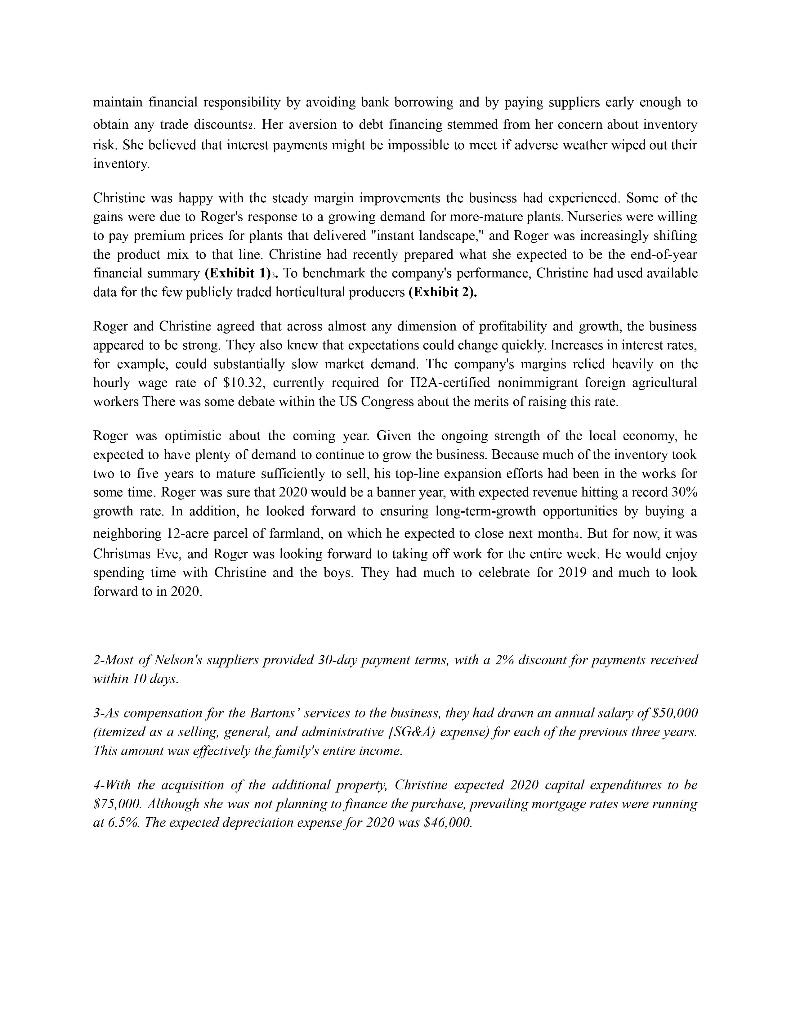
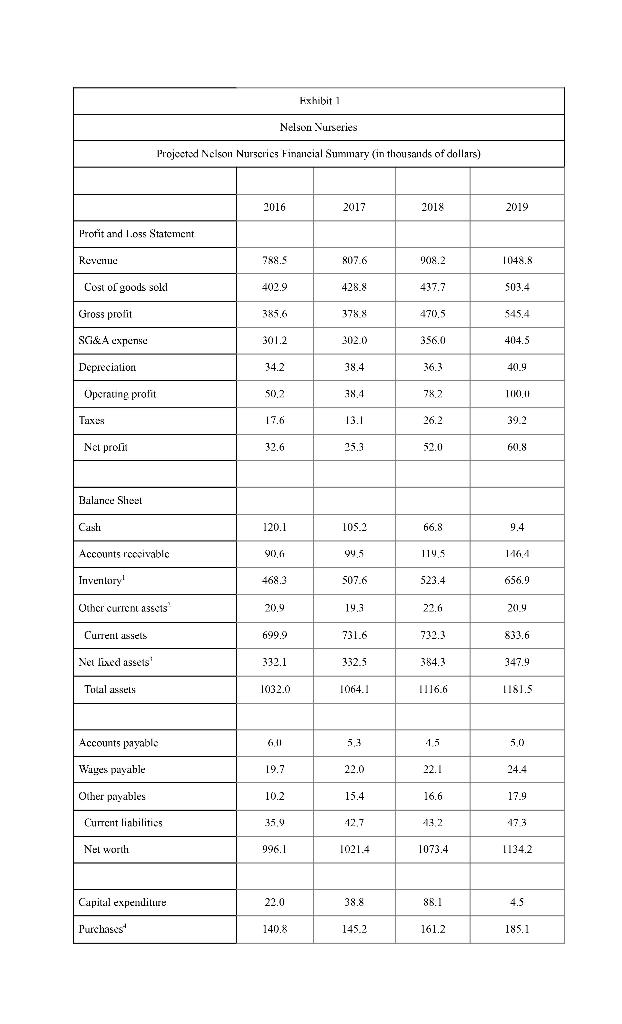

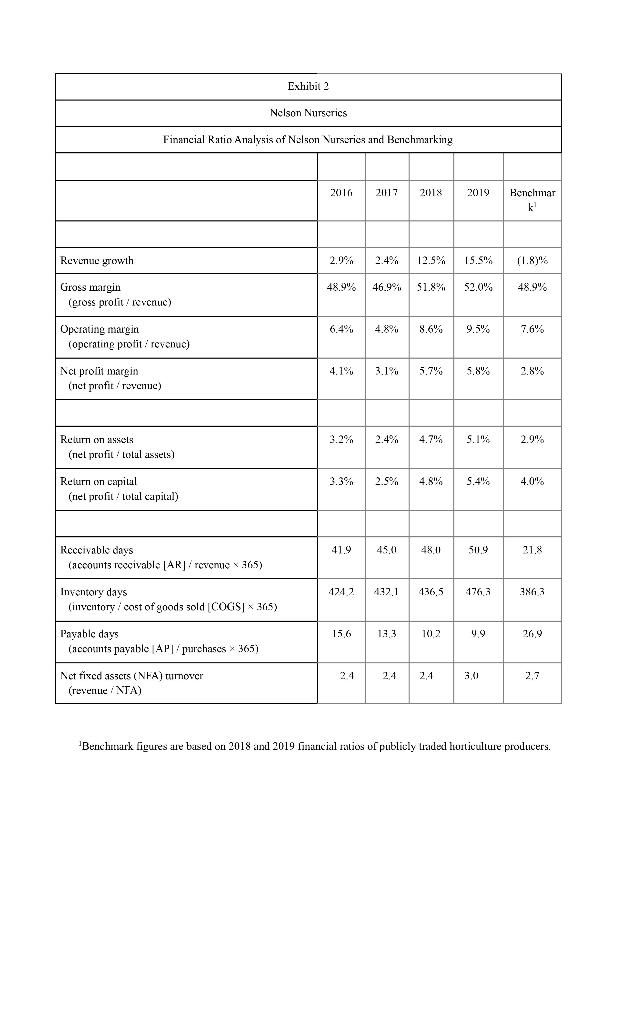
Roger Barton huinmed along to a seasonal carol on the van radio as he made his way over the dark and icy roads of Amherst County, Virginia. He and his crew had just finished securing their nursery against some unexpected chilly weather. It was Christmas Eve 2019, and Roger, the father of four boys ranging in age from 5 to 10, was anxious to be home. Despite the late hour, he fully anticipated the hoopla that would greet him on his return and know that it would be some time before even the youngest would be asleep. IIe regretted that the boys' holiday gifts would not be substantial; money was tight again this year. Nonetheless, Roger was delighted with what his company had accomplished. Business was booming. Revenue for 2019 was 15% ahead of 2018, and operating profits were up even more. Roger had been raised to value a strong work ethic. IIis father had worked his way up through the ranks to become foreman of a lumber mill in southwest Virginia. At a young age, Roger began working for his father at the mill. After earning a degree in agricultural economics at Virginia Tech, he married Christine Nelson in 2007. Upon his return to the mill, Roger was made a supervisor. He excelled at his job and was highly respected by cveryone at the mill. In 2014, facing the financial needs of an expanding family, hc and Christine began exploring employment alternatives. In late 2016, Christine's father offered to sell the couple his wholesale nursery business, Nelson Nurseries, near Lynchburg, Virginia. The business and the opportunity to be near Christine's family appealed to both Christine and Roger. Pooling their savings, the proceeds from the sale of their house, a minority-business-development grant, and a sizable personal loan from Christine's father, the Barlons purchased the business. They agreed that Roger would run the nursery's operations and Christine would ovcrscc its finances. Royer thoroughly cnjoyed running his own business and was proud of ils growth over the previous three years. The nursery's operations filled 52 greenhouses and 40 acres of productive fields, and the business cmployed 12 full-time and 15 seasonal employees. Sales were primarily to retail nurseries throughout the mid-Atlantic region. The company specialized in such woody shrubs as azaleas, camellias, hydrangeas, and rhododendrons, but also grew and sold a wide variety of annuals, perennials, and trees. Over the previous two years, Roger had increased the number of plant species grown at the nursery by more than 40% Roger was a "people person." His warm personality endeared him to customers and employees alike. With Christine's help, he kept a tight rein on costs. The effect on the business's profits was obvious, as its profit margin had increased from 3.1% in 2017 to an expected 5.8% in 2019. Roger was confident that the nursery's overall prospects were robust 1-Over the previous year, Nelson Nurseries had experienced a noticeable increase in business from small nurseries. Because the cost of carrying inventory was particularly burdensome for those customers, slighi improvements in the credit tees had been accompanied by substantial increases in sales, With Roger running the business full-time, Christine focused on attending to the needs of their active with the help two clerks, the company's books Roger knew that Christine was concerned about the recent decline in the firm's cash balance lo below $10,000. Such a cash level was well under her operating larget of 8% of annual revenue. Bul Christine had shown determination lo maintain financial responsibility by avoiding bank borrowing and by paying suppliers carly enough to obtain any trade discounts2. Her aversion to debt financing stemmed from her concern about inventory risk. She believed that interest payments might be impossible to meet if adverse weather wiped out their inventory Christin was happy with the steady margin improvements the business had experienced. Some of the gains were due to Roger's response to a growing demand for more-mature plants. Nurseries were willing to pay premium prices for plants that delivered "instant landscape," and Roger was increasingly shifting the product mix to that line. Christine had recently prepared what she expected to be the end-of-year financial summary (Exhibit 1). To benchmark the company's performance, Christine had used available data for the few publicly traded horticultural producers (Exhibit 2). Roger and Christine agreed that across almost any dimension of profitability and growth, the business appeared to be strong. They also knew that expectations could change quickly. Increases in interest rates. for example, could substantially slow market demand. The company's margins relied heavily on the hourly wage rate of $10.32, currently required for 112A-certified nonimmigrant foreign agricultural workers There was some debate within the US Congress about the merits of raising this rate. Roger was optimistic about the coming year. Given the ongoing strength of the local economy, he expected to have plenty of demand to continue to grow the business. Because much of the inventory look two to live years to mature sulficiently to sell, his top-line expansion efforts had been in the works for some time. Roger was sure that 2020 would be a banner year, with expected revenue hitting a record 30% growth rate. In addition, he looked forward to ensuring long-term-growth opportunities by buying a neighboring 12-acre parcel of farmland, on which he expected to close next months. But for now, it was Christmas Eve, and Roger was looking forward to taking off work for the entire week. He would cnjoy spending time with Christine and the boys. They had much to celebrate for 2019 and much to look forward to in 2020. 2-Most of Nelson's suppliers provided 30-day payment terms, with a 2% discount for payments received within 10 days. 3-As compensation for the Bartons' services to the business, they had drown an annual salary of $50,000 (itemized as a selling general, and administrative /SG&A, expense) for each of the previous three years. This amount was effectively the fumily's entire income. 4-With the acquisition of the additional property; Christine expected 2020 capital expenditures to he $75,000. Although she was not planning to finance the purchase, prevailing mortgage rates were running al 6.5%. The expected depreciation expense for 2020 was $46,000. Exhibit 1 Nelson Nuseries Projected Nelson Nurscrics Financial Summary (in thousands of dollars) 2016 2017 2018 2019 Profit and I.oss Statement Rovenac 788.5 807.6 2018.2 1048.8 Cost of goods sold 402.9 428.8 437.7 503.4 Gross profit 3856 3788 470),5 545,4 SC&A expense 301.2 3020) 356.0 404.5 Depreciation 34.2 38.4 36.3 40.9 Operating profit 50,2 38.4 782 110,11 I Taxes 17.6 13.1 26.2 39.2 Net prolit 32.6 333 52.0 611.8 Balance Sheet Cast: 120.1 IOS.2 66.8 9.4 Accounts rccoivable 90.6 94.5 119.5 116,41 468.3 507.6 523.4 656.9 Invenlory! Other current assets 21.9 19.3 22.6 2014 Currentlasses 699.9 731.6 7323 833.6 Net lixed assets 332.1 3323 384.3 347.9 Total assets 1032.0 1064.1 1116.6 TISI.S Accounts payable 611 5,3 -15 50) Wages payable 19.7 22.0 22.1 24.4 Other payables 10.2 15.4 16.6 17.9 Currcnt liabilities 35,9 12,7 132 473 Nel worth 996.1 1021.4 1073.4 1134.2 Capital expenditure 22.0 38.8 88.1 4.5 Purchases 140.8 145.2 161.2 185.1 Inventory investment was valued at the lower of cost or market. The cost of inventory was determined by accumulating the costs associated with preparing the plants for sale. Costs that were typically capitalized as inventory included direct labor, materials (soil, water, containers, stakes, labels, chemicals), scrar, and cwerhead Other current assets included consigned inventory, prepaid experises, and assets held for sale. Net lixed assets included land, buildings and improvements, equipmentand software. + Purchases represented the annual amount paid to suppliers. Exhibit 2 Nelson Nurscrics Financial Ratio Analysis of Nelson Nurseries and Benchmarking 2010 20117 2018 2019 Kenchimar k Revenue growth 2.0% 2.4% 12.5% 15.5% (1.8% 48.9% 46.9% 51.8% 52.0% 48.99 Gross margin (cross prolit/Ivcnuc) 4.8% 8.6% 9.5% 7.6% Operating margin (opcratine prolit revenue) 4.1% 3.1% 5.7% 5.8% 2.8% Nel prolit margin inct profittovcuc) 3.2% 2.4% 4.7% SI 2.9" Return on assets (nel profil Lotul assets) 3.3% 2.5% 4.8% 5.4% 4.0" Return on capital (niel profil/lulul capital) 41.9 45.00 48.11 511.9 21. Rcecivable days (accounts recivable LARTrochuc365) 1242 4321 1365 1763 3863 Inventory days (inventory cost of goods sold (COGSI 305) 15.6 ( 13,3 102 4.9 26.9 Payable days (aconunts payablo API purchases 365) 24 24 3.1 27 Nct fixed assets (NFA) Turnover (revenue : NJA) / Benchutark figures are based on 2018 and 2019 financial ratios of publicly traded hurticulture producers. Roger Barton huinmed along to a seasonal carol on the van radio as he made his way over the dark and icy roads of Amherst County, Virginia. He and his crew had just finished securing their nursery against some unexpected chilly weather. It was Christmas Eve 2019, and Roger, the father of four boys ranging in age from 5 to 10, was anxious to be home. Despite the late hour, he fully anticipated the hoopla that would greet him on his return and know that it would be some time before even the youngest would be asleep. IIe regretted that the boys' holiday gifts would not be substantial; money was tight again this year. Nonetheless, Roger was delighted with what his company had accomplished. Business was booming. Revenue for 2019 was 15% ahead of 2018, and operating profits were up even more. Roger had been raised to value a strong work ethic. IIis father had worked his way up through the ranks to become foreman of a lumber mill in southwest Virginia. At a young age, Roger began working for his father at the mill. After earning a degree in agricultural economics at Virginia Tech, he married Christine Nelson in 2007. Upon his return to the mill, Roger was made a supervisor. He excelled at his job and was highly respected by cveryone at the mill. In 2014, facing the financial needs of an expanding family, hc and Christine began exploring employment alternatives. In late 2016, Christine's father offered to sell the couple his wholesale nursery business, Nelson Nurseries, near Lynchburg, Virginia. The business and the opportunity to be near Christine's family appealed to both Christine and Roger. Pooling their savings, the proceeds from the sale of their house, a minority-business-development grant, and a sizable personal loan from Christine's father, the Barlons purchased the business. They agreed that Roger would run the nursery's operations and Christine would ovcrscc its finances. Royer thoroughly cnjoyed running his own business and was proud of ils growth over the previous three years. The nursery's operations filled 52 greenhouses and 40 acres of productive fields, and the business cmployed 12 full-time and 15 seasonal employees. Sales were primarily to retail nurseries throughout the mid-Atlantic region. The company specialized in such woody shrubs as azaleas, camellias, hydrangeas, and rhododendrons, but also grew and sold a wide variety of annuals, perennials, and trees. Over the previous two years, Roger had increased the number of plant species grown at the nursery by more than 40% Roger was a "people person." His warm personality endeared him to customers and employees alike. With Christine's help, he kept a tight rein on costs. The effect on the business's profits was obvious, as its profit margin had increased from 3.1% in 2017 to an expected 5.8% in 2019. Roger was confident that the nursery's overall prospects were robust 1-Over the previous year, Nelson Nurseries had experienced a noticeable increase in business from small nurseries. Because the cost of carrying inventory was particularly burdensome for those customers, slighi improvements in the credit tees had been accompanied by substantial increases in sales, With Roger running the business full-time, Christine focused on attending to the needs of their active with the help two clerks, the company's books Roger knew that Christine was concerned about the recent decline in the firm's cash balance lo below $10,000. Such a cash level was well under her operating larget of 8% of annual revenue. Bul Christine had shown determination lo maintain financial responsibility by avoiding bank borrowing and by paying suppliers carly enough to obtain any trade discounts2. Her aversion to debt financing stemmed from her concern about inventory risk. She believed that interest payments might be impossible to meet if adverse weather wiped out their inventory Christin was happy with the steady margin improvements the business had experienced. Some of the gains were due to Roger's response to a growing demand for more-mature plants. Nurseries were willing to pay premium prices for plants that delivered "instant landscape," and Roger was increasingly shifting the product mix to that line. Christine had recently prepared what she expected to be the end-of-year financial summary (Exhibit 1). To benchmark the company's performance, Christine had used available data for the few publicly traded horticultural producers (Exhibit 2). Roger and Christine agreed that across almost any dimension of profitability and growth, the business appeared to be strong. They also knew that expectations could change quickly. Increases in interest rates. for example, could substantially slow market demand. The company's margins relied heavily on the hourly wage rate of $10.32, currently required for 112A-certified nonimmigrant foreign agricultural workers There was some debate within the US Congress about the merits of raising this rate. Roger was optimistic about the coming year. Given the ongoing strength of the local economy, he expected to have plenty of demand to continue to grow the business. Because much of the inventory look two to live years to mature sulficiently to sell, his top-line expansion efforts had been in the works for some time. Roger was sure that 2020 would be a banner year, with expected revenue hitting a record 30% growth rate. In addition, he looked forward to ensuring long-term-growth opportunities by buying a neighboring 12-acre parcel of farmland, on which he expected to close next months. But for now, it was Christmas Eve, and Roger was looking forward to taking off work for the entire week. He would cnjoy spending time with Christine and the boys. They had much to celebrate for 2019 and much to look forward to in 2020. 2-Most of Nelson's suppliers provided 30-day payment terms, with a 2% discount for payments received within 10 days. 3-As compensation for the Bartons' services to the business, they had drown an annual salary of $50,000 (itemized as a selling general, and administrative /SG&A, expense) for each of the previous three years. This amount was effectively the fumily's entire income. 4-With the acquisition of the additional property; Christine expected 2020 capital expenditures to he $75,000. Although she was not planning to finance the purchase, prevailing mortgage rates were running al 6.5%. The expected depreciation expense for 2020 was $46,000. Exhibit 1 Nelson Nuseries Projected Nelson Nurscrics Financial Summary (in thousands of dollars) 2016 2017 2018 2019 Profit and I.oss Statement Rovenac 788.5 807.6 2018.2 1048.8 Cost of goods sold 402.9 428.8 437.7 503.4 Gross profit 3856 3788 470),5 545,4 SC&A expense 301.2 3020) 356.0 404.5 Depreciation 34.2 38.4 36.3 40.9 Operating profit 50,2 38.4 782 110,11 I Taxes 17.6 13.1 26.2 39.2 Net prolit 32.6 333 52.0 611.8 Balance Sheet Cast: 120.1 IOS.2 66.8 9.4 Accounts rccoivable 90.6 94.5 119.5 116,41 468.3 507.6 523.4 656.9 Invenlory! Other current assets 21.9 19.3 22.6 2014 Currentlasses 699.9 731.6 7323 833.6 Net lixed assets 332.1 3323 384.3 347.9 Total assets 1032.0 1064.1 1116.6 TISI.S Accounts payable 611 5,3 -15 50) Wages payable 19.7 22.0 22.1 24.4 Other payables 10.2 15.4 16.6 17.9 Currcnt liabilities 35,9 12,7 132 473 Nel worth 996.1 1021.4 1073.4 1134.2 Capital expenditure 22.0 38.8 88.1 4.5 Purchases 140.8 145.2 161.2 185.1 Inventory investment was valued at the lower of cost or market. The cost of inventory was determined by accumulating the costs associated with preparing the plants for sale. Costs that were typically capitalized as inventory included direct labor, materials (soil, water, containers, stakes, labels, chemicals), scrar, and cwerhead Other current assets included consigned inventory, prepaid experises, and assets held for sale. Net lixed assets included land, buildings and improvements, equipmentand software. + Purchases represented the annual amount paid to suppliers. Exhibit 2 Nelson Nurscrics Financial Ratio Analysis of Nelson Nurseries and Benchmarking 2010 20117 2018 2019 Kenchimar k Revenue growth 2.0% 2.4% 12.5% 15.5% (1.8% 48.9% 46.9% 51.8% 52.0% 48.99 Gross margin (cross prolit/Ivcnuc) 4.8% 8.6% 9.5% 7.6% Operating margin (opcratine prolit revenue) 4.1% 3.1% 5.7% 5.8% 2.8% Nel prolit margin inct profittovcuc) 3.2% 2.4% 4.7% SI 2.9" Return on assets (nel profil Lotul assets) 3.3% 2.5% 4.8% 5.4% 4.0" Return on capital (niel profil/lulul capital) 41.9 45.00 48.11 511.9 21. Rcecivable days (accounts recivable LARTrochuc365) 1242 4321 1365 1763 3863 Inventory days (inventory cost of goods sold (COGSI 305) 15.6 ( 13,3 102 4.9 26.9 Payable days (aconunts payablo API purchases 365) 24 24 3.1 27 Nct fixed assets (NFA) Turnover (revenue : NJA) / Benchutark figures are based on 2018 and 2019 financial ratios of publicly traded hurticulture producers
Step by Step Solution
There are 3 Steps involved in it

Get step-by-step solutions from verified subject matter experts
 Study Help