







Question: CASE ANALYSIS : MEMPHIS POLICE DEPARTMENT PLEASE HELP Case Analysis: Memphis Police Department POLICE Godwin liked what he heard. So much so that he agreed
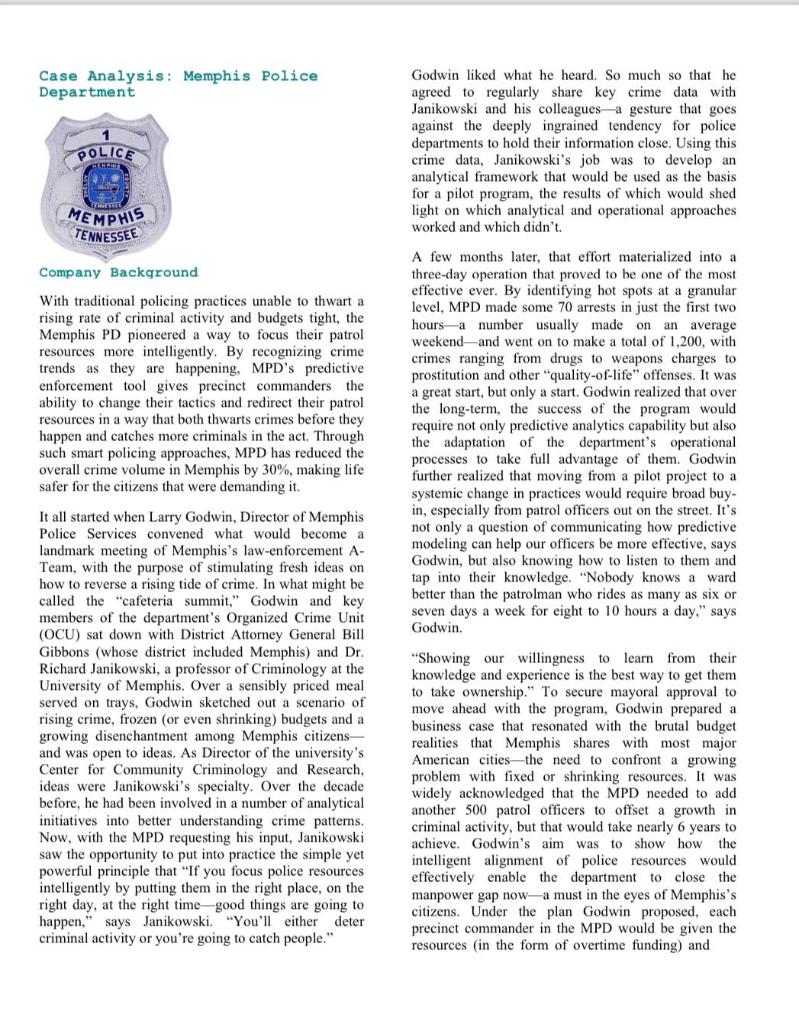
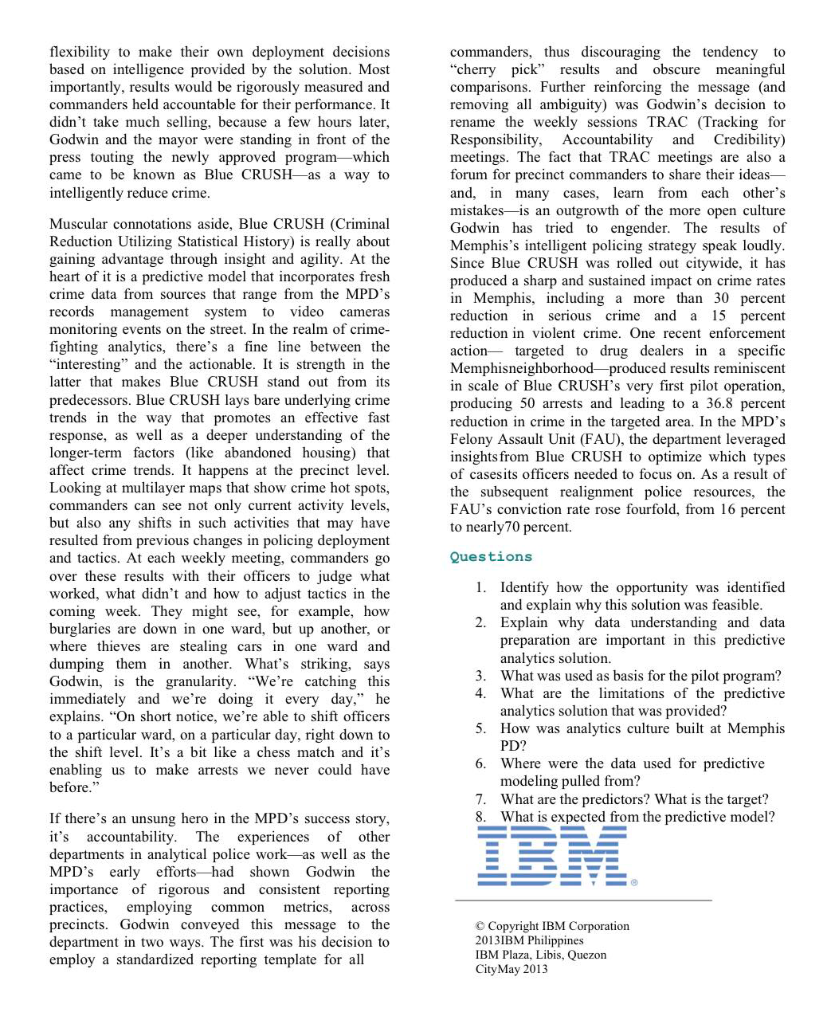
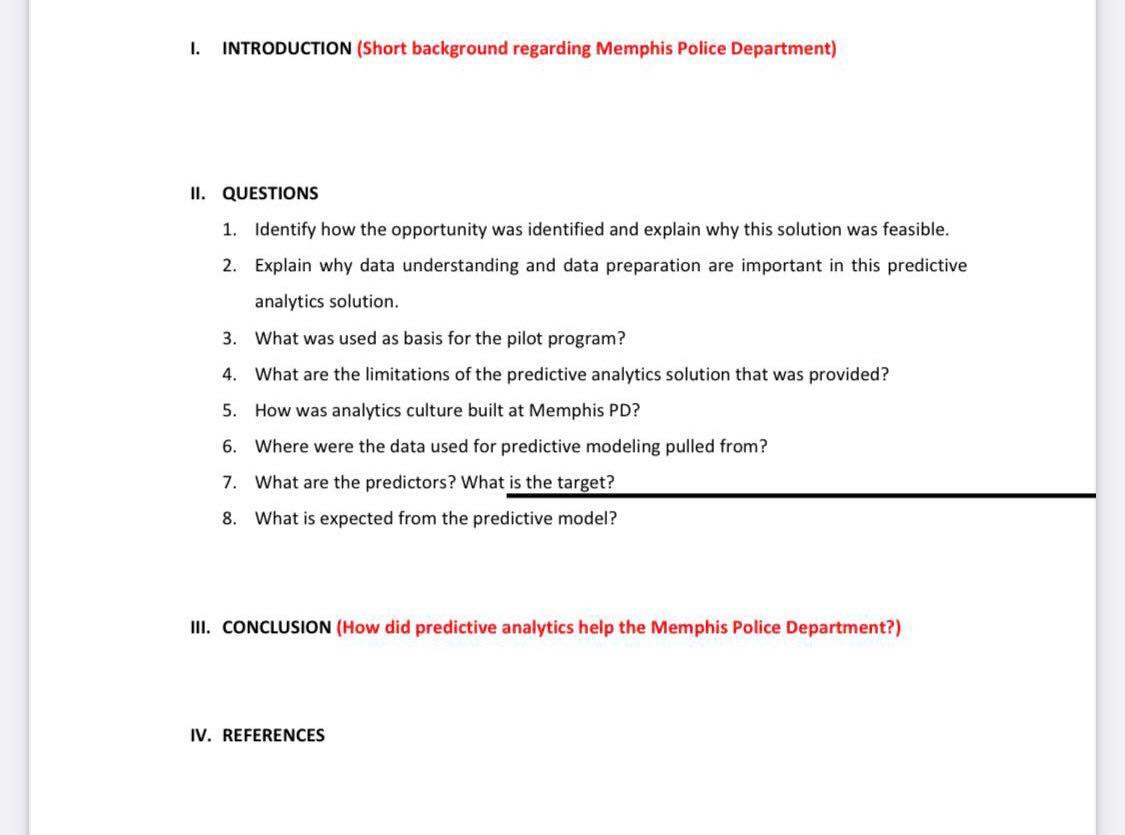 CASE ANALYSIS : MEMPHIS POLICE DEPARTMENT
PLEASE HELP
Case Analysis: Memphis Police Department POLICE Godwin liked what he heard. So much so that he agreed to regularly share key crime data with Janikowski and his colleagues-a gesture that goes against the deeply ingrained tendency for police departments to hold their information close. Using this crime data, Janikowski's job was to develop an analytical framework that would be used as the basis for a pilot program, the results of which would shed light on which analytical and operational approaches worked and which didn't. FEN MEMPHIS TENNESSEE Company Background With traditional policing practices unable to thwart a rising rate of criminal activity and budgets tight, the Memphis PD pioneered a way to focus their patrol resources more intelligently. By recognizing crime trends as they are happening, MPD's predictive enforcement tool gives precinct commanders the ability to change their tactics and redirect their patrol resources in a way that both thwarts crimes before they happen and catches more criminals in the act. Through such smart policing approaches, MPD has reduced the overall crime volume in Memphis by 30%, making life safer for the citizens that were demanding it. It all started when Larry Godwin, Director of Memphis Police Services convened what would become a landmark meeting of Memphis's law-enforcement A- Team, with the purpose of stimulating fresh ideas on how to reverse a rising tide of crime. In what might be called the "cafeteria summit," Godwin and key members of the department's Organized Crime Unit (OCU) sat down with District Attorney General Bill Gibbons (whose district included Memphis) and Dr. Richard Janikowski, a professor of Criminology at the University of Memphis. Over a sensibly priced meal served on trays, Godwin sketched out a scenario of rising crime, frozen (or even shrinking) budgets and a growing disenchantment among Memphis citizens and was open to ideas. As Director of the university's Center for Community Criminology and Research, ideas were Janikowski's specialty. Over the decade before, he had been involved in a number of analytical initiatives into better understanding crime patterns. Now, with the MPD requesting his input, Janikowski saw the opportunity to put into practice the simple yet powerful principle that "If you focus police resources intelligently by putting them in the right place, on the right day, at the right time-good things are going to happen," says Janikowski. "You'll either deter criminal activity or you're going to catch people." A few months later, that effort materialized into a three-day operation that proved to be one of the most effective ever. By identifying hot spots at a granular level, MPD made some 70 arrests in just the first two hours a number usually made on an average weekend and went on to make a total of 1,200, with crimes ranging from drugs to weapons charges to prostitution and other "quality-of-life" offenses. It was a great start, but only a start. Godwin realized that over the long-term, the success of the program would require not only predictive analytics capability but also the adaptation of the department's operational processes to take full advantage of them. Godwin further realized that moving from a pilot project to a systemic change in practices would require broad buy- in, especially from patrol officers out on the street. It's not only a question of communicating how predictive modeling can help our officers be more effective, says Godwin, but also knowing how to listen to them and tap into their knowledge. "Nobody knows a ward better than the patrolman who rides as many as six or seven days a week for eight to 10 hours a day," says Godwin. "Showing our willingness to learn from their knowledge and experience is the best way to get them to take ownership." To secure mayoral approval to move ahead with the program, Godwin prepared business case that resonated with the brutal budget realities that Memphis shares with most major American cities-the need to confront a growing problem with fixed or shrinking resources. It was widely acknowledged that the MPD needed to add another 500 patrol officers to offset a growth in criminal activity, but that would take nearly 6 years to achieve. Godwin's aim was to show how the intelligent alignment of police resources would effectively enable the department to close the manpower gap now-a must in the eyes of Memphis's citizens. Under the plan Godwin proposed, each precinct commander in the MPD would be given the resources (in the form of overtime funding) and flexibility to make their own deployment decisions based on intelligence provided by the solution. Most importantly, results would be rigorously measured and commanders held accountable for their performance. It didn't take much selling, because a few hours later, Godwin and the mayor were standing in front of the press touting the newly approved program-which came to be known as Blue CRUSHas a way to intelligently reduce crime. Muscular connotations aside, Blue CRUSH (Criminal Reduction Utilizing Statistical History) is really about gaining advantage through insight and agility. At the heart of it is a predictive model that incorporates fresh crime data from sources that range from the MPD's records management system to video cameras monitoring events on the street. In the realm of crime- fighting analytics, there's a fine line between the "interesting and the actionable. It is strength in the latter that makes Blue CRUSH stand out from its predecessors. Blue CRUSH lays bare underlying crime trends in the way that promotes an effective fast response, as well as a deeper understanding of the longer-term factors (like abandoned housing) that affect crime trends. It happens at the precinct level. Looking at multilayer maps that show crime hot spots, commanders can see not only current activity levels, but also any shifts in such activities that may have resulted from previous changes in policing deployment and tactics. At each weekly meeting, commanders go over these results with their officers to judge what worked, what didn't and how to adjust tactics in the coming week. They might see, for example, how burglaries are down in one ward, but up another, or where thieves are stealing cars in one ward and dumping them in another. What's striking, says Godwin, is the granularity. "We're catching this immediately and we're doing it every day," he explains. "On short notice, we're able to shift officers to a particular ward, on a particular day, right down to the shift level. It's a bit like a chess match and it's enabling us to make arrests we never could have before." commanders, thus discouraging the tendency to "cherry pick" results and obscure meaningful comparisons. Further reinforcing the message and removing all ambiguity) was Godwin's decision to rename the weekly sessions TRAC (Tracking for Responsibility, Accountability and Credibility) meetings. The fact that TRAC meetings are also forum for precinct commanders to share their ideas- and, in many cases, learn from each other's mistakesis an outgrowth of the more open culture Godwin has tried to engender. The results of Memphis's intelligent policing strategy speak loudly. Since Blue CRUSH was rolled out citywide, it has produced a sharp and sustained impact on crime rates in Memphis, including a more than 30 percent reduction in serious crime and a 15 percent reduction in violent crime. One recent enforcement action- targeted to drug dealers in a specific Memphisneighborhood produced results reminiscent in scale of Blue CRUSH's very first pilot operation, producing 50 arrests and leading to a 36.8 percent reduction in crime in the targeted area. In the MPD's Felony Assault Unit (FAU), the department leveraged insights from Blue CRUSH to optimize which types of casesits officers needed to focus on. As a result of the subsequent realignment police resources, the FAU's conviction rate rose fourfold, from 16 percent to nearly 70 percent. Questions 1. Identify how the opportunity was identified and explain why this solution was feasible. 2. Explain why data understanding and data preparation are important in this predictive analytics solution. 3. What was used as basis for the pilot program? 4. What are the limitations of the predictive analytics solution that was provided? 5. How was analytics culture built at Memphis PD? 6. Where were the data used for predictive modeling pulled from? 7. What are the predictors? What is the target? 8. What is expected from the predictive model? If there's an unsung hero in the MPD's success story, it's accountability. The experiences of other departments in analytical police workas well as the MPD's early efforts had shown Godwin the importance of rigorous and consistent reporting practices, employing common metrics, across precincts. Godwin conveyed this message to the department in two ways. The first was his decision to employ a standardized reporting template for all Copyright IBM Corporation 20131BM Philippines IBM Plaza, Libis, Quezon City May 2013 I. INTRODUCTION (Short background regarding Memphis Police Department) II. QUESTIONS 1. Identify how the opportunity was identified and explain why this solution was feasible. 2. Explain why data understanding and data preparation are important in this predictive analytics solution. 3. What was used as basis for the pilot program? 4. What are the limitations of the predictive analytics solution that was provided? 5. How was analytics culture built at Memphis PD? 6. Where were the data used for predictive modeling pulled from? 7. What are the predictors? What is the target? 8. What is expected from the predictive model? III. CONCLUSION (How did predictive analytics help the Memphis Police Department?) IV. REFERENCES Case Analysis: Memphis Police Department POLICE Godwin liked what he heard. So much so that he agreed to regularly share key crime data with Janikowski and his colleagues-a gesture that goes against the deeply ingrained tendency for police departments to hold their information close. Using this crime data, Janikowski's job was to develop an analytical framework that would be used as the basis for a pilot program, the results of which would shed light on which analytical and operational approaches worked and which didn't. FEN MEMPHIS TENNESSEE Company Background With traditional policing practices unable to thwart a rising rate of criminal activity and budgets tight, the Memphis PD pioneered a way to focus their patrol resources more intelligently. By recognizing crime trends as they are happening, MPD's predictive enforcement tool gives precinct commanders the ability to change their tactics and redirect their patrol resources in a way that both thwarts crimes before they happen and catches more criminals in the act. Through such smart policing approaches, MPD has reduced the overall crime volume in Memphis by 30%, making life safer for the citizens that were demanding it. It all started when Larry Godwin, Director of Memphis Police Services convened what would become a landmark meeting of Memphis's law-enforcement A- Team, with the purpose of stimulating fresh ideas on how to reverse a rising tide of crime. In what might be called the "cafeteria summit," Godwin and key members of the department's Organized Crime Unit (OCU) sat down with District Attorney General Bill Gibbons (whose district included Memphis) and Dr. Richard Janikowski, a professor of Criminology at the University of Memphis. Over a sensibly priced meal served on trays, Godwin sketched out a scenario of rising crime, frozen (or even shrinking) budgets and a growing disenchantment among Memphis citizens and was open to ideas. As Director of the university's Center for Community Criminology and Research, ideas were Janikowski's specialty. Over the decade before, he had been involved in a number of analytical initiatives into better understanding crime patterns. Now, with the MPD requesting his input, Janikowski saw the opportunity to put into practice the simple yet powerful principle that "If you focus police resources intelligently by putting them in the right place, on the right day, at the right time-good things are going to happen," says Janikowski. "You'll either deter criminal activity or you're going to catch people." A few months later, that effort materialized into a three-day operation that proved to be one of the most effective ever. By identifying hot spots at a granular level, MPD made some 70 arrests in just the first two hours a number usually made on an average weekend and went on to make a total of 1,200, with crimes ranging from drugs to weapons charges to prostitution and other "quality-of-life" offenses. It was a great start, but only a start. Godwin realized that over the long-term, the success of the program would require not only predictive analytics capability but also the adaptation of the department's operational processes to take full advantage of them. Godwin further realized that moving from a pilot project to a systemic change in practices would require broad buy- in, especially from patrol officers out on the street. It's not only a question of communicating how predictive modeling can help our officers be more effective, says Godwin, but also knowing how to listen to them and tap into their knowledge. "Nobody knows a ward better than the patrolman who rides as many as six or seven days a week for eight to 10 hours a day," says Godwin. "Showing our willingness to learn from their knowledge and experience is the best way to get them to take ownership." To secure mayoral approval to move ahead with the program, Godwin prepared business case that resonated with the brutal budget realities that Memphis shares with most major American cities-the need to confront a growing problem with fixed or shrinking resources. It was widely acknowledged that the MPD needed to add another 500 patrol officers to offset a growth in criminal activity, but that would take nearly 6 years to achieve. Godwin's aim was to show how the intelligent alignment of police resources would effectively enable the department to close the manpower gap now-a must in the eyes of Memphis's citizens. Under the plan Godwin proposed, each precinct commander in the MPD would be given the resources (in the form of overtime funding) and flexibility to make their own deployment decisions based on intelligence provided by the solution. Most importantly, results would be rigorously measured and commanders held accountable for their performance. It didn't take much selling, because a few hours later, Godwin and the mayor were standing in front of the press touting the newly approved program-which came to be known as Blue CRUSHas a way to intelligently reduce crime. Muscular connotations aside, Blue CRUSH (Criminal Reduction Utilizing Statistical History) is really about gaining advantage through insight and agility. At the heart of it is a predictive model that incorporates fresh crime data from sources that range from the MPD's records management system to video cameras monitoring events on the street. In the realm of crime- fighting analytics, there's a fine line between the "interesting and the actionable. It is strength in the latter that makes Blue CRUSH stand out from its predecessors. Blue CRUSH lays bare underlying crime trends in the way that promotes an effective fast response, as well as a deeper understanding of the longer-term factors (like abandoned housing) that affect crime trends. It happens at the precinct level. Looking at multilayer maps that show crime hot spots, commanders can see not only current activity levels, but also any shifts in such activities that may have resulted from previous changes in policing deployment and tactics. At each weekly meeting, commanders go over these results with their officers to judge what worked, what didn't and how to adjust tactics in the coming week. They might see, for example, how burglaries are down in one ward, but up another, or where thieves are stealing cars in one ward and dumping them in another. What's striking, says Godwin, is the granularity. "We're catching this immediately and we're doing it every day," he explains. "On short notice, we're able to shift officers to a particular ward, on a particular day, right down to the shift level. It's a bit like a chess match and it's enabling us to make arrests we never could have before." commanders, thus discouraging the tendency to "cherry pick" results and obscure meaningful comparisons. Further reinforcing the message and removing all ambiguity) was Godwin's decision to rename the weekly sessions TRAC (Tracking for Responsibility, Accountability and Credibility) meetings. The fact that TRAC meetings are also forum for precinct commanders to share their ideas- and, in many cases, learn from each other's mistakesis an outgrowth of the more open culture Godwin has tried to engender. The results of Memphis's intelligent policing strategy speak loudly. Since Blue CRUSH was rolled out citywide, it has produced a sharp and sustained impact on crime rates in Memphis, including a more than 30 percent reduction in serious crime and a 15 percent reduction in violent crime. One recent enforcement action- targeted to drug dealers in a specific Memphisneighborhood produced results reminiscent in scale of Blue CRUSH's very first pilot operation, producing 50 arrests and leading to a 36.8 percent reduction in crime in the targeted area. In the MPD's Felony Assault Unit (FAU), the department leveraged insights from Blue CRUSH to optimize which types of casesits officers needed to focus on. As a result of the subsequent realignment police resources, the FAU's conviction rate rose fourfold, from 16 percent to nearly 70 percent. Questions 1. Identify how the opportunity was identified and explain why this solution was feasible. 2. Explain why data understanding and data preparation are important in this predictive analytics solution. 3. What was used as basis for the pilot program? 4. What are the limitations of the predictive analytics solution that was provided? 5. How was analytics culture built at Memphis PD? 6. Where were the data used for predictive modeling pulled from? 7. What are the predictors? What is the target? 8. What is expected from the predictive model? If there's an unsung hero in the MPD's success story, it's accountability. The experiences of other departments in analytical police workas well as the MPD's early efforts had shown Godwin the importance of rigorous and consistent reporting practices, employing common metrics, across precincts. Godwin conveyed this message to the department in two ways. The first was his decision to employ a standardized reporting template for all Copyright IBM Corporation 20131BM Philippines IBM Plaza, Libis, Quezon City May 2013 I. INTRODUCTION (Short background regarding Memphis Police Department) II. QUESTIONS 1. Identify how the opportunity was identified and explain why this solution was feasible. 2. Explain why data understanding and data preparation are important in this predictive analytics solution. 3. What was used as basis for the pilot program? 4. What are the limitations of the predictive analytics solution that was provided? 5. How was analytics culture built at Memphis PD? 6. Where were the data used for predictive modeling pulled from? 7. What are the predictors? What is the target? 8. What is expected from the predictive model? III. CONCLUSION (How did predictive analytics help the Memphis Police Department?) IV. REFERENCES
Step by Step Solution
There are 3 Steps involved in it

Get step-by-step solutions from verified subject matter experts
 Study Help