







Question: Case: Cost System Considerations for CANADA SNOW CONES LTD. All of CSL's products had the same retail price, as customers could choose or combine any
Case: Cost System Considerations for CANADA SNOW CONES LTD.
All of CSL's products had the same retail price, as customers could choose or combine any flavours by scoops. Samantha set the prices to generate, on average, a markup of 100% on average full production costs. CSL's 2019 budget included manufacturing overhead (MOH) of $450,000. To estimate product costs, Samantha spread this MOH cost to products based on a proportion of the direct labour (DL) costs used in the production process. CSL's total DL costs for 2019 was $200,000, so Samantha charged the overhead to products at a rate of MOH to total DL costs.
Last week, Laura Horton, Samantha's babysitter for her daughter and the CEO of a large production firm, advised that Samantha's pricing strategy was not optimal. Laura's insight was that the expenses for producing CSL's numerous flavours were not uniform. She thought those inconsistencies should be reflected in the prices charged, or CSL's earnings would fluctuate as the combination of flavours sold varied.
Laura proposed that Samantha reestimate product costs using activity-based costing. She recommended that Samantha identify the major activities whose costs were included in the company's Manufacturing overhead costs. Then, she should apply these costs to products based on the products consumption of each of those activities. In response to Laura's suggestions, Samantha prepared the information presented below in Table 1.
Samantha decided to hire consulting firm to help calculate the costs of two demonstrative flavors as an experiment to see if Laura's activity based costing system suggested produced any significant contrasts. She asked Laura to take her best estimate as to where she might find the most material differences, if any existed. After Samantha described the products to her, Laura suggested that she use Peanut Butter Bacon and Chocolate as the test product examples. Table 2 provides data relevant to the two selected products.
Case Questions
1.Utilizing the information above, calculate the full product cost (on a per gallon basis) of the Peanut Butter Bacon and Chocolate flavors utilizing:
a.Samantha's more traditional costing system.
b.Laura's suggestion to use activity-based costing.
2.What are the impacts, if there is any at all, of switching CSL's costing method? In particular, are the any significant contrasts between traditional costing and activity-based costing in terms of:
a.Their impact on costs for independent products.
b.Their effect on CSL's total firm income? (assuming everything else remains the same, such as production and sales prices)
c.If there are significant contrasts, why are they present? If there are no significant contrasts, why are they not present?
3.What would you recommend to be Samantha's next step, based on this analysis? Explain.
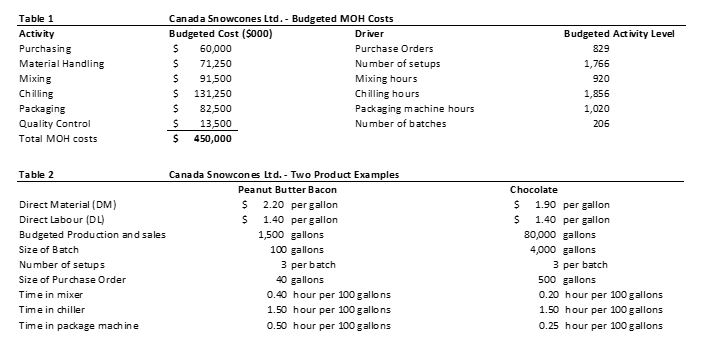
Table 1 Canada Snowcones Ltd. - Budgeted MOH Costs Activity Budgeted Cost ($000) Driver Budgeted Activity Level Purchasing 60,000 Purchase Orders 829 Material Handling 71,250 Number of setups 1,766 Mixing 91,500 Mixing hours 920 Chilling 131,250 Chilling hours 1,856 Packaging 82,500 Packaging machine hours 1,020 Quality Control 13,500 Number of batches 206 Total MOH costs S 450,000 Table 2 Canada Snowcones Ltd. - Two Product Examples Peanut Butter Bacon Chocolate Direct Material (DM) 2.20 per gallon Direct Labour (DL) 1.40 per gallon un un 1.90 per gallon 1.40 per gallon Budgeted Production and sales 1,500 gallons 80,000 gallons Size of Batch 100 gallons 4,000 gallons Number of setups 3 per batch 3 per batch Size of Purchase Order 40 gallons 500 gallons Time in mixer 0.40 hour per 100 gallons 0.20 hour per 100 gallons Time in chiller 1.50 hour per 100 gallons 1.50 hour per 100 gallons Time in package machine 0.50 hour per 100 gallons 0.25 hour per 100 gallons
Step by Step Solution
There are 3 Steps involved in it

Get step-by-step solutions from verified subject matter experts
 Study Help