







Question: Case: Dell Computers (A)? Dell Computers was founded by Michael Dell in 1984 and has its head offices in Round Rock, Texas. Recent annual sales
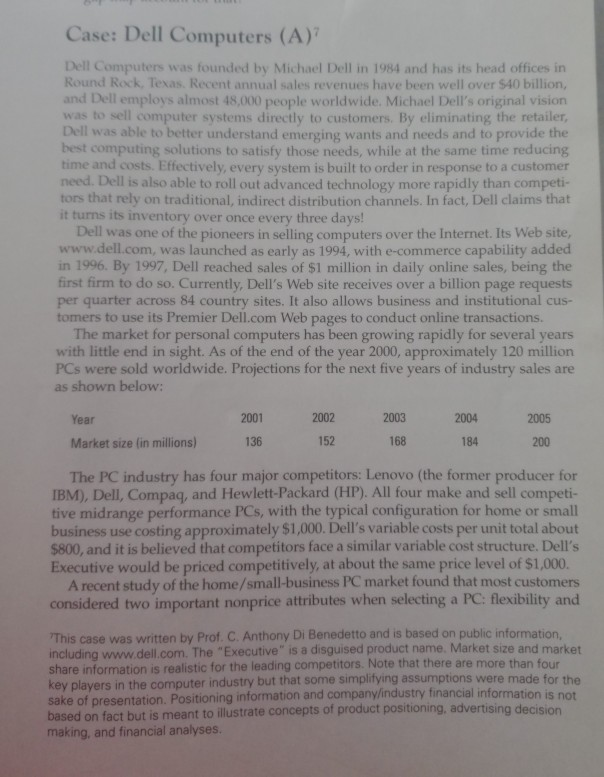
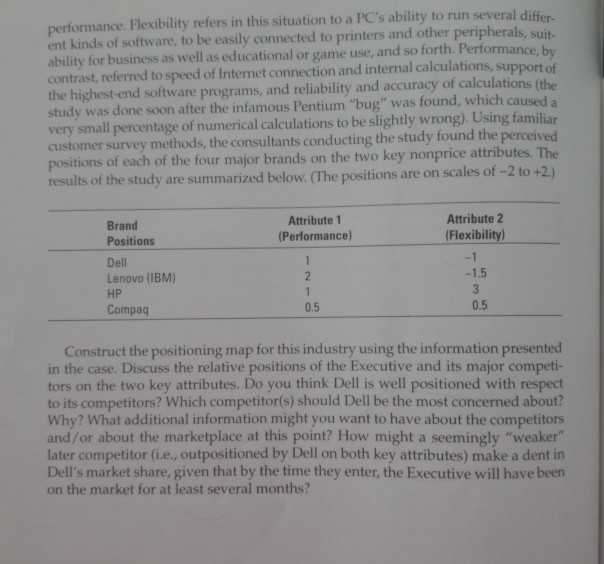
Case: Dell Computers (A)? Dell Computers was founded by Michael Dell in 1984 and has its head offices in Round Rock, Texas. Recent annual sales revenues have been well over $40 billion, and Dell employs almost 48,000 people worldwide. Michael Dell's original vision was to sell computer systems directly to customers. By eliminating the retailer, Dell was able to better understand emerging wants and needs and to provide the best computing solutions to satisfy those needs, while at the same time reducing time and costs. Effectively, every system is built to order in response to a customer need. Dell is also able to roll out advanced technology more rapidly than competi- tors that rely on traditional, indirect distribution channels. In fact, Dell claims that it turns its inventory over once every three days! Dell was one of the pioneers in selling computers over the Internet. Its Web site, www.dell.com, was launched as early as 1994, with e-commerce capability added in 1996. By 1997, Dell reached sales of $1 million in daily online sales, being the first firm to do so. Currently, Dell's Web site receives over a billion page requests per quarter across 84 country sites. It also allows business and institutional cus- tomers to use its Premier Dell.com Web pages to conduct online transactions. The market for personal computers has been growing rapidly for several years with little end in sight. As of the end of the year 2000, approximately 120 million PCs were sold worldwide. Projections for the next five years of industry sales are as shown below: 2001 2002 2003 2004 2005 Year Market size (in millions) 136 152 168 184 200 The PC industry has four major competitors: Lenovo (the former producer for IBM), Dell, Compaq, and Hewlett-Packard (HP). All four make and sell competi- tive midrange performance PCs, with the typical configuration for home or small business use costing approximately $1,000. Dell's variable costs per unit total about $800, and it is believed that competitors face a similar variable cost structure. Dell's Executive would be priced competitively, at about the same price level of $1,000. A recent study of the home/small-business PC market found that most customers considered two important nonprice attributes when selecting a PC: flexibility and This case was written by Prof. C. Anthony Di Benedetto and is based on public information, including www.dell.com. The "Executive" is a disguised product name. Market size and market share information is realistic for the leading competitors. Note that there are more than four key players in the computer industry but that some simplifying assumptions were made for the sake of presentation. Positioning information and company/industry financial information is not based on fact but is meant to illustrate concepts of product positioning, advertising decision making, and financial analyses. performance. Flexibility refers in this situation to a PC's ability to run several differ- ent kinds of software, to be easily connected to printers and other peripherals, suit- ability for business as well as educational or game use, and so forth. Performance, by contrast, referred to speed of Internet connection and internal calculations, support of the highest-end software programs, and reliability and accuracy of calculations (the study was done soon after the infamous Pentium "bug" was found, which caused a very small percentage of numerical calculations to be slightly wrong). Using familiar customer survey methods, the consultants conducting the study found the perceived positions of each of the four major brands on the two key nonprice attributes. The results of the study are summarized below. (The positions are on scales of -2 to +2.) Brand Positions Attribute 1 (Performance) Dell Lenovo (IBM) HP Compaq 1 2 1 0.5 Attribute 2 (Flexibility) - 1 -1.5 3 0.5 Construct the positioning map for this industry using the information presented in the case. Discuss the relative positions of the Executive and its major competi- tors on the two key attributes. Do you think Dell is well positioned with respect to its competitors? Which competitor(s) should Dell be the most concerned about? Why? What additional information might you want to have about the competitors and/or about the marketplace at this point? How might a seemingly "weaker" later competitor (i.e., outpositioned by Dell on both key attributes) make a dent in Dell's market share, given that by the time they enter, the Executive will have been on the market for at least several months
Step by Step Solution
There are 3 Steps involved in it
1 Expert Approved Answer
Step: 1 Unlock

Question Has Been Solved by an Expert!
Get step-by-step solutions from verified subject matter experts
Step: 2 Unlock
Step: 3 Unlock
 Study Help