







Question: CASE FOR ANALYSIS How IKEA Manages the Global Environment IKEA is the largest furniture chain in the world, and in 2011 the Swedish company operated
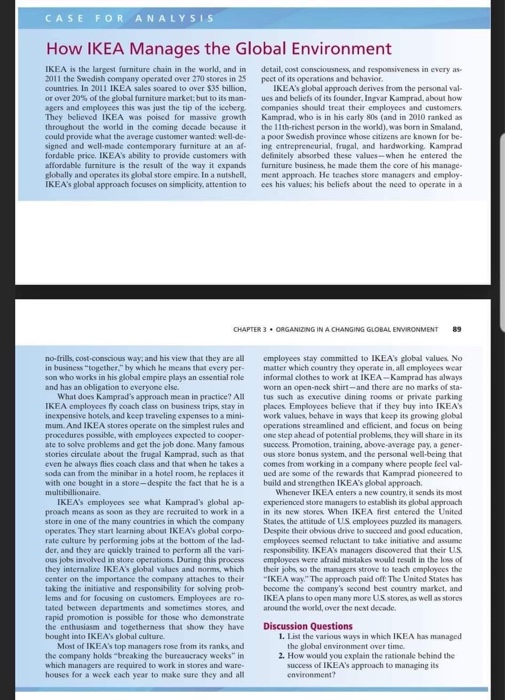
CASE FOR ANALYSIS How IKEA Manages the Global Environment IKEA is the largest furniture chain in the world, and in 2011 the Swedish company operated over 270 stores in 25 countries. In 2011 IKEA sales scared to over $35 billion, or over 20% of the global furniture market; but to its man- agers and employees this was just the tip of the iceberg They believed IKEA was poised for massive growth throughout the world in the coming decade because it could provide what the average customer wanted well-de- signed and well- made contemporary furniture at an af- fordable price. IKEA's ability to provide customers with affordable furniture is the result of the way it expands globally and operates its global store empire. In a nutshell IKEA's global approach focuses on simplicity, attention to detail, cost consciousness, and responsiveness in every as pect of its operations and behavior IKEA's global approach derives from the personal val- ues and beliefs of its founder, Ingvar Kamprad, about how companies should treat their employees and customers, Kamprad, who is in his early as (and in 2010 ranked as the 11th-richest person in the world), was born in Smaland, a poor Swedish province whose citizens are known for he ing entrepreneurial, frugal, and hardworking, Kamprad definitely absorbed these values-when he entered the furniture business, he made them the core of his manage ment approach. He teaches store managers and employ- ces his values, his beliefs about the need to operate in a CHAPTER 3. ORGANIZING IN A CHANGING GLOBAL ENVIRONMENT 89 no-frills,cost-conscious way, and his view that they are all in business together," by which he means that every per- son who works in his global empire plays an essential role and has an obligation to everyone else. What does Kamprad's approach mean in practice! All IKEA employees fly coach class on business trips, stay in inexpensive hotels, and keep traveling expenses to a mini- mum. And IKEA stores operate on the simplest rules and procedures possible, with employees expected to cooper- ate to solve problems and get the job done. Many famous stories circulate about the frugal Kamprad, such as that even he always flies coach class and that when he takes a soda can from the minibar in a hotel room, he replaces it with one bought in a store-despite the fact that he is a multibillionaire IKEA's employees see what Kamprad's global ap proach means as soon as they are recruited to work in a store in one of the many countries in which the company operates. They start learning about IKEA's global corpo rate culture by performing jobs at the bottom of the lad- der, and they are quickly trained to perform all the vari- ous jobs involved in store operations. During this process they internalize IKEA's global values and norms, which center on the importance the company attaches to their taking the initiative and responsibility for solving prob- lems and for focusing on customers. Employees are o tated between departments and sometimes stores, and rapid promotion is possible for those who demonstrate the enthusiasm and togetherness that show they have bought into IKEA's global culture. Most of IKEA's top managers rose from its ranks and the company holds "breaking the bureaucracy weeks" in which managers are required to work in stores and ware- houses for a weck each year to make sure they and all employees stay committed to IKEA's global values. No matter which country they operate in all employees wear informal clothes to work at IKEA-Kamprad has always worn an open-neck shirt--and there are no marks of sta- tus such as executive dining rooms or private parking places. Employees believe that if they buy into IKEA'S work values, behave in ways that keep its growing global operations streamlined and efficient, and focus on being one step ahead of potential problems, they will share in its success. Promotion, training, above average pay, a gener ous store bonus system, and the personal well-being that comes from working in a company where people feel val- ued are some of the rewards that Kamprad pioneered to build and strengthen IKEA's global approach. Whenever IKEA enters a new country, it sends its most experienced store managers to establish its global approach in its new stores. When IKEA first entered the United States, the attitude of US employees puzzled its managers Despite their obvious drive to succeed and good education, employees seemed reluctant to take initiative and assume responsibility. IKEA's managers discovered that their US employees were afraid mistakes would result in the loss of their jobs, so the managers stove to teach employees the "IKEA way." The approach paid off. The United States has become the company's second best country market, and IKEA plans to open many more US stores, as well as stores around the world, over the next decade. Discussion Questions 1. List the various ways in which IKEA has managed the global environment over time 2. How would you explain the rationale behind the success of IKEA's approach to managing its environment? CASE FOR ANALYSIS How IKEA Manages the Global Environment IKEA is the largest furniture chain in the world, and in 2011 the Swedish company operated over 270 stores in 25 countries. In 2011 IKEA sales scared to over $35 billion, or over 20% of the global furniture market; but to its man- agers and employees this was just the tip of the iceberg They believed IKEA was poised for massive growth throughout the world in the coming decade because it could provide what the average customer wanted well-de- signed and well- made contemporary furniture at an af- fordable price. IKEA's ability to provide customers with affordable furniture is the result of the way it expands globally and operates its global store empire. In a nutshell IKEA's global approach focuses on simplicity, attention to detail, cost consciousness, and responsiveness in every as pect of its operations and behavior IKEA's global approach derives from the personal val- ues and beliefs of its founder, Ingvar Kamprad, about how companies should treat their employees and customers, Kamprad, who is in his early as (and in 2010 ranked as the 11th-richest person in the world), was born in Smaland, a poor Swedish province whose citizens are known for he ing entrepreneurial, frugal, and hardworking, Kamprad definitely absorbed these values-when he entered the furniture business, he made them the core of his manage ment approach. He teaches store managers and employ- ces his values, his beliefs about the need to operate in a CHAPTER 3. ORGANIZING IN A CHANGING GLOBAL ENVIRONMENT 89 no-frills,cost-conscious way, and his view that they are all in business together," by which he means that every per- son who works in his global empire plays an essential role and has an obligation to everyone else. What does Kamprad's approach mean in practice! All IKEA employees fly coach class on business trips, stay in inexpensive hotels, and keep traveling expenses to a mini- mum. And IKEA stores operate on the simplest rules and procedures possible, with employees expected to cooper- ate to solve problems and get the job done. Many famous stories circulate about the frugal Kamprad, such as that even he always flies coach class and that when he takes a soda can from the minibar in a hotel room, he replaces it with one bought in a store-despite the fact that he is a multibillionaire IKEA's employees see what Kamprad's global ap proach means as soon as they are recruited to work in a store in one of the many countries in which the company operates. They start learning about IKEA's global corpo rate culture by performing jobs at the bottom of the lad- der, and they are quickly trained to perform all the vari- ous jobs involved in store operations. During this process they internalize IKEA's global values and norms, which center on the importance the company attaches to their taking the initiative and responsibility for solving prob- lems and for focusing on customers. Employees are o tated between departments and sometimes stores, and rapid promotion is possible for those who demonstrate the enthusiasm and togetherness that show they have bought into IKEA's global culture. Most of IKEA's top managers rose from its ranks and the company holds "breaking the bureaucracy weeks" in which managers are required to work in stores and ware- houses for a weck each year to make sure they and all employees stay committed to IKEA's global values. No matter which country they operate in all employees wear informal clothes to work at IKEA-Kamprad has always worn an open-neck shirt--and there are no marks of sta- tus such as executive dining rooms or private parking places. Employees believe that if they buy into IKEA'S work values, behave in ways that keep its growing global operations streamlined and efficient, and focus on being one step ahead of potential problems, they will share in its success. Promotion, training, above average pay, a gener ous store bonus system, and the personal well-being that comes from working in a company where people feel val- ued are some of the rewards that Kamprad pioneered to build and strengthen IKEA's global approach. Whenever IKEA enters a new country, it sends its most experienced store managers to establish its global approach in its new stores. When IKEA first entered the United States, the attitude of US employees puzzled its managers Despite their obvious drive to succeed and good education, employees seemed reluctant to take initiative and assume responsibility. IKEA's managers discovered that their US employees were afraid mistakes would result in the loss of their jobs, so the managers stove to teach employees the "IKEA way." The approach paid off. The United States has become the company's second best country market, and IKEA plans to open many more US stores, as well as stores around the world, over the next decade. Discussion Questions 1. List the various ways in which IKEA has managed the global environment over time 2. How would you explain the rationale behind the success of IKEA's approach to managing its environment
Step by Step Solution
There are 3 Steps involved in it

Get step-by-step solutions from verified subject matter experts
 Study Help