







Question: Case (ii): A E Rman, m > n. From our previous exercise on the SVD, we know that A may be decomposed as: El 0
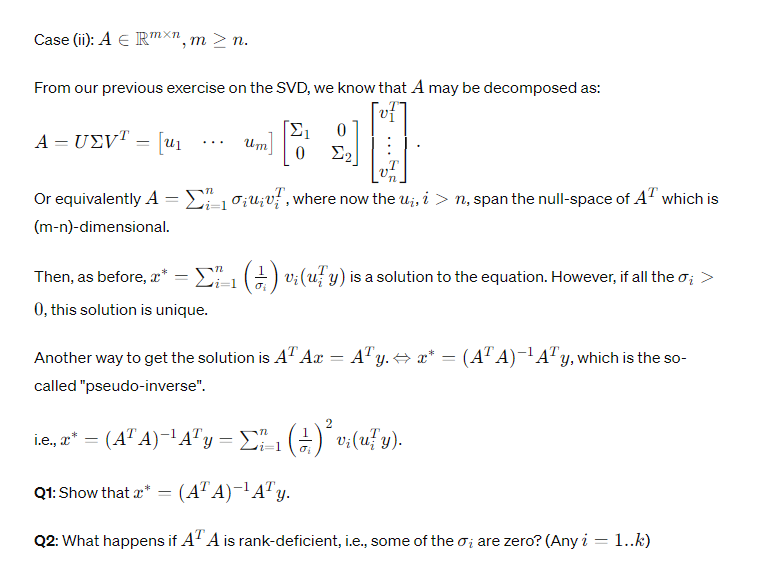
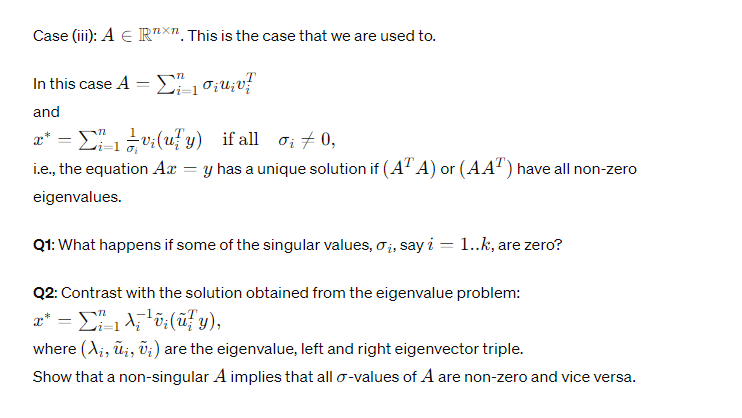
Case (ii): A E Rman, m > n. From our previous exercise on the SVD, we know that A may be decomposed as: El 0 A - UEV - [ul ... um . . 0 E2 Or equivalently A = _ ofujvi , where now the ui, i > n, span the null-space of A' which is (m-n)-dimensional. Then, as before, a* = _i (1 ) vi(u; y) is a solution to the equation. However, if all the 0; > 0, this solution is unique. Another way to get the solution is A'Ax - Ally. a* - (A'A) Aly, which is the so- called "pseudo-inverse". i.e., * - (A"A)-BATy - Er-1 vi(uly ). Q1: Show that a* - (ATA) ATy. Q2: What happens if A' A is rank-deficient, i.e., some of the ; are zero? (Any i = 1..k)Case (iii): A c Rox. This is the case that we are used to. In this case A = >f_ Cuiv!' and -vi(ury) ifall of 0, i.e., the equation Ax - y has a unique solution if (A'A) or (AA' ) have all non-zero eigenvalues. Q1: What happens if some of the singular values, o;, say i - 1..k, are zero? Q2: Contrast with the solution obtained from the eigenvalue problem: * - Cilli vi(ur y), where (Xi, wi, vi ) are the eigenvalue, left and right eigenvector triple. Show that a non-singular A implies that all o-values of A are non-zero and vice versa
Step by Step Solution
There are 3 Steps involved in it

Get step-by-step solutions from verified subject matter experts
 Study Help