Question: Case: Microsoft: In 2013, Microsoft recognized that the company would have to make some fundamental changes to compete in an industry that rewards fast-paced innovation.
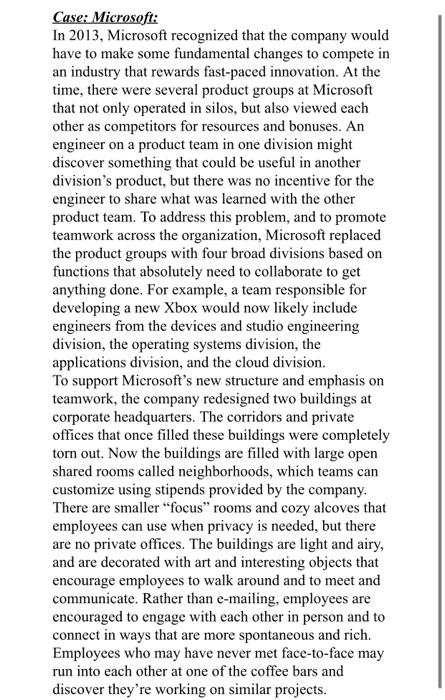
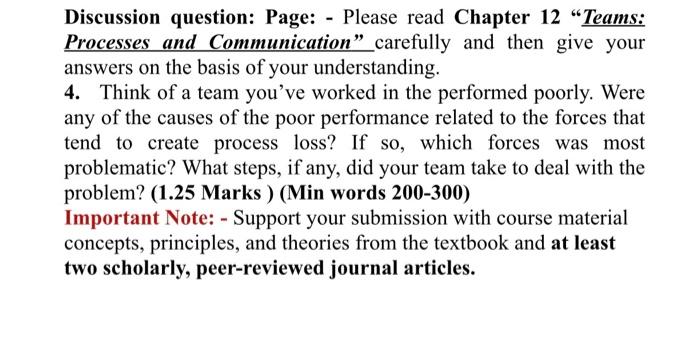
Case: Microsoft: In 2013, Microsoft recognized that the company would have to make some fundamental changes to compete in an industry that rewards fast-paced innovation. At the time, there were several product groups at Microsoft that not only operated in silos, but also viewed each other as competitors for resources and bonuses. An engineer on a product team in one division might discover something that could be useful in another division's product, but there was no incentive for the engineer to share what was learned with the other product team. To address this problem, and to promote teamwork across the organization, Microsoft replaced the product groups with four broad divisions based on functions that absolutely need to collaborate to get anything done. For example, a team responsible for developing a new Xbox would now likely include engineers from the devices and studio engineering division, the operating systems division, the applications division, and the cloud division. To support Microsoft's new structure and emphasis on teamwork, the company redesigned two buildings at corporate headquarters. The corridors and private offices that once filled these buildings were completely torn out. Now the buildings are filled with large open shared rooms called neighborhoods, which teams can customize using stipends provided by the company. There are smaller "focus" rooms and cozy alcoves that employees can use when privacy is needed, but there are no private offices. The buildings are light and airy, and are decorated with art and interesting objects that encourage employees to walk around and to meet and communicate. Rather than e-mailing, employees are encouraged to engage with each other in person and to connect in ways that are more spontaneous and rich. Employees who may have never met face-to-face may run into each other at one of the coffee bars and discover they're working on similar projects. Discussion question: Page: - Please read Chapter 12 Teams: Processes and Communication" carefully and then give your answers on the basis of your understanding. 4. Think of a team you've worked in the performed poorly. Were any of the causes of the poor performance related to the forces that tend to create process loss? If so, which forces was most problematic? What steps, if any, did your team take to deal with the problem? (1.25 Marks ) (Min words 200-300) Important Note: - Support your submission with course material concepts, principles, and theories from the textbook and at least two scholarly, peer-reviewed journal articles. Case: Microsoft: In 2013, Microsoft recognized that the company would have to make some fundamental changes to compete in an industry that rewards fast-paced innovation. At the time, there were several product groups at Microsoft that not only operated in silos, but also viewed each other as competitors for resources and bonuses. An engineer on a product team in one division might discover something that could be useful in another division's product, but there was no incentive for the engineer to share what was learned with the other product team. To address this problem, and to promote teamwork across the organization, Microsoft replaced the product groups with four broad divisions based on functions that absolutely need to collaborate to get anything done. For example, a team responsible for developing a new Xbox would now likely include engineers from the devices and studio engineering division, the operating systems division, the applications division, and the cloud division. To support Microsoft's new structure and emphasis on teamwork, the company redesigned two buildings at corporate headquarters. The corridors and private offices that once filled these buildings were completely torn out. Now the buildings are filled with large open shared rooms called neighborhoods, which teams can customize using stipends provided by the company. There are smaller "focus" rooms and cozy alcoves that employees can use when privacy is needed, but there are no private offices. The buildings are light and airy, and are decorated with art and interesting objects that encourage employees to walk around and to meet and communicate. Rather than e-mailing, employees are encouraged to engage with each other in person and to connect in ways that are more spontaneous and rich. Employees who may have never met face-to-face may run into each other at one of the coffee bars and discover they're working on similar projects. Discussion question: Page: - Please read Chapter 12 Teams: Processes and Communication" carefully and then give your answers on the basis of your understanding. 4. Think of a team you've worked in the performed poorly. Were any of the causes of the poor performance related to the forces that tend to create process loss? If so, which forces was most problematic? What steps, if any, did your team take to deal with the problem? (1.25 Marks ) (Min words 200-300) Important Note: - Support your submission with course material concepts, principles, and theories from the textbook and at least two scholarly, peer-reviewed journal articles









 Study Help