







Question: Case no. 5 Suggestion Awards. A young engineer, on active duty in the military, tries to eliminate a base that is purchased with every gyroscope.
Case no. 5 Suggestion Awards.
A young engineer, on active duty in the military, tries to eliminate a base that is purchased with every gyroscope. The base allows for quick disconnect/connect. The gyroscope is used in three different aircraft, the base is used in only one of the three. That one aircraft is no longer in production so bases are no longer needed. The other two airframe manufacturers just store them. They can neither dispose of them nor return them to the government. The "system" will not allow the engineer to delete the base from the specification. He then submits a "suggestion" through the formal Suggestion System. The engineer receives a call from a staff member in the office that handles suggestions. Military suggestors cannot receive monetary awards, so the staff member suggests that the officer add a civil service engineer to the suggestion with the arrangement that the civil service engineer split the monetary award which he is entitled to with the officer. The annual savings for suggestion amounted to $100,000 per year in 1963 dollars. The top award the officer can receive is dinner for two at the officers club. What should the officer do?
Case no. 6 False Trip Report.
A Senior Design Engineer and a Senior Fabrication Engineer scheduled a trip to review a very complex tool for an injection molded part at the supplier's plant They had been there on previous occasions over a span of many months. This complex long lead part was being developed with early supplier involvement. The Senior Design Engineer was first to turn in his trip report, and his manager noticed that the hotel bill was for a double room. He called the manager of the other engineer to see if he also charged for a room and to see if it was for the same room. Both were known to enjoy their time in bars and the thought was that they might have shared a room and double billed it to work around the daily expense limit on food. When the other expense report came in, it was for a different room number. It was also for a double room. The design manager then called the supplier to ask a technical question about the tool related to the trip report in an attempt to see if the supplier might make some remark that would shed some light on the issue. To his surprise, the supplier stated there had been no review of the tool. He stated that two weeks prior to the trip he asked the two engineers to reschedule the tool inspection since a competitor company was in-plant for a tool tryout. He further stated that the only contact was a brief status meeting in the hotel coffee shop. The design manager then confronted his engineer with the information he had gathered and asked for an explanation. The engineer immediately broke down and stated they had made plans to visit with some women they met on a previous trip and therefore did not change the date of the visit as requested by the supplier. He resigned on the spot. Since he was married, he did not want an investigation. What should the Advanced Manufacturing Engineering organization do about their Senior Manufacturing Engineer? Consider and discuss the ethical actions of the two engineers and management. Consider the ethics associated with the false trip report, and charging the company for the double room. Where should a company draw the line on technical versus personal moral issues versus business issues? As a point of information, the Fabrication Engineer was married. Should this fact be of any concern to the managers?
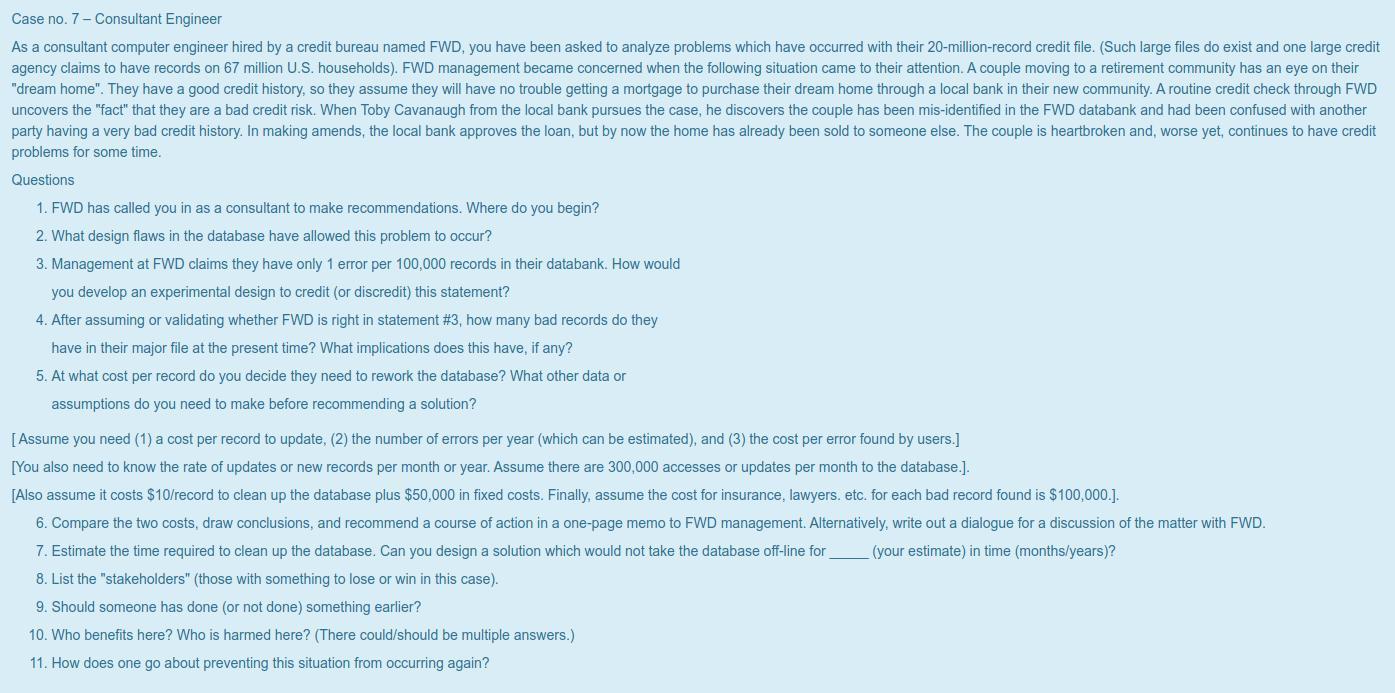
Case no. 7 - Consultant Engineer As a consultant computer engineer hired by a credit bureau named FWD, you have been asked to analyze problems which have occurred with their 20-million-record credit file. (Such large files do exist and one large credit agency claims to have records on 67 million U.S. households). FWD management became concerned when the following situation came to their attention. A couple moving to a retirement community has an eye on their "dream home". They have a good credit history, so they assume they will have no trouble getting a mortgage to purchase their dream home through a local bank in their new community. A routine credit check through FWD uncovers the "fact" that they are a bad credit risk. When Toby Cavanaugh from the local bank pursues the case, he discovers the couple has been mis-identified in the FWD databank and had been confused with another party having a very bad credit history. In making amends, the local bank approves the loan, but by now the home has already been sold to someone else. The couple is heartbroken and, worse yet, continues to have credit problems for some time. Questions 1. FWD has called you in as a consultant to make recommendations. Where do you begin? 2. What design flaws in the database have allowed this problem to occur? 3. Management at FWD claims they have only 1 error per 100,000 records in their databank. How would you develop an experimental design to credit (or discredit) this statement? 4. After assuming or validating whether FWD is right in statement #3, how many bad records do they have in their major file at the present time? What implications does this have, if any? 5. At what cost per record do you decide they need to rework the database? What other data or assumptions do you need to make before recommending a solution? [ Assume you need (1) a cost per record to update, (2) the number of errors per year (which can be estimated), and (3) the cost per error found by users.] [You also need to know the rate of updates or new records per month or year. Assume there are 300,000 accesses or updates per month to the database.]. [Also assume it costs $10/record to clean up the database plus $50,000 in fixed costs. Finally, assume the cost for insurance, lawyers. etc. for each bad record found is $100,000.). 6. Compare the two costs, draw conclusions, and recommend a course of action in a one-page memo to FWD management. Alternatively, write out a dialogue for a discussion of the matter with FWD. 7. Estimate the time required to clean up the database. Can you design a solution which would not take the database off-line for (your estimate) in time (months/years)? 8. List the "stakeholders" (those with something to lose or win in this case). 9. Should someone has done (or not done) something earlier? 10. Who benefits here? Who is harmed here? (There could/should be multiple answers.) 11. How does one go about preventing this situation from occurring againStep by Step Solution
There are 3 Steps involved in it

Get step-by-step solutions from verified subject matter experts
 Study Help