



Question: Case Objective This teaching case is about a successful medium - sized ski resort in the Berkshire Mountains of Western Massachusetts, Jiminy Peak Mountain Resort,
Case Objective
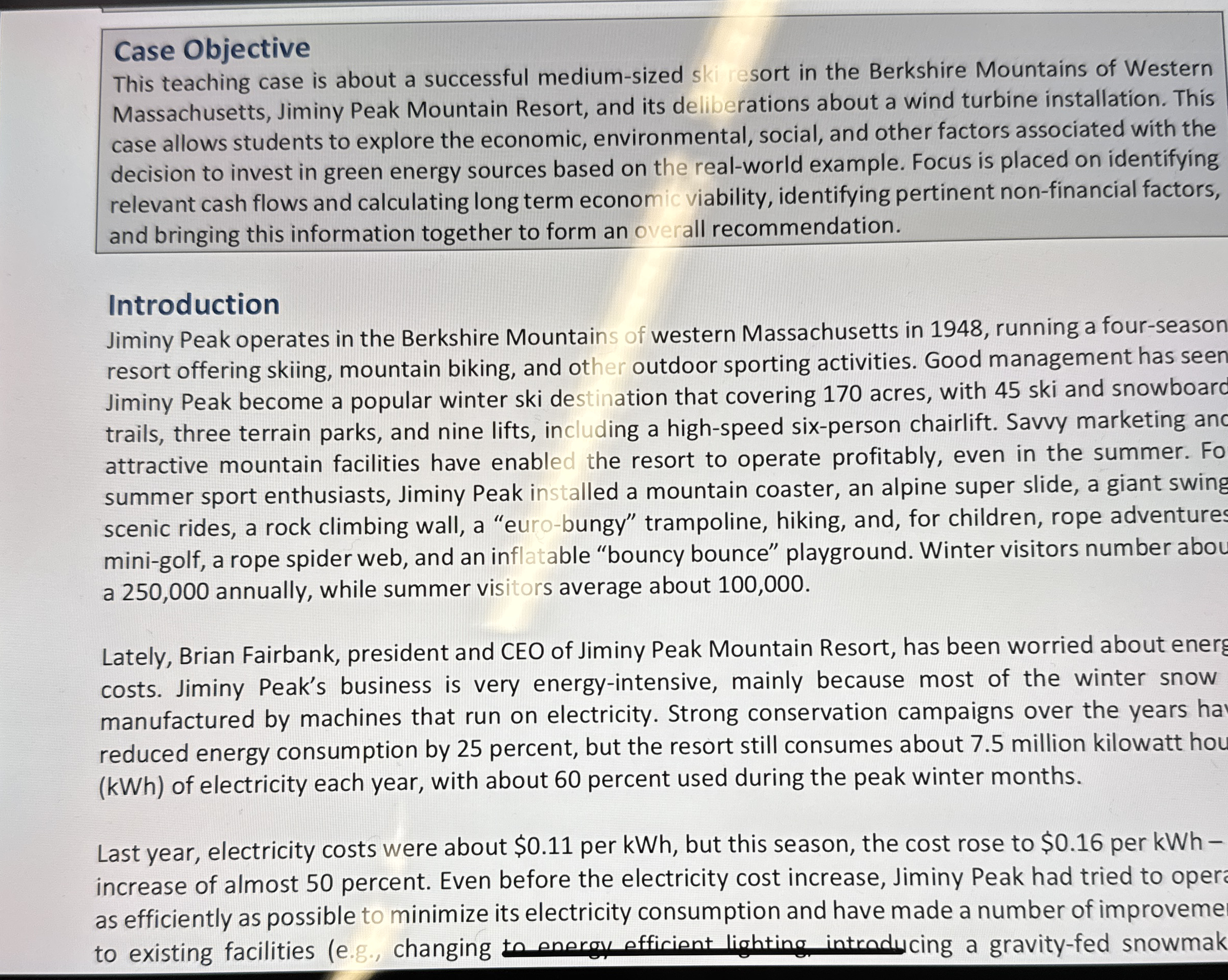
This teaching case is about a successful mediumsized ski resort in the Berkshire Mountains of Western Massachusetts, Jiminy Peak Mountain Resort, and its deliberations about a wind turbine installation. This case allows students to explore the economic, environmental, social, and other factors associated with the decision to invest in green energy sources based on the realworld example. Focus is placed on identifying relevant cash flows and calculating long term economic viability, identifying pertinent nonfinancial factors, and bringing this information together to form an overall recommendation.
Introduction
Jiminy Peak operates in the Berkshire Mountains of western Massachusetts in running a fourseason resort offering skiing, mountain biking, and other outdoor sporting activities. Good management has seen Jiminy Peak become a popular winter ski destination that covering acres, with ski and snowboard trails, three terrain parks, and nine lifts, including a highspeed sixperson chairlift. Savvy marketing and attractive mountain facilities have enabled the resort to operate profitably, even in the summer. Fo summer sport enthusiasts, Jiminy Peak installed a mountain coaster, an alpine super slide, a giant swing scenic rides, a rock climbing wall, a "eurobungy" trampoline, hiking, and, for children, rope adventures minigolf, a rope spider web, and an inflatable "bouncy bounce" playground. Winter visitors number abol a annually, while summer visitors average about
Lately, Brian Fairbank, president and CEO of Jiminy Peak Mountain Resort, has been worried about energ costs. Jiminy Peak's business is very energyintensive, mainly because most of the winter snow manufactured by machines that run on electricity. Strong conservation campaigns over the years ha reduced energy consumption by percent, but the resort still consumes about million kilowatt hou kWh of electricity each year, with about percent used during the peak winter months.
Last year, electricity costs were about $ per kWh but this season, the cost rose to $ per kWhincrease of almost percent. Even before the electricity cost increase, Jiminy Peak had tried to opera as efficiently as possible to minimize its electricity consumption and have made a number of improveme to existing facilities eg changing to energy efficient lightingintraducing a gravityfed snowmak
Step by Step Solution
There are 3 Steps involved in it
1 Expert Approved Answer
Step: 1 Unlock

Question Has Been Solved by an Expert!
Get step-by-step solutions from verified subject matter experts
Step: 2 Unlock
Step: 3 Unlock