Question: Case Objectives Research on interviews has generally shown that standardized procedures are higher in their reliability and validity than unstructured interviews Learning how structured interviews
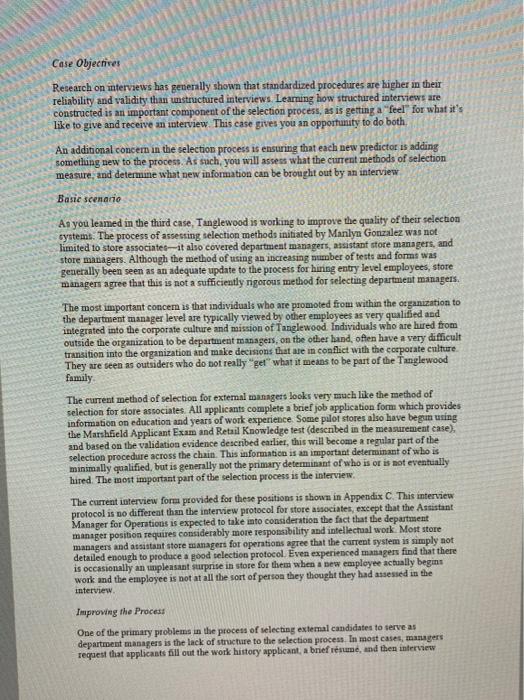
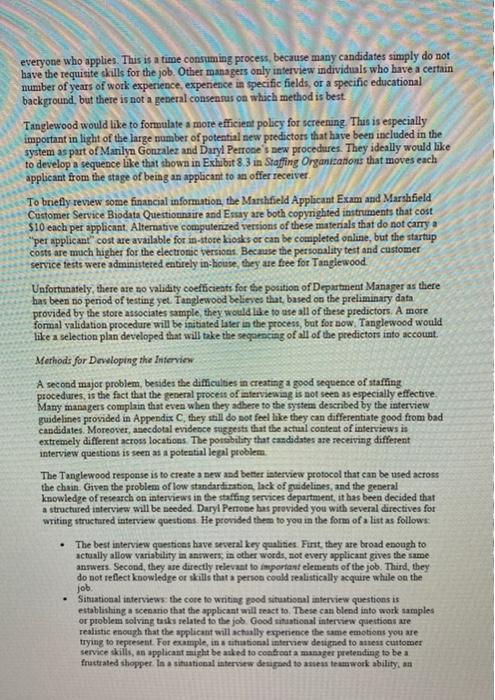
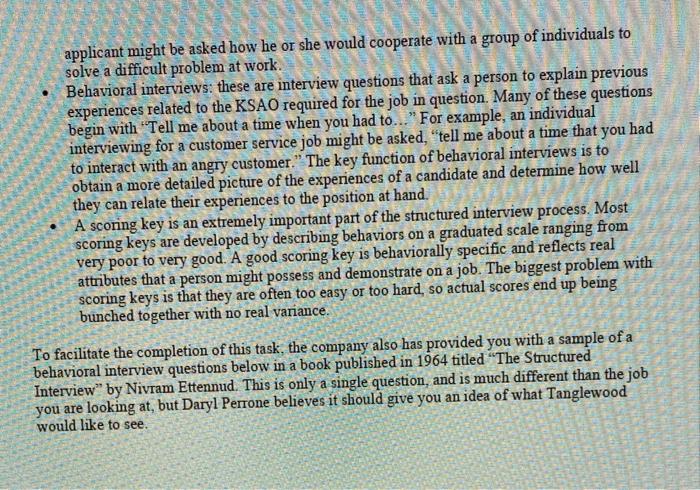
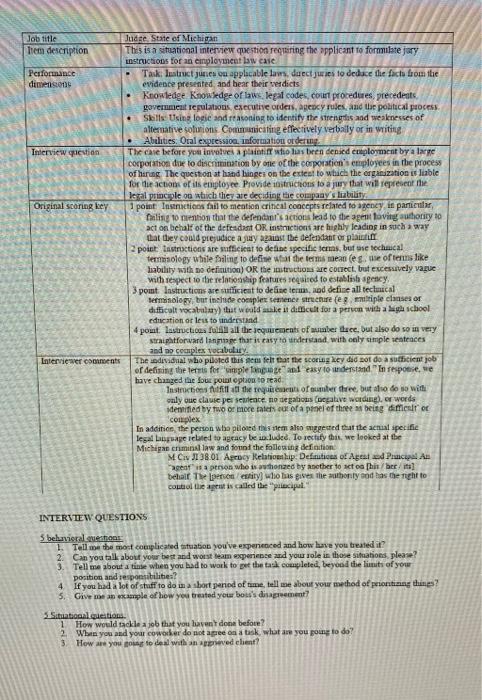
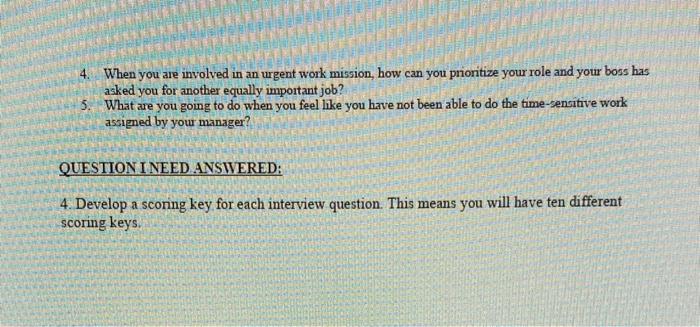
Case Objectives Research on interviews has generally shown that standardized procedures are higher in their reliability and validity than unstructured interviews Learning how structured interviews are constructed is an important component of the selection process, as is getting a "feel" for what it's like to give and receive an interview This case gives you an opportunity to do both. An additional concern in the selection process is ensuring that each new predictor is adding sometlung new to the process. As such, you will assess what the current methods of selection measure, and determine what new information can be brought out by an interview Basic scenario As you leamed in the third case, Tanglewood is working to improve the quality of their selection system. The process of assessing selection methods initiated by Manlyn Gonzalez was not limited to store associates--it also covered department managers, assistant store managers, and store managers. Although the method of using an increasing number of tests and forms was generally been seen as an adequate update to the process for hiring entry level employees, store managers agree that this is not a sufficiently rigorous method for selecting department managers. The most important concem is that individuals who are promoted from within the organization to the department manager level are typically viewed by other employees as very qualified and integrated into the corporate culture and mission of Tanglewood Individuals who are hired from outside the organization to be department managers, on the other hand, often have a very difficult transition into the organization and make decisions that are in conflict with the corporate culture They are seen as outsiders who do not really get what it means to be part of the Tanglewood family The current method of selection for exteral managers looks very much like the method of selection for store associates All applicants complete a brief job application form which provides information on education and years of work experience. Some palot stores also have begin using the Marshfield Applicant Exam and Retail Knowledge test (described in the measurement case). and based on the validation evidence described earlier, this will become a regular part of the selection procedure across the chain. This information is an important determinant of who is minimally qualified, but is generally not the primary determinant of who is or is not eventually hired. The most important part of the selection process is the interview The current interview form provided for these positions is shown in Appendix C. This interview protocol is no different than the interview protocol for store associates, except that the Assistant Manager for Operations is expected to take into consideration the fact that the department manager position requires considerably more responsibility and intellectual work. Most store managers and assistant store managers for operations agree that the current system is simply not detailed enough to produce a good selection protocol. Even experienced managers find that there is occasionally an unpleasant surprise in store for them when a new employee actually begins work and the employee is not at all the sort of person they thought they had assessed in the interview Improving the Process One of the primary problems in the process of selecting extemal candidates to serve as department managers the lack of structure to the selection process. In most cases, managers request that applicants fill out the work history applicant a brief rsume, and then interview everyone who applies. This is a time consuming process, because many candidates simply do not have the requisite skills for the job. Other managers only interview individuals who have a certain number of years of work experience, expenence in specific fields, or a specific educational background, but there is not a general consensus on which method is best. Tanglewood would like to formulate a more efficient policy for screening. This is especially important in light of the large number of potential new predictors that have been included in the system as part of Manilyn Gonzalez and Daryl Perrone's new procedures. They ideally would like to develop a sequence like that shown in Exhubut 8.3 in Staffing Organisations that moves each applicant from the stage of being an applicant to an offer receiver To briefly review some financial information, the Marshfield Applicant Exam and Marshfield Customer Service Biodata Questionnaire and Essay are both copyrighted instruments that cost $10 each per applicant. Alternative computerized versions of these materials that do not carry a "per applicant" cost are available for in-store kiosks or can be completed online, but the startup costs are much higher for the electronic versions. Because the personality test and customer service tests were administered entirely in-house they are free for Tanglewood Unfortunately, there are no validity coefficients for the position of Department Manager as there has been no period of testing yet. Tanglewood believes that, based on the preliminary data provided by the store associates sample, they would like to use all of these predictors. A more formal validation procedure will be initiated later in the process, but for now. Tanglewood would like a selection plan developed that will take the sequencing of all of the predictors into account Methods for Developing the Interview A second major problem, besides the difficulties in creating a good sequence of staffing procedures, is the fact that the general process of interviewing is not seen as especially effective Many managers complain that even when they adhere to the system described by the interview guidelines provided in Appendix C, they still do not feel like they can differentiate good from bad candidates. Moreover, anecdotal evidence suggests that the actual content of interviews is extremely different across locations. The possibility that candidates are receiving different interview questions is seen as a potential legal problem The Tanglewood response is to create a new and better interview protocol that can be used across the chrin. Given the problem of low standardization lack of guidelines, and the general knowledge of research on interviews in the staffing services department, it has been decided that a structured interview will be needed. Daryi Perrone bas provided you with several directives for writing structured interview questions. He provided them to you in the form of a list as follows: The best interview questions have several key qualities. First, they are broad enough to actually allow variability in answers in other words, not every applicant gives the same answers. Second, they are durectly relevant to important elements of the job. Third, they do not reflect knowledge or skills that a person could realistically acquire while on the job Situational interviews: the core to writing good situational interview questions is establishing a scenario that the applicant will react to. These can blend into work samples or problem solving tasks related to the job. Good situational interview questions are realistic mough that the applicant will actually experience the same emotions you are try to represent. For example, institutional interview designed to customer service skills, an applicant might be asked to contrata manager pretending to be a frustrated shopper. In a situational interview despond to assess teamwork ability, an . applicant might be asked how he or she would cooperate with a group of individuals to solve a difficult problem at work. Behavioral interviews: these are interview questions that ask a person to explain previous experiences related to the KSAO required for the job in question. Many of these questions begin with "Tell me about a time when you had to..." For example, an individual interviewing for a customer service job might be asked, "tell me about a time that you had to interact with an angry customer." The key function of behavioral interviews is to obtain a more detailed picture of the experiences of a candidate and determine how well they can relate their experiences to the position at hand. A scoring key is an extremely important part of the structured interview process. Most scoring keys are developed by describing behaviors on a graduated scale ranging from very poor to very good. A good scoring key is behaviorally specific and reflects real attributes that a person might possess and demonstrate on a job. The biggest problem with scoring keys is that they are often too easy or too hard, so actual scores end up being bunched together with no real variance. To facilitate the completion of this task, the company also has provided you with a sample of a behavioral interview questions below in a book published in 1964 titled "The Structured Interview" by Nivram Ettennud. This is only a single question, and is much different than the job you are looking at, but Daryl Perrone believes it should give you an idea of what Tanglewood would like to see. Job Title trem description Performance dimension Interview question Original scoring key Judge State of Michigan This is a situational interview question requiring the applicant to formulate jory instructions for an employment law case Tak lustructures ou applicable laws, duectures to deduce liefacts from the evidence presented and bear their verdicts Knowledge Knowledge of law legal codes, court procedures, precedents government regulations, executive orders, agency rules and use political process Skills Using logic and reasoning to identify the strengtas and weaknesses of alternative solutions Communicating effectively verbally or in writing Abilities. Oral expression, information orderung The case before you involves a plaintiff so las been denied employment by a large corporation due to discrimination by one of the corporation's employees in the process of haug. The question at hand hinges on the extent to which the organization wlable for eactions of ils employee Provide instructions to a jury that will represent the legal principle on such this are deciding the company s liability point Instructions fail to mention critical concepts related to agency in particular inling to mention that the defendant's actions lead to the age loving authority to act on behalf of the defendant OR instructions are highly leading in such a way that they could prejudice a y apast the defendant or play 2 point tastructions are sufficient to define specific teras, burse technical terminology while biling to define what the terms mean (es use of tenns like lability with no definition) OR the structions are correct, but excesuvely vague with respect to the relationship features required to establish agency 3 point Instructions are sufficient to define terms and define all technical terminology, but inchide complet etenee structure (egipte classes or difficult vocabulary) that would take it diticult for a person with a ligh school education or less to tinderstand 4 pont. Lastructural all the sequements of number dece. but also do so in very straightforwarding that it tasy to understand with only simple sentences and no complex vocabulary The adividual who pusted this nens felt that the score key did not do a suficient job of defining the terms for implengua easy to understand. In response have changed the Souz pomit option to read Instructions fulfill the requirement of our three but to do so with only our claus per seulente no negations (egative wording), or words identified by two or more latest of a panel of three being a multor complex In addition, the person who piloted this them ako magested that the actual specific legal Language related to agracy be ia.luded. To rectity that we looked at the Michigan criminal law and found the following definition MCV JI 38.01 Agroey Kelatiomkip. Definice of Agested Prince An agent is a person who is the by another to acto hitbeits] behair. The personelity who is gives the suboty odhas Denght to control the agent is called the principul." Interviewer Comments INTERVIEW QUESTIONS 5 behavioral que ens 1. Tell me the most complicated station you've experienced and how use you treated 2. Can you talk about your best and worst team experience and your role in those situations, please? 3. Tell me about a time when you had to work to get the task completed, beyond the limits of you position and responsibilities! 4 If you had a lot of stuff to do in a short period of time, tell me about your method of personnag things? 5. Give me an example of how you treated your boss's disagreement? Situational questions 1 How would take a job that you haven't done before? 2. When you and you cowoker do not agree on a task wlutare you going to do? 3. How are you to deal with an edebient? 4. When you are involved in an urgent work mission, how can you prioritize your role and your boss has asked you for another equally important job? 5. What are you going to do when you feel like you have not been able to do the time-sensitive work assigned by your manager? QUESTION I NEED ANSWERED: 4. Develop a scoring key for each interview question. This means you will have ten different scoring keys









 Study Help