







Question: case only this part (e) Integrative Case: Eco Plastics Company The target capital structure for ECO is given by the weights in the following table:
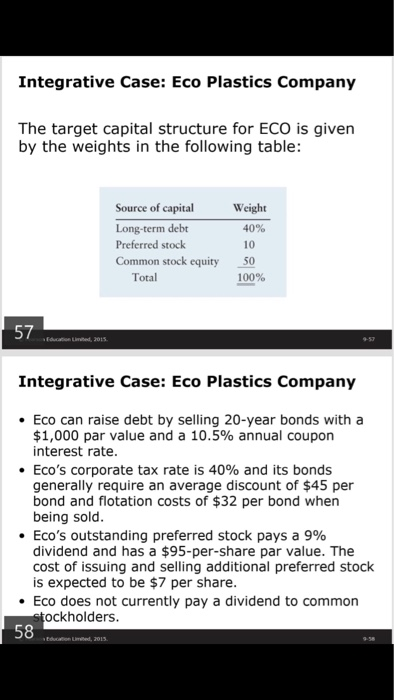
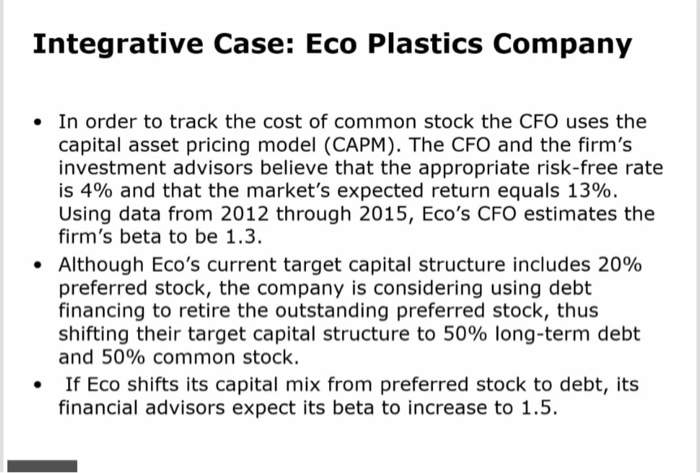
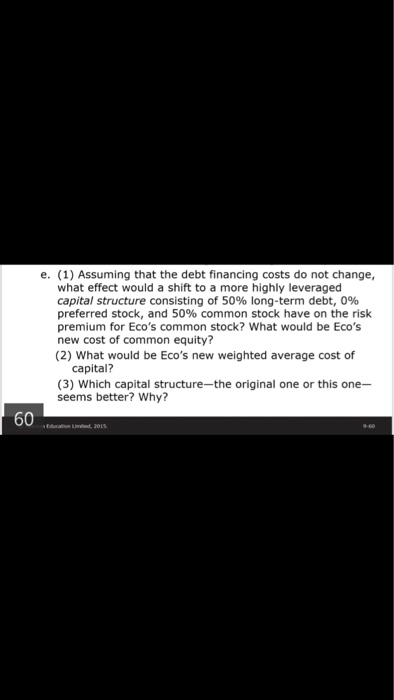
Integrative Case: Eco Plastics Company The target capital structure for ECO is given by the weights in the following table: Weight Source of capital Long-term debt Preferred stock Common stock equity Total 409 10 50 100% 57 Integrative Case: Eco Plastics Company Eco can raise debt by selling 20-year bonds with a $1,000 par value and a 10.5% annual coupon interest rate. Eco's corporate tax rate is 40% and its bonds generally require an average discount of $45 per bond and flotation costs of $32 per bond when being sold. Eco's outstanding preferred stock pays a 9% dividend and has a $95-per-share par value. The cost of issuing and selling additional preferred stock is expected to be $7 per share. Eco does not currently pay a dividend to common stockholders. 58 Integrative Case: Eco Plastics Company In order to track the cost of common stock the CFO uses the capital asset pricing model (CAPM). The CFO and the firm's investment advisors believe that the appropriate risk-free rate is 4% and that the market's expected return equals 13%. Using data from 2012 through 2015, Eco's CFO estimates the firm's beta to be 1.3. Although Eco's current target capital structure includes 20% preferred stock, the company is considering using debt financing to retire the outstanding preferred stock, thus shifting their target capital structure to 50% long-term debt and 50% common stock. If Eco shifts its capital mix from preferred stock to debt, its financial advisors expect its beta to increase to 1.5. e. (1) Assuming that the debt financing costs do not change, what effect would a shift to a more highly leveraged capital structure consisting of 50% long-term debt, 0% preferred stock, and 50% common stock have on the risk premium for Eco's common stock? What would be Eco's new cost of common equity? (2) What would be Eco's new weighted average cost of capital? (3) Which capital structure-the original one or this one- seems better? Why? 60 Education Limited, 2015 Integrative Case: Eco Plastics Company The target capital structure for ECO is given by the weights in the following table: Weight Source of capital Long-term debt Preferred stock Common stock equity Total 409 10 50 100% 57 Integrative Case: Eco Plastics Company Eco can raise debt by selling 20-year bonds with a $1,000 par value and a 10.5% annual coupon interest rate. Eco's corporate tax rate is 40% and its bonds generally require an average discount of $45 per bond and flotation costs of $32 per bond when being sold. Eco's outstanding preferred stock pays a 9% dividend and has a $95-per-share par value. The cost of issuing and selling additional preferred stock is expected to be $7 per share. Eco does not currently pay a dividend to common stockholders. 58 Integrative Case: Eco Plastics Company In order to track the cost of common stock the CFO uses the capital asset pricing model (CAPM). The CFO and the firm's investment advisors believe that the appropriate risk-free rate is 4% and that the market's expected return equals 13%. Using data from 2012 through 2015, Eco's CFO estimates the firm's beta to be 1.3. Although Eco's current target capital structure includes 20% preferred stock, the company is considering using debt financing to retire the outstanding preferred stock, thus shifting their target capital structure to 50% long-term debt and 50% common stock. If Eco shifts its capital mix from preferred stock to debt, its financial advisors expect its beta to increase to 1.5. e. (1) Assuming that the debt financing costs do not change, what effect would a shift to a more highly leveraged capital structure consisting of 50% long-term debt, 0% preferred stock, and 50% common stock have on the risk premium for Eco's common stock? What would be Eco's new cost of common equity? (2) What would be Eco's new weighted average cost of capital? (3) Which capital structure-the original one or this one- seems better? Why? 60 Education Limited, 2015
Step by Step Solution
There are 3 Steps involved in it

Get step-by-step solutions from verified subject matter experts
 Study Help