







Question: Case Problem: Scandinavian Style Chapter 12 Single Investment Risk Analysis Question: Find the sales level (after the first year) that will result in a net
Case Problem: Scandinavian Style
Chapter 12 Single Investment Risk Analysis
Question: Find the sales level (after the first year) that will result in a net present value of $0. Remember that sales the first year will be half of those after the first year.
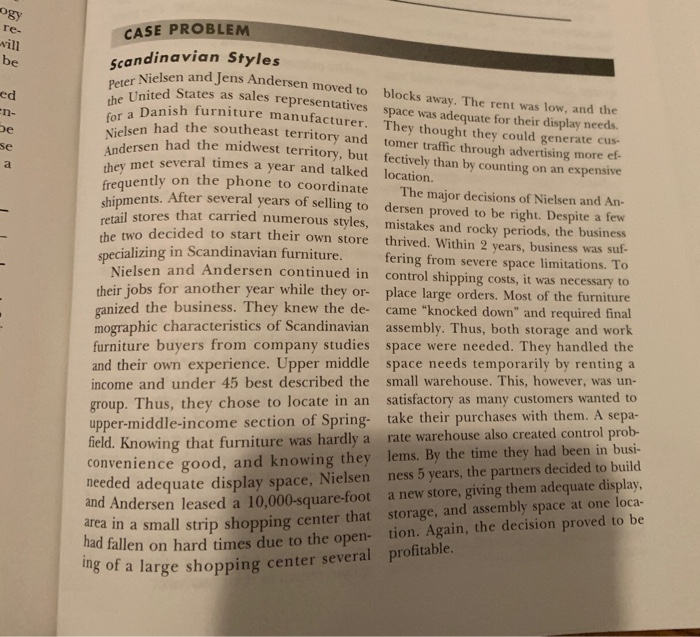
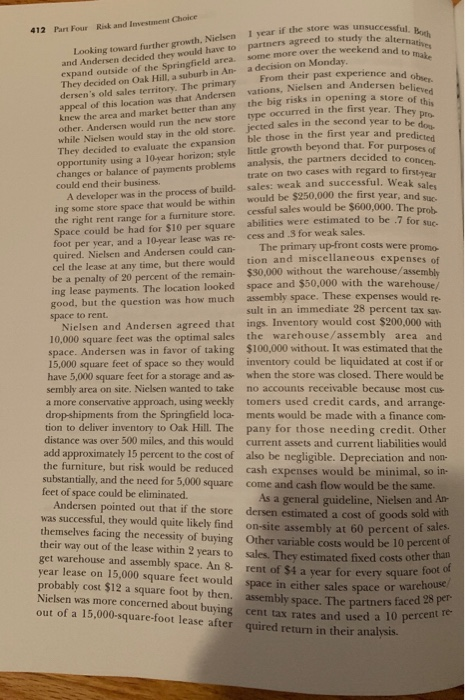
ogy re- vill be blocks away. The rent was low, and the ed en- Se Se a frequently CASE PROBLEM Scandinavian Styles Peter Nielsen and Jens Andersen moved to the United States as sales representatives space was adequate for their display needs. Nielsen had the southeast territory and for a Danish furniture manufacturer. They thought they could generate cus Andersen had the midwest territory, but fectively than by counting on an expensive tomer traffic through advertising more ef- they met several times a year and talked location. on the phone to coordinate The major decisions of Nielsen and An- shipments. After several years of selling to retail stores that carried numerous styles, mistakes and rocky periods, the business dersen proved to be right. Despite a few the two decided to start their own store thrived. Within 2 years, business was suf- specializing in Scandinavian furniture. fering from severe space limitations. To Nielsen and Andersen continued in control shipping costs, it was necessary to their jobs for another year while they or place large orders. Most of the furniture ganized the business. They knew the de- came "knocked down" and required final mographic characteristics of Scandinavian assembly. Thus, both storage and work furniture buyers from company studies space were needed. They handled the and their own experience. Upper middle space needs temporarily by renting a income and under 45 best described the small warehouse. This, however, was un- group. Thus, they chose to locate in an satisfactory as many customers wanted to upper-middle-income section of Spring- take their purchases with them. A sepa- rate warehouse also created control prob- field. Knowing that furniture was hardly a convenience good, and knowing they lems. By the time they had been in busi- needed adequate display space, Nielsen ness 5 years, the partners decided to build and Andersen leased a 10,000-square-foot a new store, giving them adequate display, area in a small strip shopping center that storage, and assembly space at one loca- had fallen on hard times due to the open- tion. Again, the decision proved to be center several profitable. ing of a large shopping 412 Part Four Risk and Investment Choice Looking toward further growth, Nielsen and Andersen decided they would have to expand outside of the Springfield area. They decided on Oak Hill, a suburb in An- dersen's old sales territory. The primary appeal of this location was that Andersen knew the area and market better than any other. Andersen would run the new store 1 year if the store was unsuccessful. Both some more over the weekend and to make partners agreed to study the alternatives a decision on Monday. From their past experience and obser vations, Nielsen and Andersen believed the big risks in opening a store of this type occurred in the first year. They pro while Nielsen would stay in the old store.jected sales in the second year to be don They decided to evaluate the expansion ble those in the first year and predicted opportunity using a 10-year horizon; style little growth beyond that. For purposes of changes or balance of payments problems analysis, the partners decided to concen trate on two cases with regard to first year could end their business. ing some store space that would be within would be $250,000 the first year, and suc A developer was in the process of build sales weak and successful. Weak sales cessful sales would be $600,000. The prob the right rent range for a furniture store. Space could be had for $10 per square abilities were estimated to be 7 for sue cess and for weak sales. foot per year, and a 10-year lease was re- quired. Nielsen and Andersen could can- The primary up-front costs were promo cel the lease at any time, but there would tion and miscellaneous expenses of be a penalty of 20 percent of the remain $30,000 without the warehouse / assembly ing lease payments. The location looked space and $50,000 with the warehouse good, but the question was how much assembly space. These expenses would re sult in an immediate 28 percent tax sav. space to rent. Nielsen and Andersen agreed that ings. Inventory would cost $200,000 with 10,000 square feet was the optimal sales the warehouse/assembly area and space. Andersen was in favor of taking $100,000 without. It was estimated that the 15,000 square feet of space so they would inventory could be liquidated at cost if or have 5,000 square feet for a storage and as when the store was closed. There would be sembly area on site. Nielsen wanted to take no accounts receivable because most cus a more conservative approach, using weekly tomers used credit cards, and arrange- drop-shipments from the Springfield loca- ments would be made with a finance com- tion to deliver inventory to Oak Hill. The pany for those needing credit. Other distance was over 500 miles, and this would current assets and current liabilities would add approximately 15 percent to the cost of also be negligible. Depreciation and non- the furniture, but risk would be reduced cash expenses would be minimal, so in substantially, and the need for 5,000 square come and cash flow would be the same. feet of space could be eliminated. Andersen pointed out that if the store As a general guideline, Nielsen and An- was successful, they would quite likely find on-site assembly at 60 percent of sales dersen estimated a cost of goods sold with themselves facing the necessity of buying Other variable costs would be 10 percent of sales. They estimated fixed costs other than rent of $1 a year for every square foot of their way out of the lease within 2 years to get warehouse and assembly space. An 8- year lease on 15,000 square feet would space in either sales space or warehouse probably cost $12 a square foot by then. assembly space. The partners faced 25 per Nielsen was more concerned about buying cent tax rates and used a 10 percentie out of a 15,000-square-foot lease after quired return in their analysis
Step by Step Solution
There are 3 Steps involved in it

Get step-by-step solutions from verified subject matter experts
 Study Help